• Home >
  • Back Issues >
  • Laser Focus World >
  • Volume 62, Issue 03
  • Volume 62, Issue 03

    More content from Volume 62, Issue 03

    Credit: Bloom Lasers
    Every manufacturing step to build a Bloom laser is accompanied by measurements from the beam propagation system.
    Case study: MKS Ophir's high-speed M2 beam measurement device boosts laser manufacturing quality for Bloom Lasers.
    March 20, 2026
    Credit: Bright Lu
    Euler bend simulation.
    By using Euler curves, in which curvature changes linearly, researchers “trick” light into staying in fundamental mode despite tight bends around a chalcogenide photonic integrated...
    March 18, 2026
    Credit: Christopher Payne/Esto
    EXTREME ULE glass.
    Low thermal expansion materials remove thermal distortion at the source, which simplifies system design and enhances reliability.
    March 12, 2026
    Illustration by Yi Yu
    DTU nanolaser is constructed in a semiconductor membrane that causes electrons and light to gather within a confined space (blue shadow).
    An energy-efficient nanolaser based on “extreme dielectric confinement” within a nanocavity takes us a step closer to on-chip data being transmitted entirely via photons.
    March 9, 2026
    Credit: Bowen Li
    Adam Shaw, Anna Soper, Danial Shadmany, and Da Yeon Koh in front of the cavity array microscope apparatus.
    Microlenses inside optical cavities allow physicists to tightly focus light onto single atoms in a way that’s both efficient and massively parallel—and it looks promising for ...
    March 4, 2026
    Credit: Chalker Lab
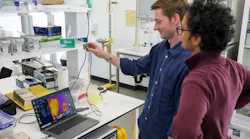
    Flinders researchers Dr. Sam Tonkin and Dr. Harshal Patel demonstrate a long-wave IR thermal imaging camera operating with the Flinders polymer lens.
    Traditional lenses made of germanium tend to cost hundreds or thousands of dollars and can’t be repaired when damaged—but a lower-cost sulfur polymer lens option is about to become...
    Feb. 26, 2026
    Credit: Sheetak
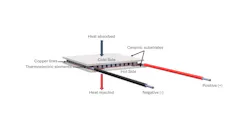
    FIGURE 1. Operating principle of a thermoelectric cooler based on the Peltier effect: When current flows through the semiconductor elements between ceramic substrates, heat is absorbed at the cold side and rejected at the hot side to create a controlled temperature differential across the device.
    Thermoelectric coolers provide precision temperature control for lasers, detectors, and integrated photonics—where addressing thermal drift at the device level is essential.
    Feb. 25, 2026
    Credit: Infinita Lab
    Post-silicon validation.
    The shift beyond silicon photonics is an expansion of the photonic materials toolkit. While silicon remains valuable for electronic-photonic integration and certain passive functions...
    Feb. 24, 2026
    Credit: Shaghayegh Yaraghi
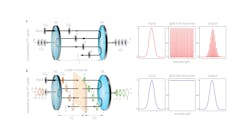
    FIGURE 1. Conventional vs. resonance-free Fabry-Pérot cavity concepts: (a) A conventional cavity with its spectral response and (b) “resonance-free” cavity with its possible spectral response.
    A novel Fabry-Pérot cavity incorporating a holographic phase mask demonstrates resonance-free operation by driving an unrestricted orbital-angular-momentum ladder-up process, ...
    Feb. 18, 2026
    Credit: Lingjie Kong
    Diagram of CLAOP deciphering a functional column.
    Cross-layer all-optical physiology provides an essential tool for directly probing functional connectivity and causal interactions within neuronal circuits—and achieves high-speed...
    Feb. 12, 2026
    Credit: POSTECH
    The team's lab setup.
    Inspired by diffractive deep neural networks, researchers create a metasurface hologram ‘optical lock’ that reveals its image/message only under the correct physical setup.
    Feb. 11, 2026