Gamechanger: A polymer infrared thermal imaging lens
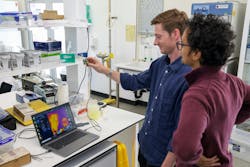
Who doesn’t love a great technology disruption? A group of researchers led by Justin Chalker, a professor of synthetic chemistry at Flinders University in Australia, came up with an amazing—and sustainable—fix for damaged IR thermal imaging lenses (see video).
Thermal imaging is currently used for applications like defense, security cameras, driver-assist functions, fire detection and firefighting, smart appliances, and many others. As the costs of detectors comes down, the optics (lenses) often remain a cost-limiting component. It tends to be a bottleneck for emerging consumer products that require low-cost thermal imaging cameras.
“Traditional lenses for thermal imaging cameras are made from expensive materials such as germanium, high-grade silicon, and chalcogenide glass,” says Chalker. “These materials are very high performing, but their high prices, low-throughput manufacturing, and poor recyclability are limitations. In the case of germanium, global supplies are highly restricted because of its strategic use for defense. Lower-cost alternatives are required—especially for civilian applications.”
Polymers for thermal imaging lenses
Chalker’s lab was inspired by the creative work of Professor Jeff Pyun’s lab at the University of Arizona. “They previously demonstrated that sulfur-rich polymers made from ultralow-cost elemental sulfur have properties well suited to thermal imaging applications,” he explains. “Our team at Flinders developed several ways to make such polymers during the past decade, so we thought we could contribute to the thermal imaging applications of these materials. The specific polymer we made had been predicted to be useful for thermal imaging—on theoretical grounds—but no synthesis had been achieved due to complex chemistry and side reactions in previous approaches. Our lab loves a synthetic chemistry challenge, so we set out to solve the problem.”
For a polymer to be used as a thermal imaging lens, it must be transparent to mid-wave or long-wave IR light, have a high refractive index, and be moldable and shape-persistent. Most synthetic polymers—including common plastics—don’t possess these properties: They absorb this IR light and have a low refractive index.
“Making polymers from elemental sulfur, however, overcomes this challenge,” says Chalker. “Our key design concept is to maximize the amount of sulfur, while also including other building blocks with minimal infrared absorption to impart good thermal stability and shape persistence. Sulfur lets the infrared light of interest pass through the lens, and its high refractive index helps with focusing power.”
The sulfur-rich polymer can be molded into a lens, which is then mounted onto the detector of the camera. “The lens is designed to focus the infrared light on the detector, which is a key step in generating an image,” says Chalker.
The group’s work, not surprisingly, included cool simulations work. “Our collaborator Michelle Coote, a professor of chemistry at Flinders University, and her team simulated the infrared spectra of our polymers, which provides information about its infrared absorptions and transmission,” says Chalker. “We used these highly accurate simulations to provide evidence we made the polymer—the simulated and measured infrared spectra matched perfectly. In the future, we will use these simulations to design new and improved polymers with even better properties. Separately, we also use simulation in the design of the lens, making sure it will have the right focal length, field of view, and other important optical properties for imaging.”
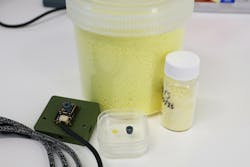
Creating a synthetic polymer for optics
The group’s polymer was previously thought to not be accessible by standard chemistry, and they had to devise a route to overcome previous challenges to make this polymer for the first time. Another lab claimed to have made the polymer, but it turns out their method suffered from the same side reactions that plagued other attempts.
“Meeting the synthetic challenge and delivering this new polymer was exciting,” says Chalker. “It was also highly satisfying that the simulated and measured infrared spectra matched perfectly. The coolest aspect of the project was using the lens in an actual camera and seeing the first images and video. This was an important milestone because this was one of the very few examples of a thermal imaging camera operating a room temperature using only polymer optics—and not germanium or silicon lenses.”
While proud of their achievements, the group is “eager to make further improvements to our lens,” says Chalker. “Our next-generation designs feature improvements to further increase infrared transparency and incorporate the maximum amount of sulfur. We believe these improvements will allow us to compete with more traditional lens materials such as chalcogenide glass. The advantage of our lens is that it is made from sulfur, so the raw materials cost a fraction of one cent. Currently, lenses are orders of magnitude more expensive.”
Thermal imaging video of a kitchen appliance acquired using a camera equipped with the Flinders polymer lens. Credit: Chalker Lab
Target: Ultralow-cost thermal imaging cameras
To make thermal imaging technology more widely available, the cost of cameras needs to drop significantly. “Our lenses are designed to support development of ultralow-cost thermal imaging cameras,” says Chalker. “Some exciting applications include using such cameras for wildlife monitoring, navigation of self-driving cars, energy-saving air conditioning, smart fire detection and suppression (detecting heat before a fire starts), and cameras that help firefighters see through smoke in rescue operations.”
Chalker’s group is now working to translate this technology into a commercial product and is in discussions with industry partners across a variety of sectors. “Our lab aims to push the limits of sulfur polymers for thermal imaging to maximize their performance at the lowest price possible,” he says. “During the next three to five years, our goal is to have commercial prototypes to support expanding use of thermal imaging into new applications and markets. We’re happy to discuss collaboration and development with prospective industry partners.”
FURTHER READING
S.J. Tonkin et al., Nat. Commun., 17, 1561 (2026); https://doi.org/10.1038/s41467-026-68889-0.
About the Author
 Sally Cole Johnson
Sally Cole Johnson
Editor in Chief
Sally Cole Johnson is Laser Focus World’s editor in chief, and she has more than 25 years’ experience as a science and technology journalist. She specializes in physics and semiconductors, and wrote for the American Institute of Physics for more than 15 years, and also covered theoretical physics and neuroscience for the Kavli Foundation, and complexity for the Santa Fe Institute. Johnson has also written extensively about military embedded systems, high-performance computing, software-defined networks, and infosec. She is a member of the National Association of Science Writers (since 2001).
When she isn’t writing about optics, photonics, or quantum advances, you can find her outside in northern NH in the garden with birds landing in her hand or heading for the mountains with her bike, skis, or crampons and ice axe.