Can quantum cascade lasers enable next-gen mid-infrared sensing?
Optical gas sensing is widely used by industrial, environmental, and medical sectors where noncontact measurement, real-time response, and reliable operation are required. Applications such as process monitoring, emissions measurement, and respiratory gas analysis often involve complex gas mixtures and rapidly changing conditions, which demand sensors capable of both selectivity and sensitivity.
Many established optical sensing systems operate within the near-infrared (NIR) range (~0.83 to 1.55 µm), where efficient light sources and highly sensitive detectors are available.1
Decades of development driven by the telecommunications industry led to reliable components—including indium gallium arsenide (InGaAs) detectors—that enable low-power operation and fast response times. But gas absorption features within the NIR spectrum are generally weaker and often lie close together spectrally, which can limit the ability to distinguish multiple gases within complex mixtures.
MIR (~3 to 11 µm) sensing addresses these limitations by targeting stronger and more distinct absorption bands. Although MIR technologies are less mature overall, the improved spectral separation available within this region supports more specific gas identification. QCLs provide a flexible and spectrally precise MIR light source, which enables direct access to narrow absorption features within a wide wavelength range and extends the applicability of MIR-based optical sensing to environments in which high measurement specificity is required.1-4
QCL development
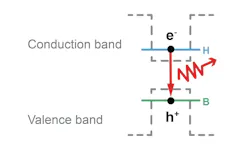
QCLs were first demonstrated during the mid 1990s and represented a significant departure from conventional semiconductor laser designs, which generate light through electron-hole recombination across the bandgap.2 This fundamentally limits the emission wavelength of the material used to make the laser.
QCLs operate via intersubband transitions within the conduction band instead (see Fig. 1). The device is formed from multiple alternating layers of semiconductor material that create a series of quantum wells, with layer thicknesses engineered to define the emission wavelength. When a voltage is applied, electrons are driven through the structure and undergo repeated transitions between conduction band energy states within designated active regions and emit a photon at each step (see Fig. 2). A single electron can generate multiple photons as it traverses the device, which gives rise to a cascade effect.
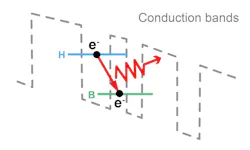
This approach provides a high degree of design flexibility and enables QCL emission wavelengths to be tailored to virtually any part of the MIR spectrum during fabrication. As a result, QCLs can be engineered to align closely with the absorption features of specific gas molecules for highly selective sensing. Narrow linewidth emission and wavelength tunability allow precise targeting of individual absorption peaks, while high spectral brightness supports detection limits at parts-per-million (ppm) or even parts-per-billion (ppb) levels under appropriate conditions.
Challenges
Although QCLs have seen significant improvements since the 1990s, several factors continue to limit their broader adoption in gas sensing systems: Manufacturing complexity, efficiency, system integration, and portability.5, 6
Manufacturing complexity. QCL fabrication involves sophisticated epitaxial growth and precise layer control, which can result in relatively low production yields and higher unit costs compared to alternative MIR emitters. Cost remains a decisive factor for many sensing applications, although increasing demand and higher production volumes are expected to improve economies of scale over time.
Efficiency. QCLs typically exhibit low wall plug efficiency, with a substantial proportion of input power converted into heat rather than usable optical output. Stable operation requires effective thermal management, often in the form of thermoelectric cooling and carefully regulated power supplies. These requirements increase system size, power consumption, and overall costs, which influences where QCL-based solutions can be deployed.
System integration. QCL operation demands precise electronic control, because even small temperature variations can lead to measurable shifts in emission wavelength. This sensitivity places additional demands on system design and requires specialist expertise during development and deployment. For applications in which simplicity and ease of use are prioritized, this level of complexity can be a deterrent.
Portability. Cooling and power requirements make QCLs less well suited to compact, battery-powered instruments, where light-emitting diodes (LEDs) and other simpler emitters often offer a more practical solution despite lower spectral precision. In parallel, established alternatives such as tungsten lamps and blackbody sources continue to be used for some systems due to their low cost, robustness, and ease of integration—despite a lack of selectivity offered by QCLs.
Combined, these factors contribute to slower uptake in cost-sensitive markets and applications that demand rugged, low-maintenance solutions. Wider adoption of QCL-based sensing is closely tied to advances in efficiency, packaging, and system integration, as well as to external drivers such as regulatory requirements that place greater value on measurement specificity and accuracy.
Future directions
Ongoing R&D points to several directions that could shape the future role of QCLs in MIR sensing. One area of focus is system integration because embedding QCLs into photonic integrated circuits or coupling them directly into optical fibers helps simplify optical alignment, reduce component count, and create more robust system architectures. Such approaches support the development of scalable sensing modules that are better suited to deployment outside of controlled laboratory environments.6, 9
Another area of active development is dual-comb QCL spectroscopy. Recent work demonstrates that QCL-based frequency combs can be used to produce compact systems capable of high-resolution, broadband spectral measurements without moving parts. These capabilities open up the possibility of replacing or complementing conventional Fourier transform infrared spectrometers in the field.
At the system level, QCLs are increasingly integrated into multi-technology sensing systems rather than deployed as standalone solutions. Low-cost MIR LEDs and detectors are well suited to distributed monitoring in settings such as urban air quality networks, agriculture, and industrial fence-line surveillance. Hybrid architectures that combine these distributed sensors with high-precision QCL-based nodes allow detailed analysis to be applied where it is most needed.
Applications driving adoption
Early adoption of QCL technology was driven largely by defense and security applications, in which performance requirements justified higher system complexity.3 Their use has since expanded into a broader range of fields, such as healthcare, climate monitoring, industrial safety, and process control, because demand has increased for gas sensing solutions capable of delivering high selectivity and reliable performance within challenging environments. But in many of these areas, QCL deployment remains at the research or early adoption stage, with promising initial results but limited large-scale implementation.
Health and safety. In hospitals, MIR sources are used for monitoring of exhaled carbon dioxide (CO2) during anesthesia to keep the patients safe during procedures.7 MIR sensors can also be used to ensure the safety of staff in the oil and gas industry, as well as other industrial settings, by detecting hazardous gases. A recently developed QCL-based prototype was able to sense methane (CH4) and hydrogen sulfide (H2S) with ppb-to-ppm sensitivity.8 Newer technologies are combining gas sensing with wireless optical communication for remote monitoring of gas leaks within high-risk zones.9
Climate strategy. QCLs are increasingly used within continuous emissions monitoring systems (CEMS) for industrial environments, where hybrid QCL-tunable diode laser (TDL) analyzers provide fast and reliable detection of gases such as CO2 and CH4—even under high temperatures and harsh operating conditions.10 Sensor networks are also being deployed around oil and gas facilities to identify fugitive CH4 emissions, an approach reinforced by Regulation (EU) 2024/1787, which mandates leak detection, repair, and comprehensive emissions reporting in oil, gas, coal, and import chains.11, 12 Compact QCL-based spectrometers mounted on drones have demonstrated CH4 detection at ppb sensitivity,13 while portable QCL-quartz enhanced photoacoustic spectroscopy (QCL-QEPAS) systems are achieving detection limits of approximately 13 ppb for CH4.14
Environmental and smart infrastructure. QCLs can also be adopted for urban air quality monitoring to help detect gases subject to binding limits under the EU Ambient Air Quality Directive.15 Researchers at the Vienna University of Technology have successfully implemented ambient air monitoring using QCLs for quantifying carbon monoxide (CO), nitrogen oxide (NO), nitrogen dioxide (NO2), nitrous oxide (N2O) and sulfur dioxide (SO2).16 Field trials have also demonstrated the use of mobile QCL dual-comb spectrometers for the remote detection and quantification of airborne chemical plumes in dense urban environments.17
Industrial process control. QCLs are well suited to process environments where ppm accuracy is required, including real-time monitoring of chemical reactions. For pharmaceutical manufacturing, they are also being evaluated for in situ reaction monitoring as part of process analytical technology frameworks to support real-time process control for quality assurance, yield optimization, and regulatory compliance to enhance operational efficiency and safety.7
QCLs offer a powerful approach to MIR gas sensing by combining high spectral selectivity with low detection limits. These capabilities make QCLs suited for applications involving complex gas mixtures and stringent measurement requirements within industrial, environmental, and medical sectors. Although challenges related to cost, efficiency, system integration, and portability remain, ongoing technical advances and increasing regulatory demands are supporting wider adoption.
REFERENCES
2. J. Faist et al., Science, 264, 5158, 553–556 (1994); https://doi.org/10.1126/science.264.5158.553.
3. R. J. Grasso, Proc. SPIE, 9933, 99330F (Sep. 26, 2016); https://doi.org/10.1117/12.2238963.
4. M. Ron, J. Laser Opt. Photonics, 10, 97 (2023).
5. S. Sreerambatla, EJAET, 9, 5, 120–126 (2022); https://doi.org/10.5281/zenodo.13325205.
6. J. Kulakowski and B. d'Humières, Proc. SPIE, 11982, 119820I (2022); https://doi.org/10.1117/12.2617419.
8. H. Moser, J. P. Waclawek, W. Pölz, and B. Lendl, Sensors, 25, 3, 635 (2025); https://doi.org/10.3390/s25030635.
9. A. Elkhazraji, M. Sait, and A. Farooq, Appl. Opt., 64, 16, D114–D121 (2025); https://doi.org/10.1364/ao.559367.
11. See https://eur-lex.europa.eu/eli/reg/2024/1787/oj/eng.
12. See www.cliffordchance.com/content/dam/cliffordchance/briefings/2025/01/2025-EU-Methane-Regulation.pdf.
13. B. Tuzson et al., Atmos. Meas. Tech., 13, 4715–4726 (2020); https://doi.org/10.5194/amt-13-4715-2020.
14. M. Jahjah et al., Analyst, 139, 2065–2069 (2014); https://doi.org/10.1039/C3AN01452E.
15. See https://eur-lex.europa.eu/eli/dir/2008/50/oj/eng.
16. A. Genner, P. Martín-Mateos, H. Moser, and B. Lendl, Sensors, 20, 7, 1850 (2020); https://doi.org/10.3390/s20071850.
17. J. Westberg et al., APL Photonics, 8, 12, 120803 (2023); https://doi.org/10.1063/5.0163308.
About the Author
Richard Harvey
Richard Harvey is the general sales manager for Hamamatsu Photonics UK Ltd., with more than 18 years’ experience within the photonics industry. His work has focused on developing OEM partnerships and supporting customers in integrating advanced photonic technologies into commercial products. More recently, Harvey has taken on responsibility for developing overseas business in India, South Africa, and the Middle East, where he works closely with partners to expand Hamamatsu’s presence within emerging markets.