Photons power AI chip, calculations at speed of light
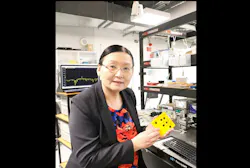
Xiaoke Yi’s group at the University of Sydney in Australia designed and built an AI nanophotonic chip prototype that manipulates light to perform calculations at a picosecond timescale (trillionths of a second)—the time it takes light to travel through its nanostructures (each one is tens of micrometers).
The group’s combined on-chip nanostructures form a neural network that recognizes and completes calculations (see video).
“Our work was motivated by the growing demands of modern data processing, particularly for AI,” says Yi, a professor of electrical and computer engineering, as well as director of the Photonics Research Group. “We’re exploring whether light can offer a fundamentally different computing paradigm by processing information at very high speed and low energy.”
Photonic neural network accelerator
The chip design is based on an inverse-design approach that considers both computational scalability and fabrication feasibility. By computationally exploring a vast design space, beyond human intuition, Yi and her group can engineer geometries to enable computational functionality within an ultracompact footprint.
“Our chip operates as a photonic neural network accelerator, in which computation is performed directly through optical propagation,” says Yi. “We encode computation directly into the nanostructure of the chip so that as light propagates and interferes, the result of the computation naturally emerges as the output.”
The computation function is physically embedded into the device geometry, which enables single-shot, low-latency interference. “Moreover, complex functions can be implemented within an extremely compact footprint and it leads to a much higher computation density,” Yi says.
Simulations play a central role in her group’s work. “We use full-wave electromagnetic simulations and combine this with inverse-design optimization,” Yi explains. “By exploiting the linearity of Maxwell’s equations, we can significantly reduce computational complexity and enable parallelization across modern computing hardware such as graphics processing units (GPUs).”
Among the most exciting aspects of this work? “Seeing how complex computational functionality can emerge directly from the light propagation via the nanostructures. Observing meaningful image classification results arise purely from engineered optical interference, within such a small footprint, was a powerful ‘aha’ moment for our team,” says Yi.
Focus on scalability
As with any emerging hardware technology, “there are ongoing challenges around scalability and system integration,” says Yi. “These are areas we’re actively advancing as the technology matures toward practical deployment. At the same time, rapid advances in integrated photonics and related technologies are steadily helping to address these challenges.”
This technology “has potential applications in high-speed, energy-efficient AI processing, real-time signal analysis, sensing systems, and future data center technologies, where reducing latency and power consumption is increasingly critical,” Yi says.
The group is now exploring improving scalability. “While this is still an emerging technology, we see strong potential for its broader adoption as the technology matures,” Yi adds. “I’m grateful for the dedication and ingenuity of the team driving this work forward.”
FURTHER READING
J. Sved et al., Nat. Commun., 17, 1059 (2026); https://doi.org/10.1038/s41467-026-68648-1.
About the Author
 Sally Cole Johnson
Sally Cole Johnson
Editor in Chief
Sally Cole Johnson is Laser Focus World’s editor in chief, and she has more than 25 years’ experience as a science and technology journalist. She specializes in physics and semiconductors, and wrote for the American Institute of Physics for more than 15 years, and also covered theoretical physics and neuroscience for the Kavli Foundation, and complexity for the Santa Fe Institute. Johnson has also written extensively about military embedded systems, high-performance computing, software-defined networks, and infosec. She is a member of the National Association of Science Writers (since 2001).
When she isn’t writing about optics, photonics, or quantum advances, you can find her outside in northern NH in the garden with birds landing in her hand or heading for the mountains with her bike, skis, or crampons and ice axe.