The race for laser-driven fusion energy heats up
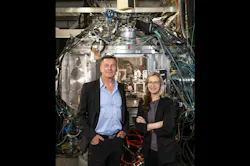
In August 2022, when the team of scientists at Lawrence Livermore National Lab’s (LLNL) National Ignition Facility (NIF) fired a shot that achieved a yield of 1.35 megajoules (MJ) of fusion energy with 1.9 MJ of laser energy, it was a long-awaited scientific breakthrough signaling fusion burn.
Later that same year during another inertial fusion (a.k.a. laser-driven fusion) experiment, scientists achieved a yield of 3.15 MJ of fusion energy with 2.05 MJ of laser energy and attained ignition. It was a thermonuclear fusion reaction created within the lab—and it kicked off a global race to put carbon-free laser-driven fusion energy on the grid by the 2030s or 2040s.
“This was a turning point when NIF first successfully showed that inertial fusion was possible, and the key is having the right kind of fuel—deuterium-tritium—and using lasers to compress and fuse it to generate gain (more energy out than put in),” says Arianna Gleason, staff scientist and deputy director of SLAC’s High Energy Density Science division. “It’s like sustaining the fuel of a star—just for a fraction of a second within a laboratory.”
It was a “mic drop moment for all of fusion,” says Siegfried Glenzer, a professor of photon science at Stanford University and director of SLAC’s High Energy Density Science division.
Why is commercial fusion a race?
The U.S. is trying to maintain its lead in ignition science, “because it’s clear whoever reaches commercial fusion energy first will change the entire economic architecture of the globe. It’s a race and whoever gets there first wins,” says Gleason.
Right now, the U.S. is collaborating with partners in Germany, France, the U.K., and Japan.
China is, not surprisingly, investing heavily in its own fusion facility and advancement. “It isn’t simply the funding China’s pouring into fusion that’s alarming—but also their workforce,” says Gleason. “For every one Ph.D. student we have in plasma science in the U.S., they have 10 in China.”
But a Ph.D. isn’t required to get involved. “Students shouldn’t think of it as a hurdle for becoming engaged in STEM or fusion, or in exploring a career in reliable and resilient energy for the U.S.,” Gleason adds. “We also need engineers, operators, technicians, and people with a science focus. Many of the technologies will need engineers to build it, and then operators to deploy the architecture to the field for the reactors and the power plants. If you’re at all interested in resilient energy for yourself or the nation, come join us.”
What’s happening at NIF now?
Work is currently underway at NIF to improve the shot rate of the laser and its repetition rate. Right now, it’s one or two shots per day.
“Our team is running a campaign right now—shot compressing fusion fuel to make or test conditions that will eventually let us do shots several times per second,” says Glenzer.
Speeding up the rep rate is essential to make this type of fusion efficient. “Today, this rep rate for delivering fuel and engaging with a laser is at a very low technology readiness level (TRL),” says Gleason. “But our team at SLAC is targeting the key parameters of the fuel to deliver the needed targetry to figure out how to best optimize delivery of the fuel at the appropriate rep rate. We need to understand the target physics so we can dial it up to address many shots, many fuel laser engagements per second.”
Laser architecture advances for fusion
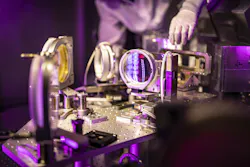
NIF was built during the 1990s and features the laser technology of the time. “We build lasers much more efficiently now than we did in the 1990s. Our technology has advanced to a point where we can have highly efficient lasers at repetition rates we need for fusion—many shots per second,” says Glenzer. “Interestingly, the microchips inside iPhones are produced with laser technology that actually came out of the laser fusion program. It was the first commercial success of laser fusion.”
Within the fusion community, laser technology is slowly moving away from older architectures that worked in the past—the flashlamp-pumped or flashlamp-based lasers were “a very strong workhorse,” says Gleason. “But we need more efficient ones, so we’re using diode-pumped solid-state lasers (DPSSLs).”
This means the supply chain for DPSSL lasers needs to be built up, because everyone is moving toward the IFE standard laser platform for required tests. “Fiber-coupled lasers are one method to move light from one location to another, used ubiquitously by telecoms, but as the fusion community tries to take advantage of the current generation of laser architectures and we build bigger lasers we need to be more mindful of how things get cooled. It’s an innovation space for companies,” Gleason says.
Excimer lasers use gas as a medium and “have a strong history with the Department of Defense (DoD) for directed-energy weapons,” says Gleason. “It’s also the basis for a fusion concept. Great progress is being made with excimer lasers, which stand on decades of physics and studies. We’re making progress to have such a powerful laser—maybe within a smaller footprint or with better efficiency. How do you cool such a large laser structure? These are places private companies can develop their own secret sauce.”
STARFIRE and RISE fusion hubs
STARFIRE fusion hub is led by LLNL, with SLAC, to commercialize laser-driven fusion energy. Its focus is high-gain target designs, target manufacturing, and DPSSLs. Members include MIT; University of California, Berkeley; University of California, Los Angeles; University of California, San Diego; University of Oklahoma; University of Rochester; Texas A&M; Fraunhofer Institute for Laser Technology; Livermore Lab Foundation; Oak Ridge National Laboratory; Savannah River National Laboratory; Focused Energy Inc.; General Atomics; Leonardo Electronics U.S.; Longview Fusion Energy Systems Inc.; TRUMPF; and Xcimer Energy Corp.
The team has access to laser labs at SLAC, so they have an opportunity to use the Linac Coherent Light Source (LCLS), the only x-ray free-electron laser (XFEL) in the U.S., to probe and interrogate capsule materials or the fusion fuel. It operates at 120 Hz, but will soon operate in megahertz.
“We use two lasers at once in our experiments at SLAC. A long-pulse laser drives shockwaves into the sample, and then we probe it with the LCLS to see what’s happening at the tiniest length and time scales to improve our physics models,” says Gleason. “We need to compare apples to apples to benchmark whether our physics model is correct. It underpins not only what the national labs need, but also gives private companies a way to predict whether part of their concept will work or not (for example, how they’re simulating their target engagement). And we’re providing this critical data to them by leveraging our access to different laser and instrument platforms.”
Another hub, RISE, is led by SLAC and Colorado State University, and involves experts from Cornell University, the University of Illinois, Texas A&M, Los Alamos National Laboratory, the Naval Research Laboratory, and private companies—Xcimer Energy Corp., Blue Laser Fusion, Marvel Fusion, and General Atomics—working on different approaches to a laser driver.
“All have a credible approach,” says Glenzer. “But it’s not like one company tries to make it all happen—this is a community and a nationwide fusion hub. Researchers are trying to advance the technologies and we’re learning from each other to try to close the research and technology gaps by the 2030s.”
Glenzer frequently gets asked by investors which fusion company to back. “Some of the laser companies can make money much earlier by delivering lasers to shoot down drones within the defense space,” he says. “But investors don't really like the idea because they want a market that only serves fusion and electricity. They actually want these companies to make fusion so they can sell electricity. It’s really interesting how focused they are on making fusion happen.”
The fusion community is “very much aware of the supply chain requirements for the fusion companies to have the resources to not only build up their demo pilot plans but then have a long-term fleet of reactors,” says Gleason. “It’s a multipronged approach in terms of where we can source the raw materials, and then manufactured components across the U.S., to set up a domestic supply chain. This is key.”
2030s or 2040s for a fusion pilot plant?
Public-private partnerships and funding are crucial to get even close to putting laser-driven fusion on the grid during the 2030s.
“Our role is primarily to support and derisk the critical technology the fusion industry/private companies need,” says Gleason. “But some companies do say they expect it to be during the 2030s.”
The U.S. Department of Energy set a goal of the 2030s. “It means we want to close all the technology and research technology gaps, some by the mid 2030s, and then build a pilot plant,” says Glenzer. “It really depends on how much money is invested, but it’s realistic to expect a pilot plant in the late 2030s or early 2040s.”
About the Author
 Sally Cole Johnson
Sally Cole Johnson
Editor in Chief
Sally Cole Johnson is Laser Focus World’s editor in chief, and she has more than 25 years’ experience as a science and technology journalist. She specializes in physics and semiconductors, and wrote for the American Institute of Physics for more than 15 years, and also covered theoretical physics and neuroscience for the Kavli Foundation, and complexity for the Santa Fe Institute. Johnson has also written extensively about military embedded systems, high-performance computing, software-defined networks, and infosec. She is a member of the National Association of Science Writers (since 2001).
When she isn’t writing about optics, photonics, or quantum advances, you can find her outside in northern NH in the garden with birds landing in her hand or heading for the mountains with her bike, skis, or crampons and ice axe.