Thermoelectric coolers prevent thermal drift within compact optical systems
Photonics technology continues to move toward smaller form factors and higher power densities. As optical components evolve from discrete packages to integrated photonic circuits, the heat flux per unit area increases sharply. A laser diode operating in a few millimeters of package area can generate local heat densities that exceed 100 W/cm2, for example, while copackaged optics and other dense optical subassemblies push these values even higher.
Thermal effects directly influence optical performance. Wavelength, output power, modulation behavior, and detector noise vary with temperature. For systems in which performance margins are narrow, even small thermal deviations can translate into channel misalignment, measurement error, or degraded image quality. As photonic devices become more compact and tightly integrated, passive cooling alone often lacks the precision required to maintain consistent operating conditions. As a result, active thermal control is increasingly implemented at the device and package level.
Thermoelectric coolers and active temperature control
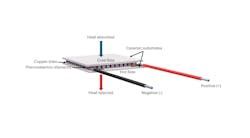
Thermoelectric coolers (TECs) operate based on the Peltier effect, a solid-state phenomenon in which an applied electric current drives heat transport across junctions of dissimilar semiconductor materials. When current flows, heat is actively pumped from one side of the device to the other. Unlike passive heat sinks or convection-based approaches, thermoelectric devices provide direct temperature control rather than relying solely on heat spreading and removal (see Fig. 1).
TECs are typically used for temperature stabilization and moderate sub-ambient cooling rather than bulk heat removal. They are most effective when paired with an appropriate heat rejection path, such as a heat sink or cold plate on the hot side. By reversing current polarity, a TEC can switch between heating and cooling modes to allow a system to maintain a fixed temperature setpoint across changing ambient conditions. It enables optical components to be held at a steady operating temperature whether the environment is cool or warm. Thermoelectric devices also respond quickly to thermal transients and often reach steady-state conditions within seconds, which makes them well suited for photonic systems that experience rapid power cycling or dynamic operating modes.
Critical photonics applications
Frequency and wavelength stability. Temperature directly affects both the refractive index of optical materials and the physical dimensions of laser cavities. In distributed feedback (DFB) lasers used for dense wavelength-division multiplexing (DWDM), wavelength typically shifts on the order of 0.1 nm per degree Celsius. With channel spacings as narrow as 0.8 nm on a 100-GHz grid, a few degrees of drift can result in channel overlap or reduced margin.
Thermoelectric stabilization allows laser junction temperatures to be held within tight tolerances, often maintaining wavelength stability on the order of hundredths of a nanometer. This level of control enables stable operation across varying ambient conditions and helps maintain compliance with network specifications. External cavity and tunable lasers place even tighter demands on thermal stability. Small temperature-induced changes in cavity length or gain medium properties translate directly into frequency drift. Active temperature control enables these sources to maintain frequency accuracy within tens of megahertz, which is critical in coherent communication systems where phase noise impacts bit error rates and system reach.
Detector cooling and noise reduction. Thermal noise sets a fundamental limit on detector sensitivity across much of the infrared (IR) spectrum. In avalanche photodiodes (APDs) and single-photon avalanche diodes (SPADs), the dark count rate increases rapidly with temperature—it often doubles for every 7° to 8°C rise. Lowering detector temperature reduces thermally generated carriers and improves signal-to-noise ratio.
Cooling a SPAD from room temperature to near 0°C can reduce dark counts by several times, for example, which improves detection performance in low-light applications such as quantum communication, time-of-flight sensing, and low-flux spectroscopy. IR detectors operating in the mid-wave (MWIR) and long-wave (LWIR) bands also benefit from thermoelectric cooling. While cryogenic systems are required for deep cooling, TECs provide a practical solution for moderate temperature reduction. Even cooling by 10° to 15°C below ambient can measurably improve noise-equivalent temperature difference (NETD) for thermal imaging systems, particularly where size, power, and reliability constraints limit mechanical coolers.
Thermal control in spectroscopy and precision optical sensing. Spectroscopic and precision sensing systems are often limited by temperature-induced wavelength drift. For tunable diode laser absorption spectroscopy and other narrowband techniques, a small shift in laser wavelength can move the emission line off a targeted molecular absorption feature. In gas sensing applications, this can translate directly into concentration error or reduced detection sensitivity. Because many absorption features are only a few picometers wide, even modest temperature variations in the laser cavity can degrade measurement accuracy.
Thermoelectric coolers provide localized temperature stabilization at the source to maintain a fixed junction temperature and preserve alignment with the intended absorption line. In compact spectroscopic modules, in which lasers, detectors, and optics are integrated within millimeter-scale packages, TECs are often positioned directly beneath the laser die or sensing element to minimize thermal path length and response time. This approach allows rapid correction of thermal drift caused by ambient fluctuations or device self-heating during current modulation. By stabilizing both the emission wavelength and detector temperature, thermoelectric control supports higher signal fidelity, improved repeatability, and long-term calibration stability in portable and embedded sensing systems.
Integration and design considerations
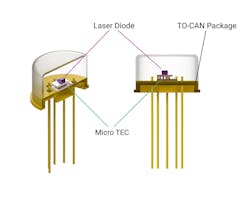
As thermoelectric cooling moves from board-level assemblies into dense optical subassemblies and multichip modules, integration challenges become more pronounced. The shift toward sub-component integration requires cooling solutions that fit within the standardized footprints of photonics packaging, such as TO cans, butterfly packages, and leadless chip carrier (LCC) formats (see Fig. 2). Within these environments, the available footprint is often limited to a few square millimeters and requires specialized microscale thermoelectric designs that can be positioned directly beneath a laser diode or detector to minimize the thermal path length and achieve effective control.
At these scales, small increases in thermal resistance or parasitic heat generation can significantly affect performance. Reliability is another key consideration, because thermoelectric devices within photonics may experience hundreds of thousands of thermal cycles during their lifetime. Mismatch in the coefficient of thermal expansion (CTE) between ceramic substrates, semiconductor elements, and interconnects can introduce mechanical stress. Modern miniaturized TEC designs address these issues through optimized material selection, metallization patterns, and packaging approaches that balance thermal performance with mechanical durability within confined spaces.
Efficiency remains a fundamental trade-off. As required temperature differentials increase, input power rises and the coefficient of performance (COP) declines. Designers must evaluate worst-case operating conditions to ensure the thermal control system does not introduce excessive self-heating or power overhead within the package.
Support for next-gen photonics
Silicon photonics, copackaged optics, and increasingly dense optical subsystems are pushing thermal management closer to the active device. These architectures demand temperature control solutions that match their scale, response time, and precision requirements. Thermoelectric coolers provide localized, solid-state temperature stabilization that complements traditional heat rejection methods and enables consistent optical performance across changing environments.
As integration levels continue to increase, thermal drift is no longer a secondary consideration but a primary design constraint. For compact optical systems in which performance margins are measured in picometers and millikelvin, precise temperature control is often the difference between stable operation and measurable performance loss. Addressing thermal drift at the device level has become a system-level requirement—not just a packaging decision.
About the Author
Brandon Noska
Brandon Noska is the director of application engineering for Sheetak (Austin, TX).