Facet stability is ‘hidden lever’ for scalable edge-emitting laser manufacturing
For edge-emitting laser (EEL) manufacturing, nanometers matter—as do minutes. Few steps are as time-critical as the interval between cleaving a laser bar and applying dielectric mirror coatings. Fresh facets oxidize and accumulate defects that can compromise coating quality and device reliability.
To manage it, manufacturers rely on costly cluster tools, inert handling, and tightly coupled process sequences. Zinc selenide (ZnSe) epitaxial overgrowth offers longer stability but requires complex molecular beam epitaxy (MBE) environments, which limit throughput and raise capital costs.
What if facet stability could be extended not for mere minutes but for weeks or months—without MBE or in situ coatings?
Recent advances in crystalline-oxide facet passivation address this. The method reconstructs the facet into an ultrathin, thermodynamically stable crystalline oxide that resists further oxidation. The result is true process decoupling, supply chain flexibility, reduced capital expenditure (capex), and reliable high-power operation.
Physics of facet instability
Freshly cleaved facets. A newly cleaved facet is chemically and electronically active—dangling bonds introduce mid-gap states that promote nonradiative recombination, localized heating, and increase susceptibility to catastrophic optical mirror damage (COMD).
Oxidation and contamination. Within seconds in ambient air, gallium arsenide (GaAs)-based facets form amorphous gallium and arsenic oxides rich in defect states. Water vapor and hydrocarbons further degrade surface quality, creating additional chemical inhomogeneities and reducing coating adhesion.
Conventional approaches are helpful but short-lived, so manufacturers rely on two main strategies to delay facet degradation: Limiting oxide formation through ultrahigh vacuum (UHV) cleaving or inert handling, or removing native oxide before applying temporary surface treatments such as amorphous hydrogenated (a-Si:H) silicon nitride (SiNx) or silicon dioxide (SiO2).
These measures delay reoxidation only briefly, which requires a rapid transfer to coating. ZnSe overgrowth offers longer stability but at the cost of slow throughput, complexity, and high capital investments.
Manufacturing constraints created by instability
Tight time windows. The passivation‑to‑coating interval is treated as a race against oxidation: Minutes are ideal and many fabs aim for direct transfer from cleaving to coating; <1 hour is manageable with inert-gas handling and minimized exposure; and after >1 hour, the oxide growth accelerates and threatens uniformity, adhesion, and overall yield.
ZnSe extends facet stability only inside the MBE cluster; once exposed to air, degradation resumes and eliminates the stability gains outside the epitaxial environment.
Capital and operational burdens. To stay within the narrow timing window, fabs invest in vacuum-integrated clusters, to minimize air exposure and tightly couple cleaving, passivation, and coating steps; MBE reactors, which add significant capital cost and limit throughput due to slow epitaxial processes; and “gloveboxes” or nitrogen transfer tunnels to maintain inert environments during handling and storage.
Each solution adds cost, complexity, or throughput constraints—often all three—and places a long‑term burden on manufacturing scalability.
Throughput constraints. Passivation takes minutes, but dielectric coating cycles approach an hour, which creates natural bottlenecks when demand is high. ZnSe overgrowth via MBE is even slower—growth runs typically require several hours per batch, which makes the approach challenging with high‑volume manufacturing. When a coater or MBE reactor is occupied, lots must queue and idle time grows.
Yield and reliability costs. Timing slips create uncontrolled oxides, which leads to multiple failure pathways: Poor coating adhesion because amorphous native oxides and contaminants interfere with nucleation and reduce interface strength; nonuniform reflectivity, driven by spatial variations in oxide thickness and surface chemistry; and increased COMD risk because defective or partially absorbed coatings increase localized heating and absorption at the facet.
Even ZnSe can add thermal mismatch and stress interfaces if the process is not tightly optimized.
Hidden costs of instability
Facet instability or the costly measures required to control it drives high capital costs (clusters, MBE); low throughput (cycle time mismatch, bottlenecks); yield losses (oxidized or defective facets); and operational overhead (inert handling, redundancy).
For decades, the industry has faced a tradeoff between speed and stability: Short‑lived oxide-removal and conditioning steps are fast but brief, whereas ZnSe overgrowth is stable but slow and costly. What’s needed is a scalable method that delivers the benefits of both approaches—and transcends them.
Crystalline oxide passivation
A fundamentally different approach. Crystalline oxide passivation reconstructs the facet into a lattice-coherent oxide using compact UHV processing. The resulting layer is thermodynamically stable, and avoids the defect‑rich, metastable states characteristic of native amorphous oxides; self-limiting in thickness, which ensures uniformity and prevents uncontrolled growth; resistant to oxidation, which maintains electronic and chemical stability even after extended air exposure; and it’s compatible with high-throughput UHV tools, which enables integration into fast, modular laser‑bar processing lines.
This eliminates the capital intensity and cycle‑time burden of MBE while providing long‑term facet stability beyond conventional surface treatments.
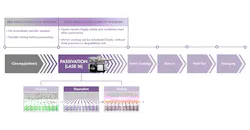
Stability for weeks to months. Untreated facets degrade in minutes and temporary conditioning lasts hours, but the crystalline oxide remains stable for weeks to months. It offers ZnSe-level stability without epitaxy to enable true process decoupling across cleaving, passivation, storage, and coating (see Fig. 1).
Enhanced coating adhesion and COMD performance. The crystalline‑oxide surface is atomically smooth and chemically uniform, which provides a superior foundation for downstream optical coatings. This results in improved dielectric coating adhesion, enabled by a clean, stable, and well‑ordered interface; lower defect density, thanks to the absence of amorphous native oxides and contamination; and COMD thresholds comparable to ZnSe but achieved with simpler, scalable processing.
Operational flexibility. Long-term stability reshapes the manufacturing workflow and eliminates the traditional coupling between process steps to enable new operational freedoms such as process decoupling (passivation and coating can operate on fully independent takt/cycle schedules, rather than being constrained by oxidation-driven urgency); inventory buffering (passivated bars can be stored, queued, or batch-optimized without degradation); global logistics (cleaving and passivation can occur at one facility while coating and testing are performed at another to enable cross‑site specialization and supply chain optimization); and optimized batch sizing (coatings organized for tool efficiency, not urgency).
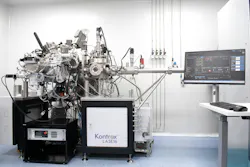
Platforms such as Comptek’s Kontrox LASE 16 system (see Fig. 2) industrialize this workflow by providing controlled UHV conditions engineered for edge-emitting laser facets. Its stable processing environment and tightly managed recipes enable consistent crystalline-oxide reconstruction at production scale.
Implications for high-volume manufacturing
Lower capital requirements. Relaxed timing windows allow discrete, modular tools instead of cluster systems or MBE reactors, which reduces capex and simplifies line design to enable more flexible factory layouts, easier capacity scaling, and reduced maintenance overhead.
Higher throughput. Passivation no longer depends on rapid transfer to the coater. Bottlenecks diminish and overall equipment efficiency improves.
Yield and reliability gains. Stable, passivated facets reduce variability and strengthen downstream coating reliability and COMD performance, which translate directly into improved yield across high‑volume production.
Distributed supply chains. Unlike ZnSe overgrowth, which effectively locks laser bars to a single MBE‑based manufacturing line, long‑term facet stability enables genuine geographic decoupling. Cleaving and passivation are done at one site, while coating and packaging are done at another—without risk of degradation during storage or transport. This unlocks distributed, resilient supply chain models, and greater operational agility.
Future of facet stability
The industry’s long-standing tradeoff of fast-but-short‑lived surface conditioning vs. slow-but-stable ZnSe epitaxy is no longer necessary. Crystalline oxide passivation provides a third path: ZnSe-level stability with process simplicity.
Preserving facet integrity for months enables flexible, high‑volume, and cost‑efficient laser manufacturing, so MBE-class performance becomes achievable at production scale.
Facet stability is no longer a countdown, but instead a capability that gives manufacturers the most valuable commodity in laser production: time.
About the Author
Jouko Lång
Jouko Lång, CTO and cofounder of Comptek Solutions, is the inventor of Kontrox technology and an expert in compound semiconductor materials. A prolific innovator, he has authored or coauthored more than 30 peer-reviewed articles and holds >10 patents driving breakthroughs that enhance semiconductor device performance and manufacturing efficiency.