Optical cavity for each atom within a quantum computer?
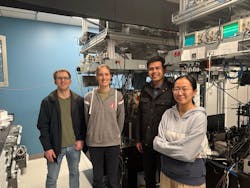
In a step closer to high-bandwidth quantum networks, a team of Stanford University physicists created an optical cavity architecture that efficiently collects single photons from single atoms (which store qubits)—and it means each atom within a quantum computer can now have its own optical cavity to guide emitted light in a desired direction.
The team, led by Jon Simon’s lab at Stanford, built an array of 40 cavities containing 40 individual atom qubits—and has since completed a full characterization of a 600-cavity array. Integrating their 600-cavity array with atoms would make it the world’s highest-bandwidth quantum network.
What inspired this work? Cavity quantum electrodynamics (QED) always seemed amazingly cool to Simon, the Joan Reinhart professor of physics and applied physics, as well as director of Q-FARM, the Stanford/SLAC Quantum Initiative, because “it felt like the ultimate limit of controlling the universe—mad scientist stuff,” he says. “Part of this is because I was an undergraduate at Caltech where Jeff Kimble, who pioneered and led the field, was faculty. It was incredibly inspiring for me, and he is greatly missed by many of us.”
Simon’s doctoral research explored atoms within cavities—Vladan Vuletic’s group at MIT—and he worked on making single-photon sources and memories for quantum networks. For his postdoc, he moved over to Harvard and worked with Markus Greiner to make synthetic matter out of interacting atoms within optical lattices. “So when I started as faculty, it seemed natural to try to make synthetic matter out of photons inside cavities,” Simon says.
This is a difficult problem because photons don’t naturally interact with one another, nor do they behave like material particles: No mass, difficult to trap, and no response to magnetic fields. “So my group ended up focusing very hard to develop new types of optical cavities that can hold photons and imbue them with the properties needed for making topological matter,” says Simon. “This led us to explore aberrations within the cavities and how they impact the mode structure, coupling cavities to one another, and even putting various different types of optics inside the cavities. It was really basic science at the intersection of atomic, molecular, and optical (AMO) physics and condensed matter, and remains a central focus of the group to this day.”
As neutral atom arrays gained traction, “we steered clear because the scientists working within this area are incredibly creative and talented, and we didn’t see a critical role for cavities to play,” Simon explains. “It changed when we realized we could make cavities with mode sizes smaller than the separation between the atoms within the array (~3 to 5 µm).”
Simon’s team was initially inspired by the multipass microscope from Mark Kasevich’s group at Stanford, which showed that, in principle, it should be possible to repeatedly focus light down to a submicron spot. “A concerted endeavor followed, in which folks across almost all projects within my group contributed ideas and techniques that got us to a single cavity with a submicron focus, and then to an array of such cavities separated from one another by only a few microns,” he says. “Nearly every paper from my group has a thread to an aspect of either the ideas or implementation of cavity arrays—it’s a special story that connects curiosity-driven basic science to what seems like could be a transformative application.”
Cavities, optical imaging, and micro-optical engineering
The team’s approach combines three basic concepts: Cavities, which modify the way objects scatter light; optical imaging, which maps many scatterers onto many cavity modes; and micro-optical engineering, which stabilizes the cavities and enables scaling. “Our central design principle is to control light in a way that’s both efficient and massively parallel,” says Simon. “We had to reconcile the requirements for strong light-matter coupling inside a cavity with those for a scalable high-numerical-aperture (NA) imaging system.”
Light collection “is a key driver of neutral atom quantum computing—we use photons emitted by the atoms to determine where they are and what their quantum states are, and to build networks between quantum computers through optical entanglement distribution,” Simon says. “More efficient light collection reduces errors and speeds up readout and entanglement generation within the computer.”
How do the team’s cavity arrays work?
Atoms emit photons in random directions and only as fast as their excited state decays. The challenge is to collect this light, and there are two good ways to go about it.
One way is “neutral atom computers that typically take advantage of high-NA objectives, which collect only a modest fraction of the light emitted by the atoms but can do this across thousands of atoms in parallel,” says Simon.
Another option is an optical cavity, which uses constructive interference of light collected over many reflections between the cavity mirrors to increase the collected fraction to increase the atom’s decay rate toward the mirrors, and the fraction of collected light. “Despite these appealing features, typical cavities have pretty large mode sizes—~20 µm—and can’t easily perform parallel and independent light collection from many atoms spaced by a few microns, which is typically the case in a neutral atom quantum computer,” Simon says. “As an added challenge, the large mode size means the light collection per reflection is very low, so we need tens of thousands of reflections to build up enough constructive interference to achieve good collection efficiency. It also means you can’t put any optics inside the cavity because it will absorb the light before it can reflect back and forth many thousands of times.”
The team’s cavity arrays offer the best of both approaches—by providing efficient light collection of a cavity and the parallelized detection of a high-NA microscope. “First, we showed it’s possible to make a cavity with a small mode of ~1 µm, by adding a lens inside the cavity. This small mode means the light collection per pass is much higher, so we can tolerate many fewer round trips of the light—tens is plenty. Because fewer round trips means tolerance to intracavity loss, this advance allows many new materials within the cavity and makes the cavity much less sensitive to aberrations and misalignments,” Simon explains.
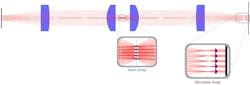
Then they figured out how to scale this up to a large cavity array. “We start by imaging the atom arrays onto a mirror that then reflects the light back through the imaging system and onto the atom array,” says Simon. “Repeating this on the other side of the array forms a cavity at the location of each atom of the array—at least in principle (in practice imperfections in the imaging system accumulate over many round trips, which scatters the light all over the place). To combat it, we add an array of little lenses (a microlens array) in front of one of the end-mirrors to refocus any rays that deviate from their proper paths, which stabilizes an array of cavities with one centered on each microlens.”
If you guessed cool simulation work is involved, you’re right. “So many cool simulations! We expended a lot of effort developing detailed numerical models of how rays and waves propagate through complex resonator geometries beyond the simple Fabry-Perot we’re all familiar with,” says Simon. “You can find a bit of this in our numerical explorations of how the array behaves without the microlens—the whole system is then geometrically unstable, but adding the microlens array rectifies this.”
The team delved into the alignment stability in much greater detail in a paper1 that matched the observed behavior to numerics, then to surprisingly simple theory, and they’re using it to project just how far these cavity arrays can be scaled: 10,000+ cavities.
Many independent cavities from one optical system
One aspect of the work that really stands out for the team was discovering they could get many independent cavities from one optical system. “When we aligned our first single cavity that had a small mode size, we noted it was surprisingly robust to the tilt of one of the (flat) mirrors,” says Simon. “This struck us as strange because a cavity with such a small mode should be incredibly sensitive to the mirror tilt.”
Then they realized mirror tilt produced a small lateral displacement of the tightly focused mode at the atomic plane—but a much larger displacement of the beam footprint on the mirror. “This suggested different mirror facets could support independent cavities and that replacing the flat mirror with a polyhedral mirror would immediately create an array of cavities,” Simon explains. “Nobody wanted to make us a polyhedral mirror, but we’d been exploring microlenses as a tool to make really fast cameras and quickly realized a lens plus a microlens array is essentially equivalent to a polyhedral mirror. With these two jumps, we were off to the races!”
It “was ‘only a matter of putting it all together,’ testing it out, reoptimizing all of the component choices, getting custom optics to replace those that weren’t performing well enough, learning to align an incredibly sensitive optical system, adding in-vacuum piezo-mechanical alignment (we’re sensitive to the locations of some lenses on a micron scale), loading atoms into the system, and coupling them to the cavities,” Simon adds. “Every part of this project required hard work from an incredibly smart, creative, and dedicated team of students and postdocs—and it’s my privilege to work with them.”
Now the team wants to improve performance in terms of more cavity modes to interface with more atoms, as well as higher finesses to collect light more efficiently to induce atoms to emit faster. “The former will likely require us to put microscope objectives within our cavity arrays, and to figure out how to increase their transmission above 99%,” says Simon. “Both will require an even deeper understanding of antireflective coatings and intracavity optical aberrations.”
Target: World’s highest bandwidth quantum network
As of February 9, 2026, the team had completed a full characterization of their new 600-cavity array. “Next up for us is integrating this 600-cavity array with atoms and using it to make the world's highest bandwidth quantum network,” says Simon.
Parallelization for higher data rates “is almost always a good thing, so we see applications across quantum science, in which cavity arrays can be used for fast readout, networking, mid-circuit measurement, and material simulators where photons hop within lattices,” Simon says. “We also see applications for sensing that transcend quantum science entirely. In many settings where a single cavity is used today, hundreds or thousands might provide a decisive advantage.”
FURTHER READING
A. L. Shaw et al., Nature, 650, 320–326 (2026); https://doi.org/10.1038/s41586-025-10035-9.
REFERENCE
1. A. Soper et al., arXiv 2602.06587 (2026); https://arxiv.org/pdf/2602.06587.
About the Author
 Sally Cole Johnson
Sally Cole Johnson
Editor in Chief
Sally Cole Johnson is Laser Focus World’s editor in chief, and she has more than 25 years’ experience as a science and technology journalist. She specializes in physics and semiconductors, and wrote for the American Institute of Physics for more than 15 years, and also covered theoretical physics and neuroscience for the Kavli Foundation, and complexity for the Santa Fe Institute. Johnson has also written extensively about military embedded systems, high-performance computing, software-defined networks, and infosec. She is a member of the National Association of Science Writers (since 2001).
When she isn’t writing about optics, photonics, or quantum advances, you can find her outside in northern NH in the garden with birds landing in her hand or heading for the mountains with her bike, skis, or crampons and ice axe.