Optical waveguide microresonators are ‘Swiss army knife’ for PICs
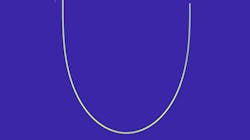
Optical waveguide microresonators created by Professor Won Park’s group at the University of Colorado Boulder are kicking the door to new on-chip sensor technologies wide open.
These tiny optical sensors trap light on-chip and build its intensity—and their high-Q factor and nonlinearity make them ideal for applications such as narrow-linewidth lasers via stimulated Brillouin and Raman scattering, frequency comb generation, or quantum information processing (see video).
“We’re interested in exploring nonlinear optics with new materials—in our case, chalcogenides, which are known for their long wavelength transparency, high nonlinearity, and an amorphous nature that have integration possibilities with other materials such as lithium niobate and silicon nitride,” explains Park, a professor of electrical engineering.
Euler?
The group’s optical waveguide microresonator design is based on Euler “U” bends, which allow light to remain inside the microresonator for about 3 nanoseconds (during the 3-ns photon lifetime, light travels about half a meter or almost a thousand round trips). This increases the path length of the devices and enables nonlinear optical interactions. It essentially gives the researchers control of the bend loss inherent in microresonators and enables ultralow-loss devices similar to other state-of-the-art materials platforms.
Simulations were critical to identify why traditional resonators lose so much light. “We used COMSOL Multiphysics to calculate mode field distributions and perform overlap integrals,” says Park. “This allowed us to pinpoint a ‘sweet spot’ at the junction where the straight and curved waveguides meet. We also used FDTD simulations to model how light propagates through the Euler curves to ensure we could suppress higher-order mode excitation that typically plagues these small-footprint devices.”
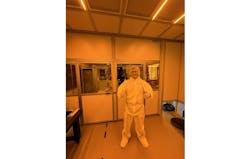
The group actually designed the structures for another experiment and were very surprised to discover high-Q factors they’ve since repeated within two different cleanrooms.
“Our ‘aha’ moment was realizing that by using Euler curves—where the curvature changes linearly—we could essentially ‘trick’ the light into staying in the fundamental mode despite very tight bends,” says Park. “It was incredibly rewarding to see our experimental results match the theoretical intrinsic quality factor of 4.55 × 10⁶. Achieving the highest nonlinear figure of merit reported for chalcogenide PICs is the cherry on top.”
Lithography challenge
To get there, the group first had to develop an electron beam lithographic patterning process for their material, because traditional lithography that uses photons is limited by the wavelength of light.
Main hurdle involved? Material sensitivity. “Chalcogenides can suffer from surface oxidation and impurity-related absorption,” says Park. “In an effort led by two graduate students, Bright Lu and James Erikson, we overcame this by using a vacuum annealing process at 250°C to improve material homogeneity and reduce surface roughness. We also needed to precisely calibrate our boron trichloride (BCl3) and argon (Ar) gas mixture during the inductively coupled plasma reactive ion etching (ICP RIE) to ensure smooth sidewalls, which is vital for maintaining ‘ultrahigh-Q’ performance.”
‘Swiss army knife’ for PICs
These resonators are akin to “a Swiss Army knife for PICs,” says Park. “Because of the high-Q factor and nonlinearity, they’re perfect for a wide variety of applications such as narrow-linewidth lasers via stimulated Brillouin and Raman scattering, frequency comb generation for metrology and telecommunications, or quantum information processing where low-loss on-chip components are not negotiable.”
Now that Park’s group has proven the platform’s low-loss capabilities (0.43 dB/m absorption loss), they’re eyeing the ultimate loss limit. “We’re also widening the waveguides further to move toward ‘material-limited’ performance, which could potentially push our Q-factors even higher and enable even more efficient nonlinear interactions,” he says.
FURTHER READING
B. Lu et al., Appl. Phys. Lett., 128, 081103 (2026); https://doi.org/10.1063/5.0305459.
About the Author
 Sally Cole Johnson
Sally Cole Johnson
Editor in Chief
Sally Cole Johnson is Laser Focus World’s editor in chief, and she has more than 25 years’ experience as a science and technology journalist. She specializes in physics and semiconductors, and wrote for the American Institute of Physics for more than 15 years, and also covered theoretical physics and neuroscience for the Kavli Foundation, and complexity for the Santa Fe Institute. Johnson has also written extensively about military embedded systems, high-performance computing, software-defined networks, and infosec. She is a member of the National Association of Science Writers (since 2001).
When she isn’t writing about optics, photonics, or quantum advances, you can find her outside in northern NH in the garden with birds landing in her hand or heading for the mountains with her bike, skis, or crampons and ice axe.