What if optical cavities stop resonating?
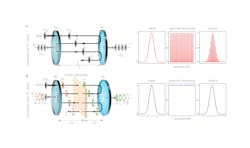
Optical cavities are central to modern optics and photonics because of their ability to recycle light efficiently. By confining light between mirrors, resonant cavities produce strong field buildup at selected wavelengths, enabling lasers, nonlinear optical processes, precision metrology, and a wide range of sensing technologies. In these systems, resonance provides both spectral selectivity and enhanced light-matter interaction.
At the same time, the narrow and geometry-sensitive nature of resonances has motivated sustained efforts to broaden cavity operation while preserving light recycling. Concepts such as white-light cavities, dispersion-engineered resonators, and omni-resonant cavities based on angularly dispersed fields have demonstrated that broadband coupling can be achieved through spectral or angular control rather than strict cavity geometry. But these approaches often rely on additional materials, precise tuning, or increased system complexity.
What if an optical cavity could recycle light without producing resonances?
In recent work (https://rdcu.be/eTlqh), researchers demonstrated a “resonance-free Fabry-Pérot cavity” that transmits light smoothly over a broad wavelength range and remains largely insensitive to cavity length. Rather than shaping the spectrum directly, this approach continuously reshapes the light inside the cavity through its orbital angular momentum (OAM) by using a single holographic phase mask (HPM).
To appreciate the distinction, consider a conventional Fabry-Pérot cavity (see Fig. 1a). Light circulates between two opposing mirrors, and when the accumulated round-trip phase equals an integer multiple of 2π, the circulating field reproduces itself and interferes constructively. This produces sharp transmission peaks at discrete wavelengths but also ties cavity performance closely to parameters such as length, alignment, and temperature. If this coherent interference is disrupted, standing waves cannot form, and resonances disappear—yielding a “resonance-free” cavity.
A resonance-free cavity
The approach Dr. Yaraghi took to demonstrate such a cavity is based on a round-trip transverse-mode evolution within a standard Fabry-Pérot cavity (see Fig. 1b). Specifically, this behavior is enabled via Laguerre-Gaussian (LG) modes, which are exact solutions of the paraxial wave equation and form a complete and orthogonal basis set. LG modes are distinguished by an azimuthally varying phase that winds around the beam axis, while maintaining a stable transverse intensity profile. An important and vital fact in this particular case is that LG modes with different OAM values are orthogonal, because their azimuthal phase structures do not overlap coherently across the beam cross-section.
The three-dimensional azimuthal phase transformation can be implemented efficiently just with an HPM that imparts a full 2π azimuthal phase upon diffraction, corresponding to an OAM of one (LG1 mode). Unlike Hermite-Gaussian modes, which simply toggle between a limited set of spatial states under intracavity phase transformations, LG modes undergo volumetric evolution.
When light is acted upon by an HPM that produces the LG1 mode, its structure evolves nonreciprocally in both the forward and backward propagation directions. When such an HPM is placed inside a cavity, the OAM order of the circulating field increases systematically with every cavity round-trip. Since the field passes through the HPM twice per round trip, the OAM order increases by two for each circulation. Consequently, a normal Gaussian input beam is converted into a cascade of higher-order twisted-light modes. Since these modes are orthogonal, they do not interfere coherently, therefore preventing standing-wave formation and eliminating cavity resonances (see Fig. 1b).
The intra-cavity element is a thin HPM (~1 mm) recorded in photo-thermo-refractive (PTR) glass, a material specifically designed to encode LG1-phase information volumetrically within the bulk of the glass. PTR is particularly well suited for operation in the near-infrared 1-µm wavelength range because of its low optical absorption, scattering, and excellent resistance to optical damage at high average powers. This allows the HPM to operate as a highly efficient and essentially transparent mode converter.
To directly observe the spatial structure of the transmitted light, the team used a specialized mode-sorting system that spatially separated different OAM states based on their phase. Measurements revealed a cascade of modes extending to high orders (up to LG19), all generated from a Gaussian input beam. The spatial mode evolution, which the HPM introduced into a conventional FP cavity, also had a dramatic impact on its spectral response. Their experiments clearly demonstrated this novel behavior (see Fig. 2).
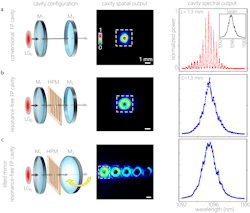
In a conventional Fabry-Pérot cavity, as it is well known, the transmission spectrum is dominated by sharp resonant peaks (see Fig. 2a). When the HPM was introduced and aligned in the Fabry-Pérot cavity, these peaks vanish and the output spectrum becomes smooth and flat, closely matching the spectrum of the input light source, therefore rendering the cavity “resonant free” (see Fig. 2b). This cavity maintained the same broadband transmission over length variations of approximately 350%. Using the OAM mode-sorter, the spectra of the first three transmitted LG modes were measured and found to exhibit the same broadband characteristics.
The cavity length robustness has important implications. Many optical systems rely on cavities for light recycling or field enhancement, but struggle with stability. A cavity that is insensitive to length fluctuations could enable more reliable sensors, broadband optical filters, and compact photonic systems that operate without active stabilization. The approach may also open new possibilities in laser design, where controlling spatial mode evolution could provide new ways to manage feedback and emission properties.
New conceptual framework for optical design
Moreover, the broadband operation of the resonance-free cavity introduces a new conceptual framework. The discrete ladder of OAM modes can be viewed as a synthetic dimension alongside optical frequency, offering a platform for exploring non-Hermitian and topological effects in optics. While these effects were not the primary focus of the present work, the “resonance-free cavity” offers a possible path to a compact and flexible testbed for studying them with potential implications for future cavity-based sensors and unconventional lasers.
Beyond immediate applications, the “resonance-free cavity” offers a new conceptual framework for optical design. It shows that spectral behavior can be controlled through spatial engineering, and that resonance is not an unavoidable feature of optical cavities. By carefully choosing the spatial mode basis and introducing a single mode-converting element, it is possible to decouple light recycling from spectral selectivity.
ACKNOWLEDGEMENT
The authors gratefully acknowledge Professor Ayman Abourady for his pioneering ideas and foundational contributions to this work.
About the Author
Shaghayegh Yaraghi
Shaghayegh Yaraghi is a postdoctoral researcher working with Professor Ivan Divliansky at the University of Central Florida–CREOL (Orlando, FL), in a research group focused on advanced volume holography.
Ivan Divliansky
Professor Ivan Divliansky is a Group leader at the University of Central Florida–CREOL (Orlando, FL).