Low thermal expansion materials redefine precision for high-performance systems
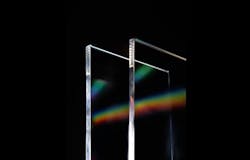
Fields that once evolved independently—high-energy lasers, precision imaging, semiconductor lithography, aerospace observation—are now converging around a critical challenge: A need to limit or eliminate thermal expansion, a constraint that increasingly defines the boundaries of innovation. The spread of larger optical apertures, higher-powered laser systems, and atomic-scale lithography is pushing engineers across industries to confront the fact that the thermal response of foundational materials determines performance limits.
This convergence reflects a broader shift in engineered systems. Performance improvements increasingly hinge on managing thermal physics at the materials level. Low thermal expansion materials (LTEMs), once reserved for elite applications, are becoming platform technologies that enable larger apertures, higher power densities, longer optical paths, and tighter integration.
For high-performance optical, laser, and aerospace systems, even nanometer-scale dimensional changes can make or break system performance. Minor thermal shifts can trigger misalignment and geometric drift—which compromise optical path stability, wavefront integrity, and overall system precision. To meet this problem head on, temperature variation must be addressed.
Athermalized system performance
Corning’s EXTREME ULE glass, an LTEM, is engineered for thermal effect immunity and expands the limits of system design. Developed with a near-zero coefficient of thermal expansion (CTE), this glass maintains dimensional invariance under significant thermal gradients, which prevents the geometric drift that undermines optical figure accuracy and mechanical coherence.
Its value lies not only in low expansion, but in the uniformity and predictability with which it behaves. Achieved through our proprietary glass elaboration processes, this LTEM glass offers exceptional homogeneity and extremely low internal stress—conditions necessary for sub-nanometer surface figure retention, high-performance optical coating enablement, and stable optomechanical integration.
For systems in which mount-induced distortion, thermal bow, or resonator cavity detuning directly impact performance, the material-level intrinsic athermalized response of LTEM glass is indispensable.
Optical systems: Preserving wavefront fidelity through thermal excursions
Optical assemblies are acutely sensitive to thermomechanical deformation. Even micrometer-scale substrate sag or nanometer-level spacing changes can produce wavefront phase errors, tilt-induced optical path difference (OPD), or coherent beam degradation in high-performance lasers.
LTEMs suppress these distortions at their source by maintaining surface figure and structural geometry as temperatures change. This stabilizes long-path interferometers, improves the coherence and pointing stability of high-energy laser systems, and extends maintenance intervals for precision imaging assemblies. As optical architectures grow larger, more integrated, and more thermally dynamic, the system-level value of materials with near-athermalized behavior becomes even more pronounced.
Lithography and metrology: Precision at the limits of thermal physics
Semiconductor manufacturing now operates within tolerances where tens of nanometers of expansion or contraction can influence overlay accuracy, critical dimension uniformity, and metrology repeatability. Lithography systems depend on ultra-stable optical benches, reticle or wafer stages, and mechanical reference frames that must retain geometric fidelity across exposure cycles—all while being faced with thermal gradients generated by high-power lasers, illumination sources, and routine system operation.
LTEMs help stabilize these platforms by maintaining low and predictable in-plane and out-of-plane deformations during thermal load fluctuations. This is essential to controlling in-plane distortion, suppressing thermal-induced stage drift, and maintaining OPD stability in interferometric measurement systems.
Aerospace optics: Stability within an extreme thermal environment
Space presents one of the harshest thermal environments of any engineered domain. Optical systems may transition between direct sunlight and deep shadow in mere minutes, experiencing temperature swings of 100°C or more. Such excursions can induce focus drift, mirror segment misalignment, thermo-elastic bending, and cumulative deformation of metering structures.
LTEMs mitigate these effects by preserving geometric fidelity across rapid and repeated orbital thermal cycles. Our ULE glass has already demonstrated such behavior for demanding spaceborne applications—reducing reliance on active compensation systems and enabling higher image stability and pointing accuracy. Corning anticipates the enhanced uniformity of EXTREME ULE glass will offer improved performance in these applications, particularly in helping satellite imaging systems push for finer spatial resolution and longer operational life.
Path forward: Engineering possibilities defined by material behavior
The next generation of precision systems will be defined less by the ingenuity of thermal compensation approaches and more by the availability of materials that inherently remain stable as temperatures change. By removing thermal distortion at the source, LTEMs simplify system design, enhance reliability, and expand the boundaries of what high-performance systems can achieve.
EXTREME ULE glass is a compelling example of this shift—it demonstrates how advanced glass engineering contributes directly to breakthroughs in optics, lasers, aerospace imaging, and semiconductor manufacturing. As lasers grow more powerful, semiconductor patterns approach atomic scales, and spaceborne optical systems demand ever greater stability, materials that maintain geometric fidelity under thermal load will anchor the next era of high-precision optical engineering.
ACKNOWLEDGEMENT
Corning and Extreme ULE are registered trademarks of Corning Inc.
About the Author
 Xavier Lafosse
Xavier Lafosse
Dr. Xavier Lafosse leads commercial technology strategy and innovation road mapping, working closely with customers and industry leaders to identify emerging trends to accelerate growth opportunities for advancing platforms across industries. Lafosse holds a doctorate in materials physics from Paris University and graduated from the École Nationale Supérieure de Chimie de Paris. He is the holder of eight U.S. patents.