Cross-layer all-optical physiology permits neuron circuit mapping
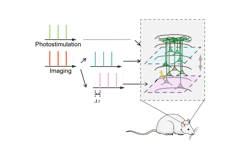
All-optical physiology (AOP), which enables simultaneous monitoring and manipulation of neuronal circuits in vivo, shows promise for taking neuroscience beyond correlation to causality. Many research groups have shown the potential of AOP for dissection of functional circuits within single field of views (FOVs), but no techniques based on AOP existed to explore functional columns, which play a critical role in our understanding of neocortical processing.
So Lingjie Kong, a professor at Tsinghua University in China, and colleagues set out to develop a new approach—cross-layer AOP (CLAOP)—that achieves high-speed, cross-layer two-photon imaging and optogenetics (see video).
“Considering that functional columns, as basic information processing units, are three-dimensional (3D) neural networks, current reports mostly miss the forest for the trees by deciphering neuronal circuits as single planes. We endeavor to develop novel tools for neuroscientists to better understand how functional columns work as a whole,” says Kong.
How does CLAOP work?
The team uses functional indicators, such as GCaMP8m, to monitor neuronal activities in vivo based on their fluorescence signals. And they use opsins to manipulate neuronal activities in vivo based on optogenetics. AOP uses a closed loop of neuronal monitoring and manipulation. But conventional imaging systems set a single focal plane, which limits the FOV at specific depths (typically <600 µm).
“Instead, CLAOP provides a novel platform for all-optical interrogation of neural circuits within functional columns,” says Kong.
Benefiting from spatiotemporal multiplexing of nonlinear microscopy, the team taps two femtosecond laser beams and focuses them at different focal depths. Electrical tunable components allow the researchers to rapidly adjust the focal depths. Corresponding signals from functional indicators can be demultiplexed by temporal demultiplexing—and it allows simultaneous imaging of multiple axial layers with delays of merely a few nanoseconds.
“By further integrating two-photon optogenetics via wavelength multiplexing, we can manipulate neuronal activities at single neuron resolutions, while simultaneously recording neuronal activities at multiple focal planes,” explains Kong. “CLAOP allows us to test fundamental theories in neuroscience, such as ‘wired together, fired together,’ by predicting connectivity from functional activity.”
Essential tool to probe functional connectivity and causal interactions
CLAOP enables the dissection of neuronal circuits within functional columns in vivo and bridges the gap between “seeing the physical structure of the functional column and understanding how it actually works in real time,” says Kong. “Our approach provides an essential tool to directly probe functional connectivity and causal interactions within neuronal circuits.”
One of the most intriguing aspects of this work for Kong is that CLAOP not only enables the study of causal interactions within neural network of functional columns, but also provides a novel platform to examine network performance drift during perturbations. “Our ‘aha!’ moment came when we realized that CLAOP can be used as an optical bidirectional brain interface, which is a way of rewiring neuronal circuits,” he says.
Kong and colleagues demonstrated their method by interrogating neuronal circuits across cortical layers and hippocampus in vivo. Their platform is also broadly applicable to probing neuronal circuits involved in brain disorders and neurological diseases.
“CLAOP opens a window to interrogate neuronal circuits along functional columns in vivo,” says Kong. “But laterally, we’re still limited by the small FOV of most optical microscopes. There’s an urgent need to develop novel AOP systems to cover multiple brain regions, or even the brain and other organs, to study information processing across brain regions and brain-body interactions, respectively. CLAOP should also be integrated.”
FURTHER READING
C. Liu et al., Cell Rep., 44, 12, 116646 (Dec. 23, 2025); https://doi.org/10.1016/j.celrep.2025.116646.
Related Articles

About the Author
 Sally Cole Johnson
Sally Cole Johnson
Editor in Chief
Sally Cole Johnson is Laser Focus World’s editor in chief, and she has more than 25 years’ experience as a science and technology journalist. She specializes in physics and semiconductors, and wrote for the American Institute of Physics for more than 15 years, and also covered theoretical physics and neuroscience for the Kavli Foundation, and complexity for the Santa Fe Institute. Johnson has also written extensively about military embedded systems, high-performance computing, software-defined networks, and infosec. She is a member of the National Association of Science Writers (since 2001).
When she isn’t writing about optics, photonics, or quantum advances, you can find her outside in northern NH in the garden with birds landing in her hand or heading for the mountains with her bike, skis, or crampons and ice axe.