• Home >
  • Back Issues >
  • Laser Focus World >
  • Volume 55, Issue 08
  • Volume 55, Issue 08

    More content from Volume 55, Issue 08

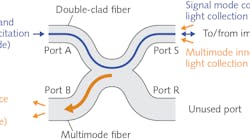
    FIGURE 1. The mode of operation of a DCFC for extraction of fluorescence emission is shown.
    Double-clad fiber couplers (DCFCs) enable seamless and efficient combinations of modalities for robust fiber-based imaging and other biomedical applications.
    Aug. 1, 2019
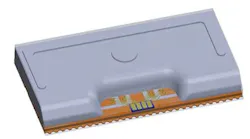
    FIGURE 1. This 905 nm four-channel surface-mount laser provides >480 W peak power.
    A four-channel laser and ultrafast driver delivers more than 480 W peak power in 2 ns pulses.
    Aug. 1, 2019
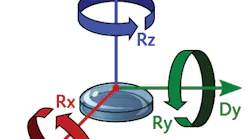
    FIGURE 1. A diagram of rigid-body motions shows the six possible degrees of freedom. For rotationally symmetric parts, the axis of symmetry is assumed to be along the Z axis.
    Optical surface measurements include alignment error from rigid-body position uncertainty; challenges exist when fitting such errors on aspheres and freeforms.
    Aug. 1, 2019
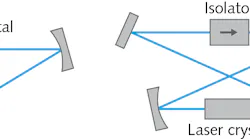
    FIGURE 1. Two laser resonators are depicted here: a linear resonator with output coupling at an end mirror, and a unidirectional ring laser.
    The design of a laser resonator is an essential part of a laser design and often a difficult task—learn how to determine required resonator mode properties and find suitable designs...
    Aug. 1, 2019
    FIGURE 1. Broad clinical applications of photobiomodulation therapy aim at reducing pain and inflammation while promoting healing and regeneration.
    When non-ionizing, non-thermal light treatment called photobiomodulation (PBM) therapy is used in the right dose and clinical context, this treatment can reduce pain and alleviate...
    Aug. 1, 2019
    (Adapted from A. Orth et al. [Ref. 11])
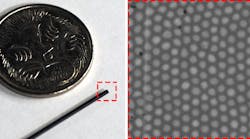
    FIGURE 1. The tip of a 30,000-core optical fiber bundle is shown next to an Australian 5 cent coin for scale (left) and a zoomed-in image (right) reveals a small region of the fiber bundle facet (dashed red box in left). Each core is roughly 2 µm in diameter and separated from its neighbors by an average of 3.3 µm.
    With each fiber acting as an independent pixel, coherent fiber bundles transmit more information than just a 2D representation of an image; specifically, the spatial light field...
    Aug. 1, 2019
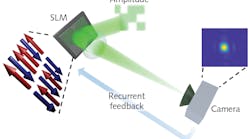
    FIGURE 1. In the scalable setting of a spatial photonic Ising machine, binary spins are encoded in the phase of a laser beam (green) by spatial modulation. Tailoring of the beam’s amplitude fixes spin-spin interaction. To find the ground-state spin configuration, the machine recurrently evolves according to a feedback signal from the camera plane. By design, maximizing the intensity in a target region (blue square) corresponds to a spin state with minimum energy.
    Researchers have built the largest photonic Ising machine to date—an optical processor for solving difficult optimization problems by modeling interacting spins via a spatially...
    Aug. 1, 2019
    (Image credit: U.S. Naval Research Laboratory)
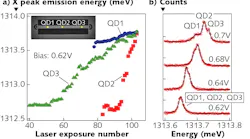
    Shown are tuning curves for three quantum dots positioned on the waveguide at the locations shown in the inset, to achieve identical emission (a). High-resolution Fabry-Perot interferometer measurements show all three quantum dots simultaneously from an output coupler with identical emission wavelength (b).
    By squeezing quantum dots using unique semiconductor-based processes, coherent single photons are generated that can be used for on-chip quantum photonics that demand identical...
    Aug. 1, 2019
    Several rotationally symmetric cavities are etched into a silicon wafer for glassblowing of 0.9-mm-diameter (left) and 1.8 mm (right) axicons.
    Axicon lenses, which are useful for microfabrication, OCT, and other applications, can now be easily made in large quantities by glassblowing.
    Aug. 1, 2019
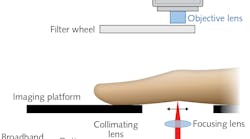
    A fast, low-cost, highly sensitive diffuse optical imaging system acquires optical transmission images dorsally to provide objective, quantitative analysis for rheumatoid arthritis (RA) diagnosis and monitoring.
    A noninvasive near-infrared diffuse optical imaging (DOI) system combines 3D digital imaging and infrared (IR) spectroscopy to map blood content in a patient’s hand for detection...
    Aug. 1, 2019
    (Image credit: University of California, Riverside)
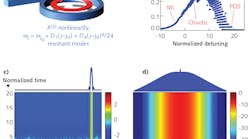
    A microresonator pumped with a CW laser (a) produces a microcomb with stable or chaotic behavior, as well as pure quartic soliton (PQS) pulse trains depending on the pump frequency (b). A high-energy random initial state will evolve with time and settle to a stable pulse with near-Gaussian power profile (c) and uniform power spectrum having a remarkable 3 dB bandwidth (d).
    Microresonator-based pure quartic solitons (PQSs) efficiently convert CW laser light into frequency combs with the power uniformity of individual CW lasers.
    Aug. 1, 2019
    1908 Lfw Nb F1
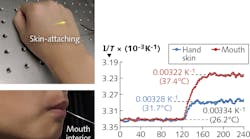
    Polymer optical fibers embedded with temperature-sensitive nanoparticles conform to the skin and endure large strain deformations that provide ratiometric temperature data, verified...
    Aug. 1, 2019