• Home >
  • Back Issues >
  • Laser Focus World >
  • Volume 56, Issue 11
  • Volume 56, Issue 11

    More content from Volume 56, Issue 11

    FIGURE 1. Transmissive diffraction mask (TDM) with vertical and horizontal gratings placed on a standard CMOS image sensor.
    An optical encoding transmissive diffraction mask on a CMOS image sensor generates both high-quality 2D color images and near-field depth maps.
    Nov. 17, 2020
    (Image credit: Dmitry Fedyanin)
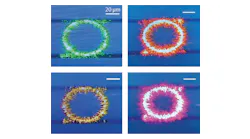
    An electrically pumped ring-shaped surface plasmon-polariton nanolaser double heterostructure consists of an InAsP/InGaAs/AlInAs layer stack on AlInAs surrounded by silicon oxide and a gold superstrate.
    An electrically pumped nanolaser with a ring-shaped cavity promises to serve as the intrachip datalink in ultrahigh-speed computer chips.
    Nov. 17, 2020
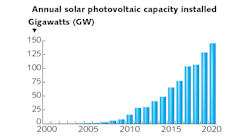
    FIGURE 1. The solar photovoltaic industry has now moved into the 100 GW-plus era, with 140–150 GW of new capacity expected to be installed during 2020.
    Solar photovoltaic panels double in power, as wafers and cells move to larger size formats.
    Nov. 17, 2020
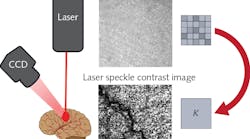
    FIGURE 1. Schematic representation of a LSCI, showing the typical illumination, imaging, and image-processing methodologies.
    Valuable information—for example, surface roughness and dynamic flow—can be obtained by carefully analyzing the speckle pattern in an image.
    Nov. 17, 2020
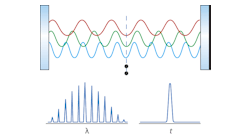
    FIGURE 1. Representation of the constructive and destructive phase interference of different wavelengths inside a laser cavity, generating pulses with ultrashort temporal pulse durations but broad wavelength bandwidths.
    A multipass cell reduces the number of mirror surfaces in a dispersive mirror-based ultrafast pulse compressor to two, enabling compactness.
    Nov. 17, 2020
    (Courtesy of Andrey Andreev)
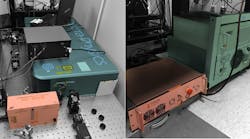
    Fixed-wavelength ultrafast lasers (left) and power supplies (right) are more compact than their tunable Ti:sapphire alternatives (fixed-wavelength laser and power supply are orange; tunable are blue-green). However, for two-photon microscopy, each laser technology has its advantages and disadvantages that the researcher must carefully consider.
    Many biologists are unfamiliar with ultrafast laser technology, but still need to decide between tunable or fixed-wavelength lasers for their two-photon microscopy applications...
    Nov. 17, 2020
    FIGURE 1. A broadband source and optical spectrum analyzer (OSA) setup requires no wavelength synchronization between the two instruments; when combined with the chip, the light can be collected and coupled to the OSA, which will then perform a sweep to record the spectral response of the PIC device under test.
    Selecting electrical or optical synchronization between tunable laser sources and optical power meters is key to accurate spectral characterization of passive optical PIC components...
    Nov. 17, 2020
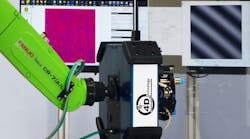
    FIGURE 1. An optical profiler mounted on a robot provides roughness metrology for large or highly curved optics.
    A robot-mounted dynamic optical profiler provides automated roughness measurements for large and complex optics.
    Nov. 17, 2020
    (Image credit: Newport/Oriel)
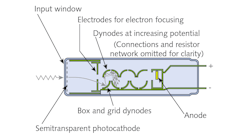
    FIGURE 1. Schematic of a photomultiplier tube (PMT); this example is of an end-on tube.
    The variety of photomultiplier tubes available is astounding, as are the many uses to which they are put.
    Nov. 17, 2020
    Researchers developed a single-cavity laser that emits high-power dual-comb femtosecond pulses, paving the way for portable, robust dual-comb light sources targeted at precision...
    Nov. 17, 2020
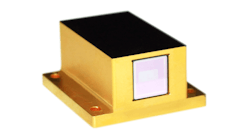
    (Courtesy of Focuslight)
    FIGURE 1. An AL01 1064 nm laser module for lidar.
    Finite-element method (FEM) simulations reduce potential thermal and stress risks when designing packaging structures for high-power laser-diodes.
    Nov. 11, 2020
    2011 Lfw Bf1
    Recent photonics stock performance plus the very successful IPOs of autotech and quantum information companies shows the potential value of photonics companies.
    Nov. 2, 2020
    2105 Lfw Lpms Supp 9a
    Laser Focus World Advanced Technology Product Video Demo Days, an interactive event platform that aggregates videos from the photonics community as well as those from related ...
    Nov. 2, 2020
    Yongjian Yang, et al., npj Computational Materials, September 17, 2020
    Voids in silica glass (yellow), which are responsible for scattering of light and degradation of signals, become much smaller when the glass is quenched at higher pressures.
    Heating and quenching silica glass at a presser of 4 GPa theoretically reduces Rayleigh scattering, potentially increasing light transmission.
    Oct. 19, 2020
    (Image: Ali Passian, ORNL, U.S. Dept. of Energy)
    Laser pulses move through an optical fiber, stimulating the electrons on the metal nanotip to form surface plasmons, assisting electrons to leave the tip. Previous fiber-optic nanotip electron guns have all required external laser pulses, which are difficult to align with the fiber tip in experiments.
    The fiber-optic nanotip electron source for research is the first to be driven by laser pulses from inside the fiber.
    Sept. 14, 2020