Edmund Optics

101 E Gloucester Pike
Barrington, NJ 08007
United States of America
856-547-3488

More Info on Edmund Optics

Designs and manufactures an array of multi-element lenses, lens coatings, imaging systems, and optomechanical equipment for the Machine Vision, Advanced Diagnostics, Biomedical, Semiconductor, R&D, and Defense markets around the globe.

Press Releases

Courtesy of Edmund Optics
Lumimax-1280x960-PR
In-stock modular ring light system simplifies machine vision illumination for a wide range of imaging applications.   July 21, 2026, Barrington, NJ, USA — Edmund Optics...
Courtesy of Edmund Optics
edmund_optics_receiving_award
Prestigious Boards of the Year Recognition Highlights Edmund Optics' Commitment to Long-Term Value Creation, Strategic Leadership, and Governance Excellence   June 25, 2025...
Courtesy of Edmund Optics
lumenflowoptics270x202pr
Off-the-shelf availability in single-unit and reel quantities simplifies prototyping and PCB integration for SMT-compatible LED optics   June 10th, 2026, Barrington, NJ,...
motorizedstages1280x960pr
Broad in-stock range of software-driven multi-axis stages and high-precision motorized platforms enables users to quickly build tailored motion solutions.   May 4th, 2026...
extended depth of focus_metalens270x202pr
Single-element, drop-in metalenses replace complex laser optics assemblies while maintaining precise focus over extended depth. April 7, 2026, Barrington, NJ, USA — Edmund...

Videos

Hqdefault 6352ed13e2e50
Sponsored
At SPIE Optics + Photonics 2022, Cory Boone, technical marketing manager at Edmund Optics, talks about the company’s laser optics offerings, including its extreme-ultraviolet ...

Podcasts

© Endeavor Business Media
lfw_ftpolivia_wheeler_williamsgraphiclandscape
Following the Photons: A Photonics Podcast
This episode of Following the Photons: A Photonics Podcast features Olivia Wheeler-Williams, coatings development manager at Edmund Optics.
© Endeavor Business Media
ftpcory_boonelandscape
Following the Photons: A Photonics Podcast
This episode of Following the Photons: A Photonics Podcast features Cory Boone, technical marketing manager at Edmund Optics.

Articles

Credit: Edmund Optics
edmund_optics
Off-the-shelf Holo/Or diffractive diffusers precisely convert collimated beams into square or circular profiles.
Credit: Edmund Optics
edmund_optics
Acktar ultra-black, light-absorbing coatings are available in Metal Velvet and Spectral Black versions.
Credit: Edmund Optics
edmund_optics
Off-the shelf Omega Optical DUV transmission gratings are designed for deep-UV wavelengths between 190 and 400 nm.
Credit: Edmund Optics
edmund_optics
TECHSPEC laser line mirrors include options manufactured with Zerodur, a glass-ceramic substrate with low thermal expansion.
Credit: Edmund Optics
edmund_optics
UAV Series fixed focal-length lenses enable sharp, high-resolution imaging for drone mapping, urban planning, and surveillance.
(Image credit: Edmund Optics)
edmund_optics
The 25-mm lenses are available uncoated, with a standard laser V-coat, or with custom coatings.
(Image credit: Edmund Optics)
FIGURE 1. The refractive index of UV-grade fused silica as a function of wavelength (left); this dispersion can lead to temporal distortion for ultrafast laser pulses. Attempting to focus a white light source through a single lens results in different focal planes for the various component colors (right); this is analogous to how ultrashort pulses experience temporal distortion when passing through a medium.
Managing the ultrashort pulse durations of ultrafast lasers can be a daunting task, especially if you are unfamiliar with their unique temporal characteristics. Understanding ...
FIGURE 1. Mechanisms for laser-induced damage differ significantly across pulse duration timescales. Longer pulses, including those with nanosecond durations, cause damage primarily through thermal effects. As pulse durations shrink to femtosecond timescales, carrier absorption and nonlinear effects become the dominant mechanisms.[2]
Understanding laser damage mechanism differences between femtosecond and nanosecond lasers promotes efficiency and longevity of laser systems.
(Image credit: Edmund Optics)
2406lfw_men_f
How can you strike the right balance between laser damage resistance and group delay dispersion requirements?
Photo 91068180 © Nikola Fific | Dreamstime.com
FIGURE 1. SWIR imaging is useful for inspecting food with high water content.
Using shortwave-infrared (SWIR) imaging, engineers develop applications for inspecting food, detecting moisture, identifying methane gas, and more.

Buyer’s Guide Listing Information

Click here for listing information and directions on how to add or update your company.

Request More Information From Edmund Optics

By clicking above, I agree to Endeavor Business Media's Terms of Service and consent to receive promotional communications from Endeavor, its affiliates, and partners per its Privacy Notice. I also understand my personal information will be shared with the sponsor of this content, who may contact me about their offerings per their privacy policy. I can unsubscribe anytime.

Additional content from Edmund Optics

FIGURE 1. OCT has allowed clinicians to better diagnose ophthalmic diseases such as age-related macular degeneration (AMD), which causes blurred vision.
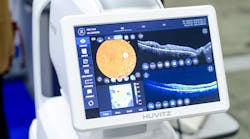
This overview of optical coherence tomography (OCT) recommends systems designers evaluate essential illumination source and optical component criteria when designing these noninvasive...
(Courtesy of Edmund Optics)
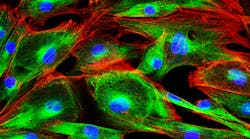
FIGURE 1. Multiphoton, or nonlinear, microscopy, uses ultrafast laser sources for capturing high-resolution three-dimensional (3D) images with reduced photobleaching and phototoxicity compared to traditional confocal microscopy techniques. However, pulse spreading can make multiphoton microscopy images like this one become blurry.
This article is part three of a three-part series focused on ultrafast lasers.
(Courtesy of Edmund Optics)
2306 Lfw Whe F
This article is the second part of a three-part series focused on ultrafast lasers.
(Image credit: Edmund Optics)
2305 Lfw Whe F
This article is part one of a three-part series focused on ultrafast lasers.
Edmund Optics
META holoOPTIX notch filters are available in either a standard 25.4 mm rigid mounted configuration (STRATA) or a 375 × 70 mm flexible configuration (FLEX).
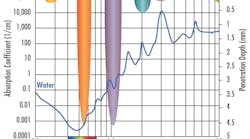
FIGURE 1. Absorption of water and tissue penetration depth at different wavelengths.
Lasers in this wavelength range have become more stable, efficient, cost-effective, and simple to use than ever before, prompting increased incorporation into medical and surgical...
Edmund Optics
Mounted machine vision filters offer 40-20 surface quality and are optimized for use with popular LEDs.
Photo 242617254 © Penchan Pumila | Dreamstime.com
Dreamstime Xl 242617254
Let’s recap all the business announcements in photonics from August 2022.
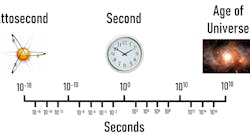
FIGURE 1. Comparison of the time scales of an attosecond, a second, and the age of the universe to illustrate the incredibly short time duration of an attosecond.
Attosecond optics for extreme ultraviolet (EUV) lasers should be designed for maximum control of the central wavelength/energy, spectral shape, spectral phase, and pulse duration...
Photo 239008597 © Penchan Pumila | Dreamstime.com
Dreamstime Xl 239008597
It’s time to recap all the photonics business news that was announced in May 2022.
Xu Vmirrors Eo+ufi
Extreme ultraviolet (EUV) mirrors are used to steer, focus, and shape attosecond pulses, based on high harmonic generation, with a temporal duration of 330 as.
Courtesy of Scientifica
FIGURE 1. A ytterbium fiber-based laser integrated with a multiphoton imaging setup creates a spatial light modulator system capable of interrogating larger neural networks at a higher resolution.
Understanding the unique properties of ultrafast lasers and optical components is critical for constructing a successful microscopy system.