Teledyne Vision Solutions (Princeton)

3660 Quakerbridge Rd
Trenton, NJ 08619
United States of America
609-587-9797
170

More Info on Teledyne Vision Solutions (Princeton)

Teledyne Vision Solutions (TVS) provides the industry's most comprehensive portfolio of imaging technology. Our depth and capability are a result of the combined strengths of Teledyne DALSAe2v CMOS SensorsFLIR IISLumeneraPhotometricsPrinceton InstrumentsJudson Technologies, Adimec, and Acton Optics.

Articles

Teledyne Princeton Instruments
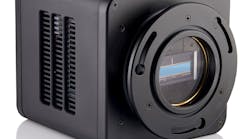
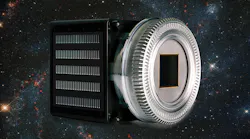
The 66 Mpixel deeply cooled COSMOS camera features large-area CMOS image sensor technology.
Photo 236693909 © Marek Uliasz | Dreamstime.com
Dreamstime Xl 236693909
Let’s recap all the photonics business news that was announced in April 2022.
Teledyne Princeton Instruments
The LANSIS 261 CCD cameras also feature a 30.72 × 3.96 mm sensor.
Teledyne Princeton Instruments
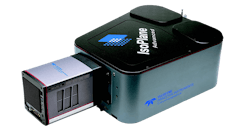
The IsoPlane 320A spectrograph features a patented astigmatism-free Schmidt-Czerny-Turner aberration-corrected optical system design.
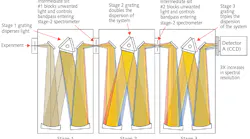
FIGURE 1. Triple spectrograph in additive dispersive mode of operation.
With multistage spectroscopy, researchers can garner crucial information about materials’ internal properties, making them better able to investigate quantum and 2D materials....
Teledyne Imaging
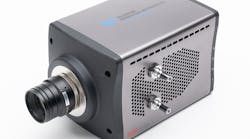
The COSMOS large-format, back side-illuminated CMOS camera delivers over 50 fps for capturing dynamic events in astronomy.
La Cera Pr Image
LACera CMOS imaging technology has uses in applications such as next-generation genomics, astronomical photometry, and ultra-high-resolution x-ray and electron imaging.
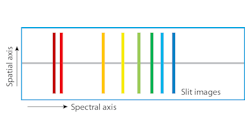
FIGURE 1. Spectral and spatial information on a two-dimensional spectroscopy camera.
Multitrack spectroscopy collects and analyzes data from several input sources with just one spectrometer and detector.
Teledyne Princeton Instruments
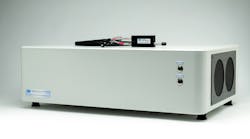
The TPIR-785 Raman spectrometer is optimized for the near-infrared region.
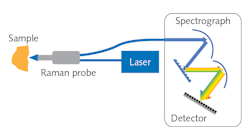
FIGURE 1. The key components of a Raman spectroscopy system are the laser, detector, spectrograph, and probe.
Technology advances are enabling Raman spectroscopy for application as a clinical tool.

Buyer’s Guide Listing Information

Click here for listing information and directions on how to add or update your company.

Request More Information From Teledyne Vision Solutions (Princeton)

By clicking above, I agree to Endeavor Business Media's Terms of Service and consent to receive promotional communications from Endeavor, its affiliates, and partners per its Privacy Notice. I also understand my personal information will be shared with the sponsor of this content, who may contact me about their offerings per their privacy policy. I can unsubscribe anytime.

Additional content from Teledyne Vision Solutions (Princeton)

Teledyne Princeton Instruments
The IsoPlane 81 compact, aberration-free, imaging spectrograph for UV to near-infrared wavelengths has use in microspectroscopy techniques such as Raman, fluorescence, and absorption...
Teledyne
The NIRvana SWIR camera has an InGaAs 640 × 512 focal plane array and a 20 µm/pixel sensor.
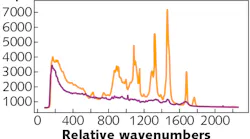
FIGURE 1. Raman spectra of lipid-rich fat tissue (orange) and protein-rich muscle tissue (purple); the broadband, autofluorescence background is clearly visible in both spectra, each of which was collected using a similar acquisition time.
New CCDs deliver 2–7X higher sensitivity in the wavelength range relevant for bio-Raman measurements and allow greater detection limits or shorter experiment times.
The University of Tokyo, Japan Science & Technology Agency, Astrobiology Center, National Astronomical Observatory of Japan, and Instituto de Astrofísica de Canarias
Content Dam Lfw Online Articles 2019 02 Muscat2 With Pixis Cameras See News Release For Credit
The 2nd-gen Multicolor Simultaneous Camera (MuSCAT2) at the Teide Observatory (Canary Islands) will find transiting exoplanets.
Teledyne Technologies will acquire Princeton Instruments, Photometrics, and Lumenera.
Content Dam Lfw Online Articles 2018 10 1810lfw Pro 13 Web
PI-MTE3 in-vacuum CCD cameras are engineered for direct detection in vacuum ultraviolet, extreme ultraviolet, and x-ray imaging applications.
Content Dam Lfw En Articles 2018 05 Princeton Instruments Collaborates With C Sops On New Pharmaceutical Technology Leftcolumn Article Thumbnailimage File
Collaboration uses spectrometer on a novel pharmaceutical technology that enables close monitoring and control of drug manufacturing processes.
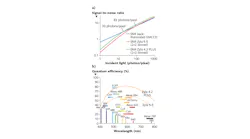
FIGURE 1. A comparison (a) of the signal-to-noise ratio vs. photon intensity for two types of Zyla cameras made by Andor Technology to that of the company’s iXon back-illuminated electron-multiplying CCD (EMCCD) shows that the EMCCD is best for the lowest photon rates, including single photon counting, while sCMOS takes over for higher (but still very low) photon rates). The quantum efficiency (QE) of Andor’s Zyla cameras is optimized for use with a range of fluorophores (b).
sCMOS cameras are now widely used in a variety of leading-edge microscopy techniques, as well as in astronomy and elsewhere.
(Courtesy of BaySpec)
FIGURE 1. This handheld 1064 Raman instrument for direct sampling (a) was released in 2010 by BaySpec (the handheld Raman product line was sold and transferred to Rigaku Raman Technology in 2011); a 1064 nm confocal Raman microscope was used to sample highly fluorescent amber at a 2 µm spot size (b).
Raman spectrometers sensitively detect organic materials for bioscience, medicine, food and agriculture, and forensics.
Content Dam Lfw Online Articles 2018 02 1712lfw Pro 13 Web
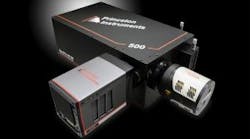
The SpectraPro HRS-500 500 mm focal length spectrograph and scanning monochromator features high spectral resolution.
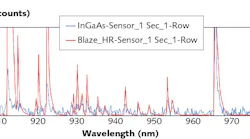
FIGURE 1. Atomic emission lamp spectra acquired using InGaAs (blue) and CCD arrays (red) with a HRS-300 spectrograph and 600 g/mm grating at 1000 nm blaze are compared.
Cameras with exceptional detection capabilities can be designed around high QE, back-illuminated CCD sensors, combined with advanced imaging spectrographs.
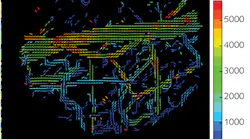
Analysis of high-resolution intravital z-section imagery enables generation of 3D flow maps depicting the microvascular network in a healthy mouse brain; velocity is noted in μm/s.
The particles provide a dramatically higher emission quantum yield, and can be easily modified for various functional-imaging applications.