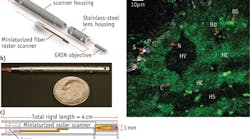
The Brain Research through Advancing Innovative Neurotechnologies (BRAIN) initiative is destined to survive in some form, even if the U.S. Congress does not pass the president...
Equipping thousands of citizen scientists with inexpensive, spectroscopic smartphone add-ons, a group of Dutch researchers recently facilitated a country-wide project to measure...
In early August, medical device company Theradome (Pleasanton, CA) announced the market release of its FDA-approved LH80 laser helmet, which offers clinical- strength hair growth...
The Nokia Sensing XCHALLENGE, a program designed to facilitate the development of sensing innovations able to promote the health of individuals, has announced 12 finalist teams...
Researchers at the University of Strathclyde (Glasgow, Scotland) and Element Six (Ascot, England) have teamed up to develop what are reportedly the first-ever tunable, continuous...
A telescoping contact lens able to switch between normal and magnified vision could someday improve vision for patients with age-related macular degeneration (AMD) and other eye...
A new infrared (IR) spectroscopy technique operates without the use of complex antibodies to quickly distinguish between strains of Staphylococcus aureus (S. aureus) bacteria,...
Photometric stereo endoscopy, a new technique developed at Massachusetts Institute of Technology (MIT; Cambridge, MA), promises to improve detection of precancerous lesions in...
Super-resolution optical microscopy has recently enabled new views of subcellular structure and operation, and in doing so promises to advance drug development, among other endeavors...
Gold nanoparticles, controlled by infrared (IR) light from a pulsed femtosecond laser, promise to promote wound healing and help doctors control blood clotting in patients undergoing...
An amorphous silicon (a-Si) metal-semiconductor-metal heterojunction photodetector with added molybdenum disulfide (MoS2) could boost the speed of medical imaging for minimal ...
Specific wavelengths of light can affect volatile compounds that control aroma and taste in such high-value crops as tomato, blueberry, strawberry, and petunia.
Researchers at Columbia University (New York, NY) report a method that enables something never before achieved: selective, high-resolution visualization of newly synthesized proteins...
Many important technologies and applications have resulted from the creative efforts of researchers and end users. Probably every day, someone working with biophotonics has an...