• Home >
  • Back Issues >
  • Laser Focus World >
  • Volume 57, Issue 08
  • Volume 57, Issue 08

    More content from Volume 57, Issue 08

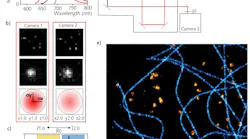
    FIGURE 1. The spectral demixing principle shows normalized spectra of two typical red dyes, AF647 and CF680, with the long-pass dichroic filter at 700 nm to separate the two emission (a); an example of PSF recordings on Cam1 and Cam2 (b, top), zoom-in (b, middle), and 2D Gaussian PSF representation to evaluate center position and photon counting (b, bottom); photon ratio distribution and an example of ranges chosen for ƛ assignment (c); an optical pathway adopted for the spectral separation, with a first dichroic separate excitation from emission—the emission light is then split with a second long-pass dichroic into the two cameras (d); and an example of image reconstruction of a Cos7 cell labeled for tubulin AF647 and Clathrin CF680 (e).
    Single-molecule localization microscopy (SMLM) methods are now vital to accessing biological information at the nanoscale. Now, a novel solution involving just a single laser ...
    Aug. 18, 2021
    Schematic representations of the optical setup; broadband vibrational imaging based on multichannel lock-in detection. Stimulated Raman scattering microscopy requires precise design. A single ultrafast pulse provides the Stokes pulse and sources a broadband pulse from an optical parametric oscillator. The broadband pulse is pre-compensated for dispersion in a grating compressor, and separated into a reference and pump pulse, which are spectrally dispersed and simultaneously measured by linear arrays of balanced photodetectors.
    Simultaneous pump and Stokes beams can stimulate Raman scattering, which is measured as a decrease in transmitted pump intensity—with detailed attention to system architecture...
    Aug. 18, 2021
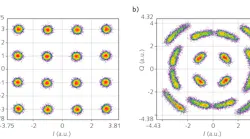
    FIGURE 1. Received 16 quadrature amplitude modulation (QAM) constellations without (a) and with (b) the presence of laser phase noise.
    With the inception of coherent transmission, rigorous performance requirements have been placed on tunable laser technology. Researchers more and more are discovering in those...
    Aug. 18, 2021
    FIGURE 1. Schematic representation of a simple neural network for spectral processing consisting of two hidden layers, each with four neurons and a binary output layer.
    There is no doubt that the future of photonics in healthcare, especially in diagnostic healthcare, will hinge on machine learning, but it is critical to remember that it's a tool...
    Aug. 18, 2021
    Although traditional lithium-ion batteries have high energy and long lifetimes, they are not suitable to create a fossil fuel-free world. A new imaging technique could help in...
    Aug. 18, 2021
    A schematic of how a light-field print works (a) and a light-field print observed from different angles (b) are shown.
    Traditional 2D images display a fixed appearance, unable to control light rays and thus 3D images. Researchers in Singapore are addressing this problem.
    Aug. 18, 2021
    Timo Betz
    Researchers produced instructions for building the microscope in several languages: https://github.com/tobetz/legomicroscope.
    Researchers in Germany are working to inspire and assist potentially budding scientists, namely youths, by combining microscopes with ordinary phones and even toys.
    Aug. 18, 2021
    Thanks to a new DNA-based device, patients may not have to wait for medical test results. The technology has the potential for doctors to obtain such results in minutes, without...
    Aug. 18, 2021
    Courtesy of Aykut Argun
    Illustration of how a neural network is used to retrieve interesting information from a microscope image.
    AI and deep learning are already hugely impacting many industries, applications, and scientific fields. A new tool has the potential to revolutionize microscopy for everything...
    Aug. 18, 2021
    akitada31/Pixabay
    A new multicore fiber-optic monitoring system has the potential to enhance 5G. According to researchers at the Universidad Carlos III de Madrid (UC3M), in collaboration with the Universidad Politécnica de Valencia (UPV), such a system, which they have patented, could optimize energy consumption and preserve data transmission capacity. The team’s work could lead to a parallel system, in which they will continually monitor the node’s energy needs. And in obtaining a single optical signal, “the system can also monitor temperature changes in the fiber core, energy distribution using optical means at different network points, and the state of the communication channel used within the fiber.”
    A new multicore fiber-optic monitoring system has the potential to enhance 5G, as it could optimize energy consumption and preserve data transmission capacity.
    Aug. 18, 2021
    2108 Lfw Nb1
    A recurrent neural network is giving a boost to fluorescence samples with a framework for 3D imaging; it demonstrates a deep learning-enabled volumetric microscopy framework.
    Aug. 18, 2021
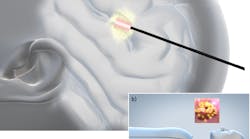
    FIGURE 1. Laser-induced thermal therapy (LITT; a) and photodynamic therapy/ photoimmunotherapy (PDT/PIT; b) are used to treat cancer and other severe pathologies.
    Whether supporting minimally invasive surgical procedures, killing tumors, or treating dermatological pathologies, light-based therapies play an important role in improving the...
    Aug. 18, 2021
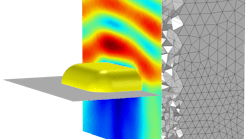
    FIGURE 1. Scattering of light by a gold nanoparticle embedded in a substrate. The finite element mesh is also shown.
    Simulation is used for design, optimization, and diagnostics in diverse applications including optical fibers, lasers, smartphones, and autonomous vehicles. However, optical simulation...
    Aug. 16, 2021
    Rising Star Hero
    In its inaugural year, the Rising Stars Awards program celebrates young researchers, scientists, and other industry up-and-comers for their dedication to photonics and who are...
    Aug. 3, 2021