
• Home >
  • Back Issues >
  • Laser Focus World >
  • Volume 44, Issue 5
  • Volume 44, Issue 5

    More content from Volume 44, Issue 5

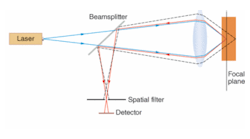
    FIGURE 1. In confocal fluorescence microscopy, the illuminating light (blue) is focused through a short-focus lens into a sample, where it induces fluorescence (red), which the lens collects and directs back toward the light source. A dichroic beamsplitter transmits the illuminating beam, but reflects the fluorescence toward a detector, where a spatial filter blocks light from other points. Note that light from other planes in the sample (dashed line) is strongly attenuated by the spatial filter.
    Powerful new techniques use fluorescence imaging and nonlinear techniques to probe cells; developers hope to produce a new generation of clinical tests.
    May 1, 2008
    The advent of invisibility cloaks for electromagnetic (EM) waves has arisen from clever theoretical advances in transformation optics, for which exit EM waves can be made identical...
    May 1, 2008
    Th 0805lfwnb1
    While mercury cadmium telluride photodiodes and quantum-well infrared photodetectors are well established in military and other applications, the performance of these detectors...
    May 1, 2008
    The use of fluorophore-metal interactions has the potential to dramatically increase the detectability of single fluorophores for both single-molecule detection (SMD) and fluorescence...
    May 1, 2008
    Although it is well understood theoretically that a focused Gaussian beam will present phase-velocity variations across its waist both radially and axially, experimental verification...
    May 1, 2008
    Th 0805lfwnb
    Numerous laser-based methods exist for creating patterns and textures on a substrate, including traditional lithography, direct-write methods, and exposure through self-assembled...
    May 1, 2008
    The optical-damage threshold in bulk fused silica is important for establishing the performance limits of high-power laser systems, but the mechanism is poorly understood.
    May 1, 2008
    Single-photon detectors have enabled strides toward viable quantum information processing.
    May 1, 2008
    Th 0805lfwnb3
    A patent-pending microscope substrate design developed at the National Institute of Standards and Technology (NIST; Gaithersburg, MD) allows nanotechnology researchers to track...
    May 1, 2008
    Fernanda Sakamoto, MD, of Harvard Medical School and her colleagues at the Wellman Center for Photomedicine at Massachusetts General Hospital (Boston, MA) are using a tunable ...
    May 1, 2008
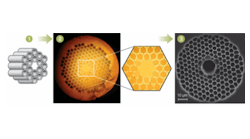
    FIGURE 1. In the modified fabrication method of hollow-core photonic-bandgap fibers, several hundred capillaries each 1 to 2 mm in diameter are stacked to create a preform. The core is formed by simply omitting some capillaries from the middle of the stack (1). The preform is drawn down to canes preserving the structure—the image shows an optical microscope image of a cane cross section. The diameter is approximately 3 mm. No central tube has been used to define the hollow core (2). In a final step the cane is inflated by being pressurized from the top while being drawn down into fiber. The scanning-electron-microscope image of the final fiber shows the thinner wall of glass around the fiber core (3).
    Optical fibers are typically formed from two glasses: the first, with a higher refractive index, runs down the middle of the fiber, forming the core in which light is trapped;...
    May 1, 2008
    (Courtesy of Friedrich-Schiller-Universität Jena)
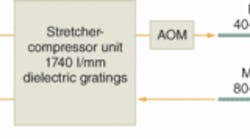
    FIGURE 1. A millijoule-level high-repetition-rate fiber chirped-pulse amplification system includes an optical isolator (ISO), acousto-optical modulator (AOM), and specialized photonic-crystal fiber (PCF).
    The power-handling capabilities of the main amplifier in a fiber laser reveal a potential performance of gigawatt peak power at megahertz repetition rate.
    May 1, 2008
    (Courtesy of Joan Edwards and Dwight Whitaker)
    FIGURE 1. A nine-frame image sequence shows the explosive discharge of spores from Sphagnum moss recorded at 10,000 fps, thanks to the capabilities of modern high-speed digital cameras.
    Advances in high-speed imaging systems make it possible to record ultra-high-speed movements of biological systems (less than 1 ms) under lighting conditions that do not damage...
    May 1, 2008
    (Courtesy of Microvision)
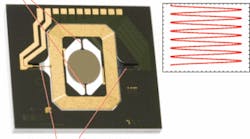
    FIGURE 1. In miniature projector displays, a single MEMS mirror rotates biaxially to raster-scan a two-dimensional image—much like old TVs but with photons instead of electrons.
    Mobile laser-projectors based on MEMS will soon enable consumers to project full-color, high-resolution images from mobile phones, laptop computers, personal media players, and...
    May 1, 2008
    (Courtesy of AFE Technology Coatings)
    FIGURE 1. A head-up display combiner with a rugate coating is used in aircraft to reflect a monochromatic green display.
    A head-up display (HUD) provides the ability to project information onto a transparent screen so that it appears to be floating in space as a virtual image.
    May 1, 2008
    (Courtesy of Quantum Communications Victoria)
    Materials Engineer David Simpson from Quantum Communications Victoria (QCV) observes the growth of diamond nanocrystals in a microwave plasma-enhanced chemical-vapor-deposition reactor. A patented technique for optical pumping of single-atom nitrogen defects in the diamond nanocrystals (inset) creates an excited state that generates single-photon emission at 700 nm, allowing show-floor operation of QCV’s newly released SPS 1.01 single-photon source.
    Now that fiber-to-the-home (FTTH) and 40 Gbit/s systems are being commercially deployed, it seems that the telecom industry is already looking ahead to terabit networks to feed...
    May 1, 2008
    The diode-laser company Dilas (Mainz, Germany), opened its first manufacturing facility in China.
    May 1, 2008
    (Courtesy of Trumpf-Laser)
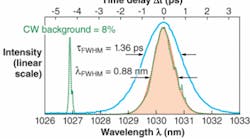
    The thin-disk scheme generated a CW background near 1027 nm. The autocorrelation trace and optical spectrum of the laser output show a 1.36 ps pulse length and 0.88 nm pulse width at a center wavelength of 1030.3 nm.
    Optimizing the power of pulses in the picosecond regime is important for advances in micromachining, direct pumping of parametric devices, and high-field physics.
    May 1, 2008
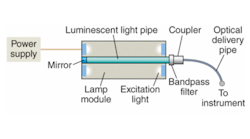
    A typical light engine comprises a lamp module and delivery optics. The Lumenor light-pipe geometry integrates a significant fraction of the light, resulting in high external efficiencies that are optimized by the design of the lamp module (including the excitation source) and the unique geometric shape of the pipe. Increased power levels can be obtained by scaling the light pipe and associated excitation.
    Lumencor (Beaverton, OR), a year-old company focused on the development of novel light engines, is targeting life-science instrumentation with its initial products and is gearing...
    May 1, 2008
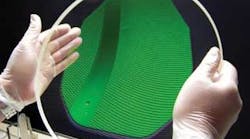
    Lasers are used to imprint a wood-grain design onto the surface of medium-density fiberboard, giving it the appearance of expensive wood.
    Medium-density fiberboard, or MDF, is probably one of the most versatile and useful wood products.
    May 1, 2008
    (Courtesy of the Mi3 project)
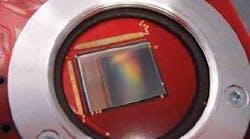
    The Mi3 project’s Vanilla sensor (here, bonded to printed-circuit board) is a multipurpose active-pixel sensor developed by the Mi3 Consortium in the U.K.
    A major UK collaboration has borne fruit over a range of research areas. The Multidimensional Integrated Intelligent Imaging Project (Mi3) pooled the talents from 11 research ...
    May 1, 2008
    (Courtesy of National Research Council of Canada)
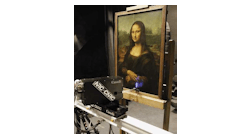
    FIGURE 1. A high-resolution 3-D color laser scanner mounted on a translation stage was used to scan the Mona Lisa. The scanner uses red, green, and blue wavelengths as the laser source, which, when superimposed in the scanning system, results in the projection of a white, 50- to 100-µm-diameter laser spot on the object.
    With the advent of increasingly cost-effective, high-resolution optical-imaging technologies, art historians are delving deeper into the world of forensic science.
    May 1, 2008
    (Courtesy of Johns Hopkins University/Gary Brooker and Joseph Rosen)
    In contrast to conventional imaging, FINCH preserves 3-D information in the 2-D image that is captured by the FINCH process. FINCH projects a set of rings (Fresnel zone plates) for all points. The size, location, and the number of Fresnel rings created on the image sensor code where the sample is for every single point on the image.
    Three-dimensional imaging just got faster and far simpler, thanks to scientists at Johns Hopkins University (JHU; Rockville, MD) and Ben-Gurion University of the Negev (BGU; Beer...
    May 1, 2008
    The TruDefender FT from Ahura Scientific is a 3 lb Fourier-transform infrared system designed for first responders performing field-based chemical identification in hazmat and military situations.
    A trip to the “Big Easy” may evoke images of slower, more genteel times, but Pittcon 2008, held March 1–7 at the massive Ernest N. Morial Convention Center (New Orleans, ...
    May 1, 2008
    The 2008 Lemelson-Rensselaer Student Prize was awarded to Martin Schubert for designing the first polarized LED. Light emitted by the LED chip is primarily polarized in the plane of the quantum wells of the chip; a specially designed reflector selectively rotates the polarization of this side-emitted light (in-plane polarized light) to x-polarized light traveling upward. (Courtesy of Rensselaer Polytechnic University) with this design, the in-plane polarized side-emitted light is directed upward with a single dominant linear polarization.
    Martin Schubert, a doctoral student in electrical, computer, and systems engineering at Rensselaer Polytechnic University (Troy, NY), won the $30,000 Lemelson-Rensselaer Student...
    May 1, 2008
    Milton Chang is admired for his leadership in science, business, and nonprofit arenaas.
    May 1, 2008
    (Courtesy of Axsys)
    The gyro-stabilized V14 HD Cineflex camera system, shown here mounted on a helicopter for filming of the Discovery Channel’s “Planet Earth” television series, was featured at the Axsys booth. Axsys collaborated with Cineflex on the imaging system.
    A healthy attendance of 5700 bolstered a 16% increase in the number of exhibitors over last year at SPIE’s Defense + Security Symposium (DSS) 2008 at the Orlando World Center ...
    May 1, 2008
    Hitachi’s patented finger-vein authentication device uses infrared LEDs and a CCD camera to scan and image the vein pattern in each finger and compare it to the database associated with the application assigned to that finger.
    Biometric identification methods such as fingerprinting, voice authentication, face recognition, and iris scanning all have pros and cons in terms of their ease of use and level...
    May 1, 2008
    SensL, a provider of low-light solutions, signed a $200,000 contract with the Thomas Jefferson National Accelerator Facility for the optimization of low-light detectors and the...
    May 1, 2008
    The Defense Advanced Research Projects Agency awarded Sun Microsystems (Santa Clara, CA) $44.29 million for a five-and-a-half-year research project focused on microchip interconnectivit...
    May 1, 2008
    Precision-optical-component manufacturer Edmund Optics (Barrington, NJ) forged a cooperative agreement with Clemson University and Benet Laboratories at the Watervliet Arsenal...
    May 1, 2008