• Home >
  • Back Issues >
  • Laser Focus World >
  • Volume 51, Issue 05
  • Volume 51, Issue 05

    More content from Volume 51, Issue 05
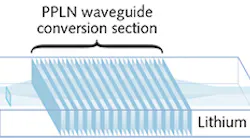
    FIGURE 1. A schematic depicts a non-critical phase-matched PPLN waveguide chip.
    Periodically poled lithium niobate (PPLN) waveguide frequency-conversion devices have advantages over their bulk counterparts.
    May 5, 2015
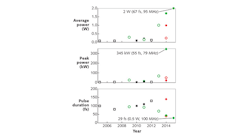
    FIGURE 1. The progress of ultrafast mid-IR Cr:ZnS/ZnSe oscillators based on different mode-locking methods is compared: SESAM (squares), graphene (diamonds), Kerr-lens (circles), and by type of the gain medium: single-crystal (open symbols) and polycrystalline (solid symbols). Arrows show the record parameters obtained to date (based on the data published in references 1 and 2 and the most current results obtained at IPG Photonics).
    Kerr-lens mode-locking of polycrystalline chromium-doped zinc sulfide and zinc selenide leads to multiwatt output power, pulse durations approaching three optical cycles, and ...
    May 5, 2015
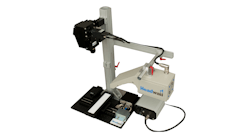
    FIGURE 1. The starter kit comprises a hyperspectral sensor (VNIR or SWIR), illumination kit, full software control, and a moving stage to properly scan materials of interest.
    With its fine spectral detail, hyperspectral imaging reveals information on the makeup of ancient art, texts, and other forms of cultural heritage.
    May 5, 2015
    FIGURE 1. The flash-lidar-timing concept illustration of simple timing of laser pulse, reflected light, and switches within the camera or detectors.
    Lidar has the required accuracy to safely navigate self-driving cars. Semiconductor-laser-based flash lidar systems using VCSELs may speed commercialization and adoption by lowering...
    May 5, 2015
    FIGURE 1. A schematic shows a waveguide-integrated nanowire single-photon detector (light yellow) contacted by metal leads (gold). The waveguide (blue) is supported by a buried oxide layer (light grey) with lower refractive index.
    By embedding superconducting nanowire single-photon detectors (SNSPDs) in nanophotonic circuits, these waveguide-integrated detectors are a key building block for future on-chip...
    May 5, 2015
    (From Jeff Hecht and Dick Teresi, Laser: Supertool of the 1980s)
    FIGURE 1. Press-release photo from Hughes Research Labs showed a larger lamp than Maiman used. The extra power probably helped others reproduce the ruby laser from newspaper accounts.
    Content Dam Lfw Print Articles 2015 05 1505lfw Ove2
    Aurea Technology, Northrop Grumman Cutting Edge Optronics, and Inrad Optics are this year's winners in the Analytical Instruments or Systems, Lasers and Sources, and Optical Components...
    May 4, 2015
    Jeff Hecht's article "Gas lasers: Durable survivors evolve new forms" in the March 2015 issue of Laser Focus World provided many fond memories of our early days in the new field...
    May 4, 2015
    United States and international laser product standards define the safety 'class' of laser products. Laser classes generally indicate the laser's hazard level during normal operation...
    May 4, 2015
    Conard Holton2
    With apologies to Thomas Kuhn, the philosopher of science who wrote The Structure of Scientific Revolutions and made famous the term "paradigm shift," I have been observing some...
    May 4, 2015
    (Adapted from reference 1)
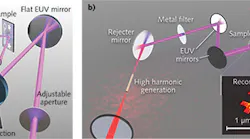
    FIGURE 1. Schematic of a typical tabletop CDI microscope (a = transmission, b = reflection). An ultrashort near-infrared pulse is focused into a hollow capillary, where high-harmonic generation produces 13 nm light. The fundamental light is stripped away with the combination of a silicon rejector mirror (set at Brewster's angle for the fundamental) and a thin metallic filter. The light is spectrally filtered by two Bragg reflectors and focused onto the sample. The scattered light from the sample is collected on the detector. A reconstruction is shown in the inset.
    High-harmonic generation and coherent diffraction imaging can produce quantitative phase and amplitude high-contrast images.
    May 4, 2015
    Content Dam Lfw Print Articles 2015 04 Lfw April Bf Ursi Kurt Web
    This month is the second part of an interview with the husband-wife team of Professor Ursula Keller and Dr. Kurt Weingarten.
    April 29, 2015
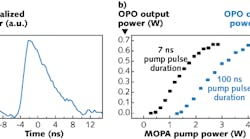
    Pulses produced by a Tm:fiber MOPA have an asymmetric shape due to high gain in the first amplifier (left). Output power of the MOPA-pumped OPO versus MOPA pump power is shown for MOPA pulses of 7 an 100 ns duration (right).
    A novel fiber-based master-oscillator power-amplifier source contains a thulium-doped single-mode fiber oscillator.
    April 29, 2015
    (Image credit: S. M. Kuebler of UCF and R. C. Rumpf of UTEP)
    False-color scanning electron microscopy shows a spatially variant photonic crystal (SVPC) designed at UTEP and fabricated at UCF using multiphoton direct-laser writing. The SVPC was designed to bend light (illustrated in red) through a 90° turn. The blue lines are experimental measurements of light intensity at λ0 = 2.94 μm at the exit faces of the SVPC, showing that the lattice can steer the beam through a turn with radius as small as 6.4λ0.
    Spatially variant photonic crystals (SVPCs) can be used to steer light beams efficiently around extremely tight corners.
    April 29, 2015
    FIGURE 1. A variable-focus liquid-crystal (LC) contact lens consists of two PMMA substrates with LC sandwiched in between to form a meniscus LC lens. The direction of the LC orientation is changed by varying the applied voltage.
    Researchers have developed a contact lens that contains a homeotropically vertically aligned liquid-crystal configuration.
    April 29, 2015
    (Image credit: Epner Technology)
    The thermal shield for the lunar corner-cube retroreflector is coated with Laser Gold to allow measurements critical in understanding dark energy and matter.
    In 2016, gathered scientific data could improve our understanding of gravitation and general relativity and, as a result, dark energy and dark matter.
    April 28, 2015
    (Courtesy of Lasertel)
    An 800 kW laser-diode array developed and made at Lasertel is one of four such arrays that will pump the final power amplifier of the High-Repetition-Rate Advanced Petawatt Laser System (HAPLS) to be installed at the Extreme Light Infrastructure (ELI) Beamlines facility currently under construction in the Czech Republic.
    Lawrence Livermore National Laboratory has installed and commissioned the highest-peak-power laser-diode arrays in the world.
    April 28, 2015
    1505lfw Nb F4 Web
    Surface acoustic waves (SAWs) are used by certain electronic components in mobile phones and other devices as compact filters.
    April 27, 2015
    Content Dam Lfw Print Articles 2015 05 1504lfwnb Oct Web
    Researchers used optical coherence tomography (OCT) to quantify in situ spinal-cord deformation/deflection as a function of various nitrogen gas-jet flow rates.
    April 27, 2015
    1505lfw Nb F2 Web
    A team of researchers has identified a way to approach the cooling temperature of liquid nitrogen by reducing parasitic heating losses and maximizing the absorbed laser power....
    April 27, 2015
    Content Dam Lfw Print Articles 2015 05 1505lfw Nb F3 Web
    Interband-cascade lasers (ICLs) produce light from interband transitions, rather than the intersubband transitions of quantum-cascade lasers (QCLs).
    April 27, 2015
    1505lfw Nb F1 Web
    Carbon3D can fabricate 3D-printed objects tens of centimeters in size with 100 μm resolution in minutes.
    April 27, 2015