• Home >
  • Back Issues >
  • Laser Focus World >
  • Volume 48, Issue 01
  • Volume 48, Issue 01

    More content from Volume 48, Issue 01

    (Courtesy of Sandia National Laboratory)
    A transmission electron microscopy (TEM) cross-section reveals a selective-area epitaxially overgrown germanium (Ge) structure before chemical-mechanical polishing (CMP); the bottom-up fabrication process for this photodiode enables a low dislocation-defect density.
    To maintain the bandwidth demands for future communications networks, integrated-photonics architectures based on silicon photonics and other semiconductor platforms are being...
    Jan. 1, 2012
    A two-dimensional photoresist pattern spells out the words TAMU KACST using the Rabi oscillation-based lithography method
    A new technique from Texas A&M University (TAMU) and The National Center of Mathematics & Physics (KACST) that uses two lasers and exploits molecular oscillations in the lithographic...
    Jan. 1, 2012
    A flexible metamaterial film created by researchers at the Technical University of Denmark and Boston University drastically reduces reflection of terahertz radiation, and can...
    Jan. 1, 2012
    RXI LED collimator with retroreflecting grooves requires no metalization
    A group from the Universidad Politécnica de Madrid and LPI has created a plastic RXI collimator for LEDs that does not require any metalization.
    Jan. 1, 2012
    Multicore optical fibers could reduce congestion on passive optical networks
    The number of optical fibers needed for access networks using passive optical network (PON) architectures is increasing demand for high-density fiber cables. An interesting solution...
    Jan. 1, 2012
    A superluminescent diode shows a simultaneously thermal and coherent output at a temperature of about 190 K
    Researchers at the Technischen Universität Darmstadt have demonstrated a state of light that is at the same time incoherent in the first order (spectrally broadband) and yet coherent...
    Jan. 1, 2012
    Stacked OLEDs have improved output characteristics and longer lifetime than conventional single-active-layer OLEDs
    Engineers at Osram AG have developed a stacked organic light-emitting diode (OLED) architecture that improves output characteristics and increases lifetime compared to conventional...
    Jan. 1, 2012
    (Courtesy of H. Vogelmann)
    A high-power DIAL system is sited at the Environmental Research Station Schneefernerhaus on Germany’s Zugspitze, above most of the atmosphere’s lower-level moisture. Backscattered light from the DIAL collected by a Newtonian telescope (in the laboratory below the white domes) provides information on the vertical water-vapor distribution in the free troposphere.
    Researchers at the Environmental Research Station Schneefernerhaus, high in the German Alps, have developed a high-power differential-absorption lidar (DIAL) that can measure ...
    Jan. 1, 2012
    1201lfw01 F1
    The financial earthquake that rattled worldwide economies in 2008/2009 has subsided, but aftershocks continue; European debt and a possible slowdown in China give laser companies...
    Jan. 1, 2012
    (Adapted from P. Kluczynski et al. [1])
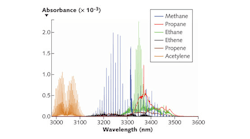
    FIGURE 1. The absorbance spectra are shown for selected hydrocarbons in the 3.0-3.6 µm mid-infrared region. Data are provided by the HITRAN molecular database.
    Tunable diode laser spectroscopy (TDLS) enabled by distributed-feedback (DFB) laser diodes with monomode tuning behavior in the wavelength range exceeding 3 µm expands hydrocarbon...
    Jan. 1, 2012
    FIGURE 1. Three slidar channels, each having a different dispersion, produce three different relative delays, varied by tuning the wavelength of the source. Their dispersions are given in ps/nm.
    A phased-array slow-light detection and ranging ("slidar") setup relies on a tunable laser source and fiber sections that have different dispersions; the result is a fast and ...
    Jan. 1, 2012
    FIGURE 1. A schematic illustrates the optical antenna effect. The yellow arrows represent photon flux, which is “funneled” into the gold-HSQ-gold channel in the near field by the surrounding gold structures.
    Integrated with metallic optical nano-antennae, superconducting-nanowire single-photon detectors become faster and more efficient.
    Jan. 1, 2012
    FIGURE 1. A frequency comb (bottom) is the Fourier transform of a train of modelocked pulses (top). The frequency spacing of the teeth of the comb equals the pulse repetition rate. The spectral bandwidth of the pulse train, which can be enhanced by nonlinear effects, determines the frequency range of the comb. The comb frequencies are an integral multiple of the comb separation, plus an offset frequency, as shown at bottom.
    Born at the cutting edge of ultrafast spectroscopy a dozen years ago, now frequency combs are being developed for applications from astronomy to radar and telecommunications.
    Jan. 1, 2012
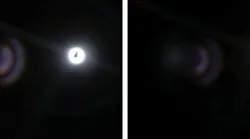
    FIGURE 1. Two images have different stray-light amounts and corresponding average intensities per pixel. The first, with default gamma, has an average intensity per pixel of 12.201 (left); the second, with linear gamma, has an average intensity per pixel of 6.139 (right).
    All imaging optics have stray-light issues, which usually appear as ghost images or reflections from non-optical surfaces that degrade the final image.
    Jan. 1, 2012
    FIGURE 1. Optical fibers are most commonly based on the double-clad fiber geometry (a), commonly with an octagon-shaped inner cladding to increase pump absorption (b).
    Fiber laser performance at the kilowatt power level has been improved by the careful matching of active and passive fibers, which has led to higher-power operation while maintaining...
    Jan. 1, 2012
    (Courtesy of Ondax)
    FIGURE 1. A diagram shows a typical CPA system using either VHGs or dispersive gratings as both the stretcher and compressor. The VHG-based system is an order of magnitude smaller than the dispersive grating configuration. An equivalent FBG-based system would be similar to the VHG configuration with dimensions limited by the minimum bend radius of the fiber.
    Chirped volume holographic gratings offer high damage threshold and an ultracompact footprint for improvements in chirped pulse amplification laser systems.
    Jan. 1, 2012
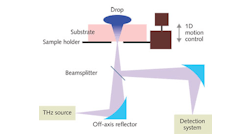
    FIGURE 1. An experimental setup shows the terahertz scanning reflectometer. A fine-pitch, one-dimensional motion control system is used to move the substrate (sample holder) in and out of the focal point while the detection system acquires data in real time. For kinetics measurements, the specimen is kept fixed and focused.
    Smart terahertz scanning reflectometer and spectrometer systems exploit the ability of terahertz radiation to penetrate nonmetallic objects and sense the motions of molecules....
    Jan. 1, 2012
    Conard Holton2
    Since the recession of 2008–09, the swings in global markets have alternately inspired and rattled confidence among manufacturers and users of photonics technologies and products...
    Jan. 1, 2012
    Here’s the latest on the tantalizingly ephemeral Higgs boson. We’re talking about “The Missing Link, The God Particle, etc., etc.” and other significant labels used by the popular...
    Jan. 1, 2012