• Home >
  • Back Issues >
  • Laser Focus World >
  • Volume 53, Issue 09
  • Volume 53, Issue 09

    More content from Volume 53, Issue 09

    (Courtesy of Cambridge Technology)
    FIGURE 1. A high-capacity Cambridge Technology Lincoln Laser aerostatic-bearing polygonal scanner has a partially evacuated optical chamber.
    Repetitive high-speed linear scanning of a laser beam is often best achieved with a spinning polygon mirror.
    Sept. 13, 2017
    FIGURE 1. Parallel- and serial-type active vibration control systems are shown in which the support spring and cancellation actuator are either in parallel or in series.
    New techniques allow air isolator supports to be stacked on active vibration-cancellation hard mounts, creating stable optical tables for sensitive multiphoton imaging and single...
    Sept. 13, 2017
    The TruFlow laser amplifier for extreme-ultraviolet (EUV) applications is an essential part of the next-generation EUV lithography systems using radiation at about 13 nm.
    Peter Leibinger, vice chairman, and Christian Schmitz, president of the laser division, of the TRUMPF Group shared their fascination and thoughts on the past, present, and future...
    Sept. 13, 2017
    As part of DARPA's Neural Engineering System Design (NESD) program, Rice University researchers are developing a thin interface to monitor and stimulate vast numbers of neurons in the brain's outermost layer, the cortex.
    The Neural Engineering System Design (NESD) program, launched in 2016 to facilitate precision communication between the brain and the digital world, has taken a giant step.
    Sept. 13, 2017
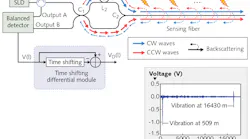
    Using a Sagnac interferometer-based setup and the principles of optical time domain reflectometry (OTDR), a low-cost fiber-optic distributed vibration sensor (a) can be used to sense tiny vibrations along fiber lengths up to 16 km (b).
    Fiber-optic sensors that measure distributed vibration along a length have myriad applications, including oil and gas pipeline monitoring, border security, and structural integrity...
    Sept. 13, 2017
    (Courtesy of Bryan Williams, University of Liverpool)
    After capturing 3D OCT images of the car paint, the metallic flakes are automatically 'extracted' and measured via software algorithms; pictured are the thousands of flakes extracted from a 2.25 × 1.4 mm painted car-panel section.
    Many cars are coated with paint that exhibits a metallic or glittery sheen—the properties of the sheen are determined by the distribution and characteristics of metal or mica ...
    Sept. 13, 2017
    The retrieved depth information is shown for face six of a die from digital holographic reconstruction and phase unwrapping (a), and a typical 3D perspective from tomography maintains depth information in the point cloud (b); the result is a true 3D visualization in a VR environment using HoloLens (c).
    Holography and its promise to create realistic 3D scenes instead of flat 2D images continues to be a major subject of photonics research.
    Sept. 13, 2017
    (Courtesy of Richard Norte)
    An ultralight photonic-crystal (PhC) reflective membrane has been made at sizes up to 1 cm2 ([a], next to bulk optic, and [b], zoomed in next to an optical fiber); the PhC pattern consists of a square array of holes (c).
    A research group is developing and increasing the area of ultralight highly reflective photonic-crystal-based membrane mirrors only nanometers thick.
    Sept. 13, 2017
    Content Dam Lfw Print Articles 2017 09 1709lfw Nb F4
    Researchers have demonstrated the shortest light pulse ever developed, a 53-attosecond (as) x-ray (100-330 eV) flash produced via high-harmonic generation (HHG).
    Sept. 13, 2017
    Content Dam Lfw Print Articles 2017 09 1709lfw Nb F3
    Researchers have succeeded in developing hydrogel optical fibers that are not only flexible and stretchable, but have light-guiding properties that enable their use in biological...
    Sept. 13, 2017
    Content Dam Lfw Print Articles 2017 09 1709lfw Nb F2
    A team of researchers has unveiled a type of Ge laser made from highly tensile-strained nanowires that not only lases, but has a low lasing threshold of about 3.0 kW/cm2 at its...
    Sept. 13, 2017
    Content Dam Lfw Print Articles 2017 09 1709lfw Nb 5
    Researchers have developed a new lensless camera using an 8 x 8 optical phased array (OPA) receiver.
    Sept. 13, 2017
    Content Dam Lfw Print Articles 2017 09 1709lfw Nb 1
    Researchers are using photonics to harness the biological finesse of an actual insect to perform robotic tasks, including pollination, surveillance, or carrying small payloads...
    Sept. 13, 2017
    Conard Holton2
    It may be a stretch to compare an engineer or researcher working in photonics to the owner of your local brewpub -- or maybe not.
    Sept. 13, 2017