• Home >
  • Back Issues >
  • Laser Focus World >
  • Volume 52, Issue 03
  • Volume 52, Issue 03

    More content from Volume 52, Issue 03

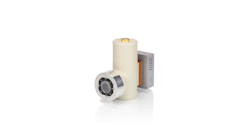
    FIGURE 1. Conventional galvo rotor construction (left) is contrasted with ScannerMAX Saturn rotor construction (right).
    Once built primarily around bulky and expensive krypton lasers, the newest multicolor laser systems have taken advantage of improved scanning systems and advanced software programmabili...
    March 18, 2016
    FIGURE 1. Transmission of 1 Tbit/s using ten 100 Gbit/s channels in 50 GHz slots (a) compared with a 1 Tbit/s superchannel using 10 lasers spaced at 37.5 GHz intervals across a 375 GHz range. The superchannel spans the band without buffer layers shown between the conventional 50 GHz channels (b).
    Superchannels now can transmit hundreds of gigabits/s long-haul distances on standard singlemode fiber. Large mode-area fibers can carry superchannels further and faster, and ...
    March 18, 2016
    (Courtesy of Sill Optics)
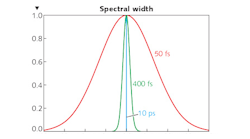
    FIGURE 1. For ultrafast lasers, a formula defines the spectral width of a transform-limited pulse to be a function of the pulse duration.
    Ultrafast laser optics must overcome the unusually amplified obstacles of dispersion, color aberrations, and ghost reflections.
    March 18, 2016
    (Courtesy of IPG Photonics)
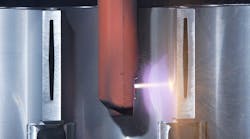
    FIGURE 1. The cylindrical surface of a bore for an automobile engine is micromachined using a 2 kW single-mode fiber laser from IPG Photonics, then sprayed with plasma to create a hard coating that replaces conventional cylinder liners. Laser-machined microgrooves help the resulting coating to adhere to the cylinder.
    Today's high-power CW fiber lasers have become naturals at reliable, capable materials processing.
    March 18, 2016
    FIGURE 1. Shown is a schematic of a microring resonator, commonly used in integrated photonics. This resonator consists of a waveguide formed into a closed ring, which acts as a resonant cavity, and an input/output waveguide. The main design parameters are the ring radius (r), the waveguide widths (w), and the gap (g) between the input/output waveguide and ring.
    Knowing only the desired functionality, 'objective first' software designs smaller, optimized silicon photonic devices.
    March 18, 2016
    Neal Bergano
    Undersea fiber-optic cables enable a connected world and make the Web worldwide.
    March 18, 2016
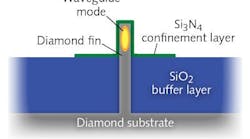
    An example of a fin waveguide in diamond-based integrated photonics shows the physical connection of the light-carrying portion of the diamond waveguide with the diamond substrate. The waveguide by itself in air would be too thin to carry the fundamental mode, but with the addition of a silicon nitride (Si3N4) confinement layer to its upper portion, the upper part of the waveguide can channel light. A low-index SiO2 buffer layer spanning most of the lower portion of the waveguide supports the waveguide, but eliminates any light-carrying modes in the lower portion.
    A new waveguide geometry allows confinement of light and a physical connection with the substrate of the same material.
    March 18, 2016
    (Courtesy of Menlo Systems)
    Thanks to careful engineering, the FOKUS optical frequency-comb module has been launched into space for a second time, performing without error and setting an important precedent for future research.
    The FOKUS instrument from Menlo Systems traveled into space on January 23, 2016.
    March 18, 2016
    (Courtesy of Eleftherios Goulielmakis)
    To create an attosecond optical pulse, a few-femtosecond continuum pulse is spectrally divided into four bands (represented here by colors), each of which is separately compressed using dispersive mirrors. The four pulses are then combined precisely in space and time to produce the final pulse (represented here by white, with the half-cycle temporal pulse shape shown at bottom right).
    A team of researchers has pushed visible-light pulses into the attosecond regime, creating pulses only 380 as long.
    March 18, 2016
    Content Dam Lfw Print Articles 2016 03 1602lfw Nb F3
    Generation of green light from a silicon-on-insulator nanoplasmonic waveguide using third-harmonic generation has been demonstrated.
    March 18, 2016
    Content Dam Lfw Print Articles 2016 03 1603lfw Nb 2
    An artificial laser guide star process is critical for astronomical adaptive optics applications.
    March 18, 2016
    1603 Lfw Nb 3
    The BLAZE Laserlight bike light projects a bright-green image of a bicycle 6 m ahead on the pavement.
    March 18, 2016
    Content Dam Lfw Print Articles 2016 03 1603lfw Nb 1
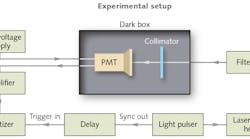
    Photomultiplier tubes (PMTs) are essential components of many scientific and other optical systems.
    March 18, 2016
    Conard Holton2
    Fiber-optic communications technology is so intrinsic to our Internet-enabled, cloud-driven, instant-video world.
    March 18, 2016