Simplify quantum photonics: Visible DFB lasers enable scalable architectures
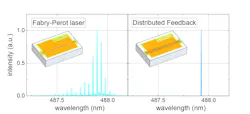
Laser technology is a core enabler across quantum computing, sensing, and communications. Requirements are stringent: Narrow linewidth, low noise, precise wavelength targeting, and long-term stability. Many platforms, including trapped ions, neutral atoms, and atomic sensors, require multiple laser channels aligned to specific transitions.
Historically, these requirements were met through several approaches. External-cavity diode lasers (ECDLs) combined with frequency conversion became a standard laboratory solution. Single-frequency fiber lasers paired with external frequency-doubling cavities are also widely used, particularly for exceptional spectral purity. More recently, visible ECDL systems based on specialized gain media are emerging for direct access to quantum-relevant wavelengths.
While these architectures deliver excellent optical performance, they introduce substantial system complexity. Frequency conversion stages require nonlinear crystals and carefully stabilized build-up cavities that increase the system footprint and are highly sensitive to environmental disturbances. Even when a laser source exhibits excellent frequency stability, the external cavity often becomes the Achilles’ heel of the overall system because it requires active stabilization and periodic maintenance. As systems scale toward dozens or hundreds of optical channels, these challenges become increasingly difficult to manage.
Quantum systems are moving from laboratory demonstrations toward deployable products, and performance is no longer constrained primarily by physics—but instead by the practicality, robustness, and scalability of the laser subsystem.
Architectural constraints
External cavity designs provide narrow linewidth and tunability but require mechanical stability and active control. Frequency conversion extends access to visible wavelengths but adds inefficiencies, alignment overhead, and additional noise sources. These tradeoffs compound in multichannel systems, in which each wavelength path must be individually stabilized. The result is poor scalability. Increasing channel count leads to larger footprints, higher power consumption, and increased calibration effort. Reliability also becomes a limiting factor for applications requiring continuous or field operation.
Visible DFB lasers: Direct emission at quantum wavelengths
indie’s line of visible DFB lasers address these constraints by integrating wavelength selection directly within the semiconductor gain medium. Rather than relying on an external cavity to select a single operating mode, a periodic grating is embedded within the laser itself to enforce single-frequency operation at the source (see Fig. 1). This architecture eliminates mechanically sensitive external cavities and simplifies the overall optical system—providing inherently stable spectral behavior while dramatically reducing component count. Recent advances at indie's Switzerland-based Photonics team (formerly Exalos; acquired by indie in 2023) extended our DFB technology into the visible spectrum using gallium nitride (GaN)-based materials.1 Devices now cover wavelengths from ~375 nm to 535 nm (see Fig. 2), and target key transitions for ytterbium, cesium, rubidium, strontium, and barium ions—central to many quantum platforms.
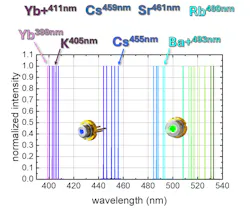
Direct emission removes the need for nonlinear optics, which reduces insertion loss and simplifies system design. Output powers of tens of milliwatts—scalable with semiconductor amplification—are sufficient for many cooling, trapping, and readout applications. When higher powers are required, semiconductor optical amplifiers (SOAs) can scale output power into the single-watt range and preserve the spectral characteristics of the seed laser. It provides a compact alternative to bulk optical amplification schemes.2
Benchmarking: DFB vs. ECDL + SHG architectures
The differences between visible DFB lasers and ECDLs plus second-harmonic generation (SHG) systems are best understood at the system level (see table).
System-level comparison of visible DFB lasers and ECDL + SHG architectures
ECDL plus SHG systems remain advantageous for maximum tunability and ultranarrow linewidths. Fiber laser plus SHG architectures offer excellent frequency stability but inherit many of the same challenges associated with external frequency-doubling cavities. Visible ECDL systems eliminate some conversion complexity but still rely on external cavity stabilization.
Unfortunately, they all scale poorly. In contrast, DFB lasers trade some tunability for substantial gains in simplicity, robustness, and manufacturability. For deployable quantum systems, these advantages often outweigh the benefits of extreme tunability.
Spectral performance and mode-hop-free tuning
Visible DFB lasers provide intrinsic single-frequency emission with linewidths below 1 MHz and side-mode suppression above 40 dB. Mode-hop-free tuning is achieved through temperature and current control. Temperature tuning enables coarse alignment (~10–20 pm/K), while current modulation provides fine and fast adjustment (see Fig. 3).
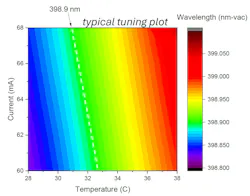
While sub-megahertz linewidths satisfy many quantum operations, some reference sources require even greater coherence. Hybrid architectures that combine DFB lasers with photonic integrated circuits (PICs) are attracting significant interest. Integrated resonators, stabilization structures, and optical feedback elements can further narrow effective linewidth of semiconductor technologies.3 Such approaches may ultimately provide a path toward highly scalable quantum systems built from standardized laser and photonic building blocks.
Unlike external cavity systems, this approach avoids mechanical tuning elements. The absence of mode hops across the usable range simplifies system control and reduces the need for active feedback, which is particularly beneficial for cooling or trapping sequence applications that require dynamic frequency sweeps.
Reliability and operational stability
Reliability is critical for deployable quantum systems. Semiconductor DFB lasers benefit from established manufacturing and reliability models. Lifetime testing indicates stable operation of more than 10,000 hours under constant power, with moderate current increase over time. Eliminating external cavities also improves robustness against vibration and temperature variation. These characteristics enable use in compact field-deployed systems for which environmental control is limited.
Manufacturing scalability
A key advantage of DFB technology is compatibility with wafer-scale semiconductor processing. Using metal-organic chemical vapor deposition (MOCVD)-grown GaN substrates, devices can be produced with high uniformity and throughput. Production volumes of millions of devices per year are feasible, with wavelength control typically within ±1 nm across wafers. It enables standardized components and scalable multichannel architectures.
Implications for quantum systems
Simplified laser subsystems directly impact system scalability. In quantum computing, reduced optical complexity enables expansion toward larger qubit counts. For sensing, compact and robust sources support deployment in real-world environments. For communications, manufacturable components enable practical quantum network infrastructure. The broader trend is clear: As quantum technologies transition from research instruments to engineered products, laser architectures must evolve from precision laboratory assemblies toward scalable semiconductor platforms.
Laser subsystem complexity has been a persistent constraint in quantum system design. ECDL, fiber laser, and frequency-converted architectures deliver high performance but often impose penalties in size, complexity, and operational robustness.
Visible DFB lasers offer an alternative approach by integrating wavelength selection directly within the semiconductor source. Combined with semiconductor amplification and photonic integration, they provide a viable path toward scalable quantum photonics. As quantum technologies transition from demonstrations to commercial systems, the ability to replace complex optical assemblies with compact manufacturable semiconductor devices may prove as important as any advance in the quantum hardware itself.
REFERENCES
1. M. Rossetti, M. Malinverni, A. Castiglia, and M. Duelk, Proc. SPIE, 13912, 1391209 (Mar. 5, 2026); https://doi.org/10.1117/12.3080363.
2. M. Malinverni, M. Rossetti, A. Castiglia, and M. Duelk, Proc. SPIE, 13912, 139120A (Mar. 5, 2026); https://doi.org/10.1117/12.3081262.
3. G. Perin et al., Proc. SPIE, PC14090, PC140900A (May 28, 2026); https://doi.org/10.1117/12.3099267.
About the Author
Philipp Vorreau
Philipp Vorreau is VP and general manager of the SLEDs Photonics Division at indie (based in Schlieren, Switzerland).
Marco Rossetti
Marco Rossetti, Ph.D., is R&D manager at indie (based in Schlieren, Switzerland), and was a graduate student at Ecole Polytechnique Fédérale de Lausanne (EPFL)’s Institute of Photonics and Quantum Electronics (Lausanne, Switzerland).
Marcus Duelk
Marcus Duelk is VP of R&D at indie (based in Schlieren, Switzerland).