Thorlabs Inc

56 Sparta Ave
Newton, NJ 07860
United States
973-579-7227
973-300-3600
1200

More Info on Thorlabs Inc

Thorlabs designs and manufactures system-level solutions as well as building-blocks for the industry, including optomechanics, motion control, optical components, fiber, lasers, optoelectronics, and imaging components in our 20,000 product catalog.

Products

The Quantalux sCMOS camera offers extremely low read noise of
ZBLAN and Indium Fluoride fiber optics for transmission up to 5.5 microns.
Ti:Sapphire laser with one of the broadest spectra commercially available
Femtosecond fiber laser with >500 mW at 2 microns
Femtosecond-pumped mid-infrared supercontinuum source

Podcasts

© Endeavor Business Media
lfw_ftpjennifer_cablegraphicsocmed
Following the Photons: A Photonics Podcast
This episode of Following the Photons: A Photonics Podcast features Jennifer Cable, president of Thorlabs.

Articles

(Photo credit: Justine Murphy/Endeavor Business Media)
Jennifer Cable, president of Thorlabs, sat down with Laser Focus World Editor in Chief Peter Fretty to discuss how Thorlabs continues to successfully navigate an evolving marketplace.
Jennifer Cable sits down with Laser Focus World to discuss the Thorlabs culture and efforts to build a skilled workforce.
(Courtesy of R. Kato/Tokushima University)
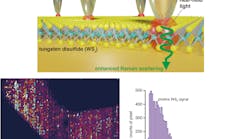
In a schematic of a robust, long-duration TERS imaging technique, a metallic nanotip images several points in a large area of a WS2 monolayer placed on a gold thin film (a). A superposition of two different intensity images, pure WS2 at 422 cm-1 and defect scattering of WS2 at 410 cm-1, reveals a high density of nanoscale protrusions in a large-area far-field confocal Raman image (b). A histogram of the same modes shows a defect density of 5.2% in the WS2 sample (c).
Advances in tip-enhanced Raman spectroscopy (TERS) can improve spatial resolution and stability, enabling longer imaging and spectroscopic characterization of sub-diffraction-...
Photo 154741952 © Pop Nukoonrat | Dreamstime.com
Dreamstime Xl 154741952
The Lasers & Photonics Marketplace Seminar rounded out the day with a panel discussion, moderated by John Dexheimer, president of LightWave Advisors.
American Chemical Society
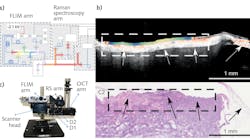
A new multimodal tool combines OCT, fluorescence lifetime (FLIM) imaging, and Raman spectroscopy for rapid and efficient diagnosis (a); the FLIM and OCT data is also shown, with image details correlated with histology results (b).
A newly developed imaging tool combines optical coherence tomography (OCT), Raman spectroscopy, and fluorescence lifetime imaging (FLIM) in a single multimodal scanning microscope...
(Photo 91795514 © Ivelinr | Dreamstime.com)
Dreamstime M 91795514
Jennifer succeeds her father Alex Cable, who founded the photonics equipment company in 1989.
(Image credit: J. Zhang, MIT)
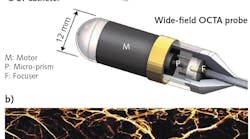
Fiber-coupled endoscopic probes scan surrounding tissue at high rates, enabled by a megahertz-range MEMS-VCSEL variable wavelength source (a). The high rates enable angiographic imaging without administering any contrast agent, as in the image of swine esophagus vasculature shown here (b).
Optical interferometry is accurate and noninvasive, making optical coherence tomography (OCT) a valuable clinical diagnostic tool.
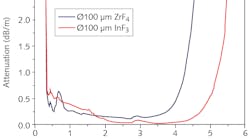
FIGURE 1. Attenuation of optical fibers made of fluoride glasses, showing a significantly wider transmission window into the mid-IR as compared to silica fibers. Indium fluoride (InF3) glass has a wider transmission window in the mid-IR than zirconium fluoride (ZrF4) glass.
A commercially available mid-IR supercontinuum source has a broadband output from 1.3 to 4.5 μm, providing orders-of-magnitude higher brightness than thermal IR sources.
Thorlabs
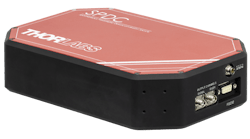
A Correlated Photon-Pair Source produces >450 kHz photon pairs at 810 nm.
(Image credit: Nanjing University)
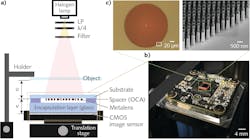
FIGURE 1. Device architecture and metalens fabrication: a schematic of the optical setup for MIID (a), a photograph of the highly compact MIID (b), and a top-view optical microscope image and side-view SEM image of the fabricated α-Si metalens with a diameter of 200 μm (c).
Researchers at Nanjing University have developed a metalens-integrated imaging device (MIID) and centimeter-scale microscopic imaging prototype that breaks FOV constraints.
Thorlabs
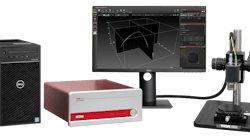
The Atria swept-source optical coherence tomography (OCT) system produces wavelengths centered at 1060 nm and comes in 60 and 200 kHz versions.

Buyer’s Guide Listing Information

Click here for listing information and directions on how to add or update your company.

Request More Information From Thorlabs Inc

By clicking above, I agree to Endeavor Business Media's Terms of Service and consent to receive promotional communications from Endeavor, its affiliates, and partners per its Privacy Notice. I also understand my personal information will be shared with the sponsor of this content, who may contact me about their offerings per their privacy policy. I can unsubscribe anytime.

Additional content from Thorlabs Inc

(Images: University of Texas)
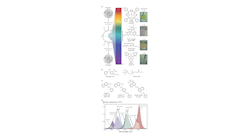
FIGURE 1. Visible light curing, with the general mechanism (oxidative quenching) for a three-component system (left) and chemical structures of photoinitiator (PI) and photoredox catalysts (PRCs), and corresponding pictures of photocured films with qualitative gel times (right) all shown (a). Chemical structures of iodonium acceptor (A) and borate donor (D) coinitiators (b); chemical structures of opaquing agents (OAs) (c); and photons absorbed vs. wavelength for PI and PRC compounds at optimal photocuring concentration (d) are also shown. OA at 0.5 mM (red) and 1 mM (green, blue, and violet). Light exposure was from calibrated violet (405 nm), blue (460 nm), green (525 nm), and red (615 nm) LEDs at the DLP 3D printer image plane.
Researchers at The University of Texas, Austin have developed novel photopolymer resins that contain a three-component light-reactive system to enable rapid and efficient curing...
(Image credit: ANU)
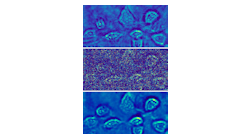
A hologram of fibroblast cells taken at a light intensity substantially above the shot-noise limit has relatively low noise (top). A shot-noise-limited hologram of the fibroblast cells has obvious high noise (center). A Holo-UNet-restored shot-noise-limited hologram has an image quality comparable to the hologram taken at a high intensity. These images are stills from an ANU video that can be found at https://youtu.be/nNkcdZsveHQ.
Quantitative phase microscopy (QPM) systems operating under low light to preserve cells can now have high-quality digital-holographic images, thanks to machine learning.
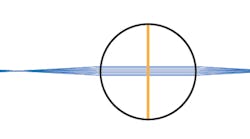
A ball lens with a small pass-band-creating air gap (center) can be rotated to move the passband across a large spectral region; here, the ball lens is part of an optical system that can be used in hyperspectral imaging.
Based on frustrated total internal reflection, a tunable filter is compact, has a large range, and can be easily designed into optical systems.
Chrolis L
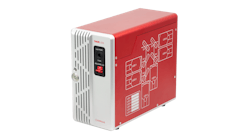
The Chrolis six-color light engine for fluorescence excitation applications features a configurable design.
Thorlabs
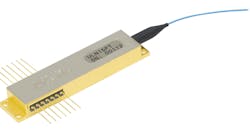
The ULN15PT 1550 nm ultra-low-noise semiconductor laser from Thorlabs provides output power >100 mW.
Thorlabs
MicroSpot focusing objectives are designed for UV excimer lasers and other UV sources in on-axis laser focusing and microimaging applications.
University of South Carolina
Thomas Crawford parlayed his research experience with disk drive technology into a startup company that eventually caught the eye of Thorlabs
Acquisition by Thorlabs facilitates continued university-industry partnership in Columbia, SC.
Coda Devices
The Thorlabs acquisition of Coda Devices will include Coda’s portable Raman spectroscopy products, such as this analyzer that can detect heroin and fentanyl inside clear baggies, protecting the lives of first responders who can avoid direct contact with unknown substances.
The companies will work together to expand the market reach of Coda Devices' coded-aperture Raman Spectroscopy techniques.
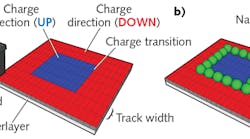
FIGURE 1. A schematic depicts the MagAssemble pattern writing process, in which the write head rasters back and forth across the perpendicular magnetic recording medium within each track. By selectively changing the magnetic-field direction of each bit, the charge transition boundaries create a custom 2D template (a). When the template is introduced into a magnetic nanoparticle solution, nanoparticles self-assemble along the magnetic charge transitions (b).
Programmable self-assembly of nanoparticle patterns enables a low-cost platform for nanoscale to mesoscale structures such as life-science substrates, custom diffraction gratings...
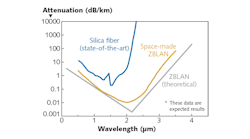
FIGURE 1. The attenuation curve of state-of-the-art, telecommunications-grade silica fiber is contrasted with space-produced ZBLAN and the theoretical ZBLAN attenuation.
Alternatives to relatively high loss silica optical fibers like ZBLAN have historically been limited by the confines of gravity fed manufacturing processes. However, this could...

Norland develops UV curing adhesives and interferometric test equipment for the fiber-optic industry.
Content Dam Lfw Online Articles 2018 09 Thorlabs
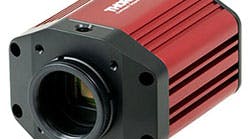
CS505 scientific cameras offer pixel count of 2448 × 2048 and quantum efficiency of 79% at 600 nm with