• Home >
  • Back Issues >
  • Laser Focus World >
  • Volume 58, Issue 09
  • Volume 58, Issue 09

    More content from Volume 58, Issue 09

    (Courtesy of Illumina)
    FIGURE 1. Photonics technologies continue bringing DNA sequencing to new heights.
    Armed with a full map of humans’ genetic makeup and DNA, researchers and clinicians are identifying and treating diseases like never before.
    Aug. 15, 2022
    (Photo credit: The Boubacar Kanté group)
    FIGURE 1. Dr. Wayesh Qarony, Rushin Contractor, Emma Martin, Professor Boubacar Kanté, and Dr. Walid Redjem in the lab.
    A 60-year-old roadblock about how to increase the power of surface-emitting lasers is gone—and it may enable more powerful lasers to cover longer distances.
    Aug. 12, 2022
    This all-perovskite solar tandem cell was created by Karlsruhe Institute of Technology researchers via fully scalable deposition models.
    In a photovoltaics advance, researchers in Germany create a prototype for upscaling high-efficiency two-terminal all-perovskite tandem solar cells with fully scalable deposition...
    Aug. 11, 2022
    (Courtesy of R. Kato/Tokushima University)
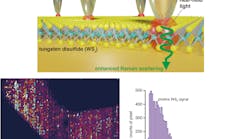
    In a schematic of a robust, long-duration TERS imaging technique, a metallic nanotip images several points in a large area of a WS2 monolayer placed on a gold thin film (a). A superposition of two different intensity images, pure WS2 at 422 cm-1 and defect scattering of WS2 at 410 cm-1, reveals a high density of nanoscale protrusions in a large-area far-field confocal Raman image (b). A histogram of the same modes shows a defect density of 5.2% in the WS2 sample (c).
    Advances in tip-enhanced Raman spectroscopy (TERS) can improve spatial resolution and stability, enabling longer imaging and spectroscopic characterization of sub-diffraction-...
    Aug. 10, 2022
    Photo 188715343 © Josepalbert13 | Dreamstime.com
    Dreamstime Xl 188715343
    Over the past few months, we have spent a considerable amount of time and energy revisiting our newsletter process with the goal of aligning our newsletter strategy with our evolving...
    Aug. 10, 2022
    Photo 131649246 © Designer491 | Dreamstime.com

    Dreamstime Xl 131649246
    LightPath CEO Sam Rubin discusses the company’s approach to an evolving industry.
    Aug. 9, 2022
    (Courtesy of L. Fu et al.)
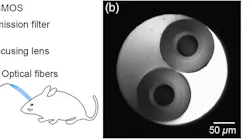
    FIGURE 1. The construction of a multichannel fiber photometry system. A light beam from a 488 nm laser is coupled into all multimode fibers simultaneously by an objective. The emitted fluorescence is then collected by the same optical fibers and detected by a sCMOS camera (a). The fiber end faces on the sCMOS camera for the dual-channel mode (b) and four-channel mode (c).
    Increasingly preferred over conventional brain imaging techniques, optical fiber photometry is allowing a better a grasp of the brain’s innerworkings. But this is only the beginning...
    Aug. 9, 2022
    FIGURE 1. Absorption of laser radiation in various materials at room temperature [1, 2].
    Higher output power optimizes joining processes in new application areas.
    Aug. 5, 2022
    2209 Lfw Fip F 62ea6df874f12
    Meet Kathleen A. Richardson, Pegasus Professor of Optics & Photonics, Materials Science, and Engineering at the University of Central Florida’s Center for Research and Education...
    Aug. 3, 2022
    (Courtesy of Xianchuang Zheng, Jinan University Institute of Nanophotonics/Adapted from ACS Central Science 2022)
    FIGURE 1. The neutrophil microcraft can carry a nanoparticle, bypass an obstacle, and then deliver it to a targeted position.
    A new technique combining scanning optical tweezers and acousto-optic deflectors could lead to development of natural, biocompatible microcrafts in the body.
    Aug. 2, 2022
    (Photo credit: Tibor Nemeth)
    Professor Maiken Mikkelsen in her lab at Duke University, where the experiments were performed.
    A new fabrication approach combines colloidal chemistry with traditional deposition techniques to create surfaces with precise nanoscale dimensions—given by nanoparticles—over...
    Aug. 1, 2022
    (Courtesy of University of Adelaide, Australia)
    FIGURE 1. An imaging needle (outer diameter: 0.57 mm), capable of acquiring optical coherence tomography and fluorescence images through a single optical fiber.
    A tiny probe that produces different imaging types could make cancer surgeries more effective and improve outcomes.
    July 29, 2022
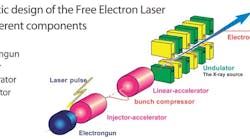
    FIGURE 1. Schematic design of the free-electron laser with different components.
    SwissFEL enables unprecedented insights into structures and ultrafast processes in action and at the nanoscale.
    July 22, 2022