• Home >
  • Back Issues >
  • Laser Focus World >
  • Volume 46, Issue 8
  • Volume 46, Issue 8

    More content from Volume 46, Issue 8

    In optical communications and other semiconductor-laser-based systems, testing the impact of laser linewidth at the source used to require purchase of several different lasers...
    Aug. 1, 2010
    FIGURE 1. Reflective optics can image a broad spectral range without chromatic aberration using only two mirrors and a supporting structure.
    Reflective optical systems can handle high power across a broad wavelength spectrum and may provide a less complex and lower-cost alternative to refractive systems.
    Aug. 1, 2010
    FIGURE 1. Photovoltaic efficiency in converting light into electricity has improved steadily since the mid-1970s, as tabulated by the National Renewable Energy Laboratory (NREL; Golden, CO). Measurements are for laboratory devices using solar simulators under comparable conditions.
    Solar cell performance has been improving slowly for years. Now developers are exploring new designs and structures, which they hope can give a big boost to energy conversion ...
    Aug. 1, 2010
    (Courtesy of QED Technologies)
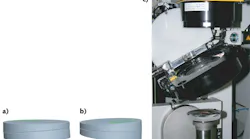
    FIGURE 1. Two counter-rotating optical wedges (a and b) are at the heart of a VON assembly (c). The relative angular position of the wedges can be changed, and the wedges can be tilted as a unit, to introduce varying amounts of astigmatism and coma.
    Removing astigmatism and coma with a variable optical null allows an aspheric stitching interferometer to measure surfaces with departures up to 1000 waves from the best-fit sphere...
    Aug. 1, 2010
    (Courtesy of Rensselaer Polytechnic Institute)
    The terahertz radiation-enhanced emission of fluorescence (THz-REEF) technique enables measurement of the absorption spectra of 4-Amino-2, 6-dinitrotolune (4A-DNT).
    Although many time-domain terahertz-wave detection techniques have been developed, high ambient-moisture absorption rules out "remote" terahertz sensing, shutting out a host of...
    Aug. 1, 2010
    (Courtesy of A*STAR)
    FIGURE 1. A schematic illustration shows a waveguide-integrated germanium/silicon (Ge/Si) avalanche photodetector (APD).
    Made with readily available group IV germanium and silicon materials, a CMOS-compatible waveguide-integrated avalanche photodiode offers a gain-bandwidth of 105 GHz, extending...
    Aug. 1, 2010
    (Courtesy of Caltech)
    Photon-induced near-field electron microscopy (PINEM) images show a protein vesicle at t = 0 fs, t = 200 fs, and t = 1 ps (a). A transmission electron microscopy (TEM) image of an E. coli cell (b, left) is contrasted with a label-free (no contrast agents used) image of the same cell using PINEM (b, right) at a magnification of 19,000X.
    Transmission electron microscopy (TEM) continues to be a powerful imaging tool at the nanometer scale and below.
    Aug. 1, 2010
    (Courtesy of Eleftherios Goulielmakis)
    In a vacuum chamber, a quasi-static gas cell filled with neon triples the frequency of a broadband ultrafast IR-laser pulse.
    Femtosecond and attosecond light pulses are now allowing scientists to deeply explore the workings of atoms, molecules, and nanoparticles.
    Aug. 1, 2010
    In the course of my research of suitable science books for your summer reading, I came across a list of books that have been entered for the British Royal Society's annual prize...
    Aug. 1, 2010
    (Courtesy of Tim Wilkinson)
    Maskless holographic lithography produces a photoresist image (b) of a black-and-white representation of the University of Cambridge's crest (a).
    The hunt for the next big thing–or small thing–in lithography could do away with photomasks in favor of holograms, according to researchers at the University of Cambridge (England...
    Aug. 1, 2010
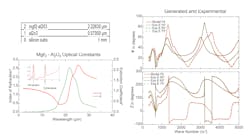
    FIGURE 1. Shown here are the optical model (a), generated and experimental ψ-Δ fits (b), and n(λ) and k(λ) for the polymer film (c). The inset shows k(λ) for 2 to 10 mm. Absorptions at ~3 and 6 mm indicate the presence of water in the film.
    Modern IR-spectroscopic ellipsometry instruments and data analysis software provide accurate and repeatable thickness and optical property measurements of substrates and film ...
    Aug. 1, 2010
    (Courtesy of Shizuoka University)
    A thin-film reflectance coating is the basis of an emissivity-modulated layer (inset shows a cross-sectional transmission-electron-microscope image) that shifts radiation toward the visible as shown in the plot of reflectance versus wavelength.
    Just when you thought incandescent light bulbs were dead, researchers have modified the blackbody radiation of an incandescent bulb, demonstrating the possibility of 95% electric...
    Aug. 1, 2010
    81127
    By any measure, last month's SEMICON West event in San Francisco, CA provided a welcome boost to photonics market watchers.
    Aug. 1, 2010
    (Courtesy of Heriot Watt University)
    A spoke target is imaged both in focus (top row) and 0.5 m out of focus (bottom row) with a 300 mm telephoto lens. Counter-rotating cubic phase plates placed in front of the lens vary the cubic phase shift from zero (at 60º plate angle) to a maximum (at 45º plate angle). For this particular lens and focal range, a 55º position is best.
    An optical technique called "wavefront coding," invented by Ed Dowski and Thomas Cathey at the University of Colorado (Boulder, CO) in the mid-1990s, provides a simple, effective...
    Aug. 1, 2010