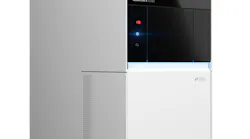
Nanoscribe, part of the Lab14 Group, offers high-resolution 3D printers and grayscale lithography systems that bridge the gap between laboratory research and industrial production. With the versatile Quantum X product line, users can access modular, customizable solutions for nano- and microfabrication. From 3D bioprinting for life sciences to aligned 3D micro-optics manufacturing for photonics packaging.
At Nanoscribe, we develop high-performance photoresins tailored to Two-Photon Polymerization (2PP) and Two-Photon Grayscale Lithography (2GL®). Engineered for resolution, ...
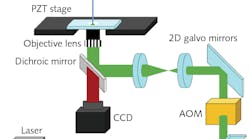
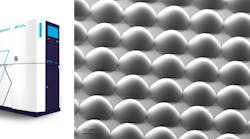
Quantum X litho is the world’s first system for Two-Photon Grayscale Lithography (2GL®), designed for the fabrication of 2.5D, or planar, micro-optics. This maskless...
Quantum X bio is a versatile, high-resolution 3D bioprinter based on Two-Photon Polymerization (2PP). It enables the fabrication of intricate structures from subcellular ...
Quantum X shape is a configurable high-resolution 3D printer based on Two-Photon Polymerization (2PP). It combines ultimate flexibility with submicron accuracy for rapid ...
Quantum X align is Nanoscribe’s high-precision 3D optics printer, engineered for the direct fabrication of microoptical components on photonic chips and optical fibers...
Nanoscribe, a global leader in high-precision 3D microfabrication, has secured multiple orders in Q1 2026 for its Quantum X systems from three internationally leading organizations...
IPX-Clear photoresin for high-precision micro-optics is optimized for 3D printing by 2GL technology and compatible with two-photon polymerization. The material achieves transparency...
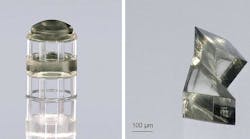
The Quantum X align lithographic-based 3D printer enables auto-aligned printing of freeform micro-optical elements directly onto optical fibers and photonic chips.
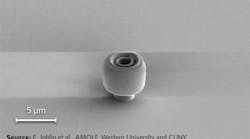
Using two-photon direct laser writing, a microscopic asphere is fabricated on the fiber tip of a fiber-optic microendoscope; the lens is aberration-free.
The novel photonic integrated technology is expected to bring optical coherence tomography (OCT) from stationary clinical use to broader, mobile use in ophthalmic care.
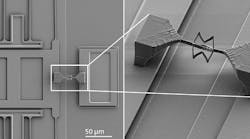
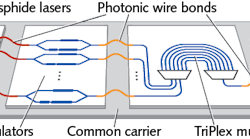
Ultrafast-laser-written free-space photonic wire bonds connect III-V laser diodes on one chip with silicon photonics on another chip with an insertion loss of 0.4 dB.
When common additive manufacturing (3D printing) technologies like stereolithography reach their limitations in resolution, 3D laser lithography achieves its full potential in...
Integrated photonics can be written in glass via nonlinear absorption by focusing a short-pulse-duration laser into the glass; quantum-integrated-photonics (QIP) devices are being...
Among the papers that the organizers of the Cell Bio show (the American Society for Cell Biology annual meeting, Dec. 13-17, 2008) chose to highlight for journalists covering ...