Meet quantum laser company Vexlum and its CEO Jussi-Pekka Penttinen
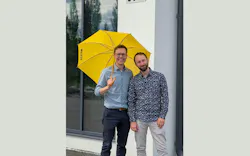
Vexlum recently opened a R&D lab in London to meet a surge in demand for its VXL laser system for neutral atom and trapped-ion quantum computing approaches in the U.K. The new lab will support the company’s mission to provide high-power laser engines at any wavelength, and enable laser development, testing, and validation for its customers. Stefan Truppe, an associate professor of physics at Imperial College London who’s known for his pioneering work with deep ultraviolet lasers for cooling gases of atoms and diatomic molecules to near absolute zero, is its managing director and will focus on strategic growth and industrial partnerships.
Laser Focus World: Can you introduce us to the company?
Jussi-Pekka Penttinen: Vexlum is a deep-tech company that specializes in high-power, single-frequency semiconductor laser systems based on our proprietary vertical-external-cavity surface-emitting laser (VECSEL) technology. Spun out from Tampere University in Finland, we develop and manufacture lasers that offer unmatched performance in system size, power, and cost for demanding applications in quantum technology, medicine, scientific research, and the semiconductor industry.
LFW: Can you give us an idea of the number of lasers/types needed for various quantum approaches?
Penttinen: Neutral strontium illustrates just how laser-intensive atom-based quantum systems can be. A typical setup needs at least five wavelengths: High-power 461-nm light for initial cooling, a sub-kilohertz 689-nm laser for narrow-line cooling, a sub-hertz 698-nm clock laser, and re-pumpers at 679 nm and 707 nm. The VEQTOR project, led by Vexlum and Menlo Systems, consolidates these functions into a modular 19-inch rack, which replaces several separate laser systems with a compact turnkey platform. This is also a key focus for our U.K. R&D office, where we work closely with university groups, quantum companies, and other stakeholders to develop compact and rugged photonics engines tailored to each application’s specific requirements.
LFW: How does Vexlum differentiate itself within the quantum realm?
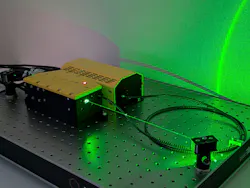
Penttinen: By eliminating the infrastructure bottleneck holding back quantum scaling. Vexlum’s VECSEL architecture consolidates bulky laboratory laser setups into a rugged, roughly 2-L platform—a tenfold reduction in volume—while still delivering the watt-level power, ultralow noise, and wavelength flexibility (UV to infrared) needed to precisely manipulate atomic qubits. The key distinction isn’t simply miniaturization but also retaining demanding laser performance while reducing system size, complexity, and alignment requirements.
LFW: How critical is it to get a supply chain in place for quantum ecosystems now?
Penttinen: It’s essential. Quantum architectures are maturing rapidly, but the supporting hardware still depends heavily on bespoke components, small production volumes, and a limited number of specialist suppliers. Long lead times or the loss of a single source can delay an entire program. Building a resilient supply chain now is what allows the sector to move from one-off laboratory demonstrations to repeatable, manufacturable, and commercially deployable systems.
LFW: What are the biggest challenges with establishing a supply chain?
Penttinen: The main challenge is the continued reliance on custom or one-off hardware assembled from many different suppliers. A delay or specification change in a single component can hold up the entire system, and limited standardization makes it difficult to reproduce successful designs at scale. Our London R&D office addresses this directly by placing laser and photonics development close to the U.K. quantum community. Working alongside end users lets us incorporate feedback early, define shared interfaces, and turn highly specialized laboratory solutions into reliable standardized modules.
LFW: Most intriguing things you’re seeing emerge within the quantum realm?
Penttinen: Three developments stand out to me. In quantum processing, dynamic neutral-atom tweezer arrays can now rearrange qubits during a computation, which enables nonlocal connectivity and potentially reduces the physical-qubit overhead required for fault-tolerant error correction. In quantum simulation, ultracold polar molecules are particularly exciting because their strong, long-range dipolar interactions offer a natural route to emulating complex quantum materials without relying entirely on elaborate artificial control sequences. Meanwhile, quantum sensing is moving beyond the optical table and cold-atom systems are being developed as compact rugged instruments for navigation, gravimetry, and field measurements. Together, these advances point to a broader shift: Using the underlying physics more intelligently while engineering quantum systems that are practical, reliable, and deployable.