The lost art of nomography is reborn through AI
Innovation rarely begins with a fully formed invention. It begins with exploration—moving through a design space, testing relationships, noticing sensitivities, and asking what changes when one variable is pushed while another is held fixed. Nomographs are powerful for this kind of inventive thinking because they turn equations into visible landscapes. Rather than producing only a single answer, they reveal tradeoffs, nonlinear behavior, equivalent solutions, and regions of opportunity that can remain hidden in a spreadsheet or simulation. For an inventor, a nomograph is more than a calculator—it’s an exploration instrument. Artificial intelligence (AI) is now making this once labor-intensive tool practical again.
Introduction to nomographs
A nomograph, or nomogram, is a graphical calculating device.1-3 By placing a straightedge across specially arranged scales, a user can solve an equation visually and read the result where the line intersects with another scale. Once constructed correctly, even a fairly complicated relationship can often be evaluated in seconds.
Before electronic calculators and digital computers became ubiquitous, nomographs were used across engineering, science, medicine, navigation, and industry for fluid flow, electrical design, structural loading, ballistics, optics, dosage, and manufacturing. A good nomograph could replace pages of arithmetic, logarithm tables, or repeated slide-rule work.
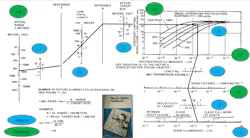
A favorite example of mine appears in the RCA Electro-Optics Handbook, first published in 1968. The annotated Figure 1 presents an 11-dimensional model of an electro-optical image-intensifier system (see Fig. 1). Seven design inputs—including characteristics of a nighttime scene—combine to produce four performance metrics, among them limiting visual range. For both the electro-optics (EO) designer and the system user, it’s a practical calculator and a compact visual map of system behavior.
The modern mathematical development of nomography is generally credited to French engineer Maurice d’Ocagne, who formalized the discipline in the late nineteenth century. Through much of the twentieth century, nomographs appeared routinely in engineering handbooks and operating guides because they were portable, required no power, and reduced repetitive calculation.
Unlike an ordinary graph, a nomograph uses deliberately transformed scales—linear, logarithmic, reciprocal, or otherwise—so that a straightedge connecting known values intersects the corresponding unknown value. The geometry of the chart encodes the governing equation.
The optical example developed here follows that tradition by combining the Thin Lens Equation, image magnification, and object-space depth of field into a single graphical calculation.
AI and the nomography revival
Nomographs faded from engineering practice not because they stopped being useful but because rigorous ones were difficult to construct. Development could require coordinate transformations, logarithmic and reciprocal scaling, projective geometry, careful layout, and painstaking drafting. Calculators, spreadsheets, and simulation tools naturally displaced them.
AI changes this equation. AI-assisted derivation and rendering can help transform governing equations into scale functions, arrange linked axes, generate artwork, and test the construction numerically. The engineer still owns the physical model, assumptions, operating limits, and interpretation; AI reduces the mathematical and drafting burden.
That makes nomography practical again as a complement to simulation and experimentation—a visual way to explore a design space rather than only calculate isolated operating points.
AI-assisted nomography
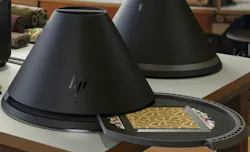
A six-axis optical nomograph developed for HP Z Captis demonstrates this workflow (see Fig. 2). I served as the EO architect and designer for Captis, where optical geometry, working distance, sensor placement, magnification, aperture, and depth of field are closely interdependent. Changing one parameter can affect several others. A conventional calculation determines a single operating point, but it does not necessarily show how the system responds as these variables change.
The integrated Captis nomograph places six key variables on one chart:
- object distance, do;
- focal length, f;
- image distance, di;
- image magnification, | m |;
- total object-space depth of field;
- lens f-number, N.
These variables are connected through three governing optical relationships. The first is the Thin Lens Equation,

which connects object distance, focal length, and required sensor-to-lens image distance. The second relationship,

connects focal length, image distance, and magnification. The third estimates geometrical object-space depth of field:

where c is the selected acceptable circle of confusion.
These three relationships can’t all be represented accurately with ordinary linear scales. The Thin Lens Equation is naturally handled with reciprocal scales, while magnification and depth of field require logarithmic and specially transformed scales. AI-assisted derivation and rendering made it practical to develop these coordinate systems, combine them in one six-axis chart, and numerically test their alignment. The result retains the intuitive straightedge operation of a traditional nomograph while incorporating several mathematically distinct optical relationships.
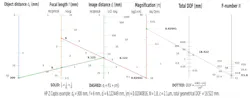
For the illustrated Captis operating condition (300-mm object distance, 6.0-mm focal length, f/1.8, and an assumed acceptable circle of confusion of 2.1 μm), the nomograph gives an image distance of approximately

a magnification of

and a total object-space depth of field of approximately

An independent near- and far-focus calculation gives a total depth of field of about 18.528 mm, differing from the nomograph by only about 0.006 mm. The graphical transformations were also evaluated across thousands of randomized optical cases, with collinearity residuals near numerical machine precision. This validation is essential because an attractive nomograph is useful only if its scales and alignment rules faithfully reproduce the governing equations.
The greater value is not that the nomograph reproduces one calculated answer. It lets the engineer see how the design behaves. Transformed scales show that depth of field is strongly dependent on magnification; even a modest increase can sharply reduce acceptable focus range. Increasing f-number increases depth of field, while working distance affects both image position and magnification. These sensitivities are in the equations, but become more intuitive when displayed together.
AI made the iterative derivation, graphical construction, numerical verification, and refinement practical, while the physical model and engineering interpretation remained the engineer’s responsibility. The resulting Captis nomograph is shown in Figure 3.
My Captis example points to a broader opportunity. Similar multivariable relationships occur in thermal resistance and airflow, pressure drop and fluid flow, acoustics, structural loading, optical resolution, electrical power, and manufacturing tolerances. Wherever coupled equations define a useful design space, AI-assisted nomography offers another way to explore and communicate it.
It comes with an important limitation. This nomograph uses the Thin Lens Equation as a first-order representation of Captis. The production camera uses a sophisticated 7P lens assembly, so a complete optical prescription would predict imaging performance more accurately. The nomograph is therefore an exploration and design tool, not a substitute for the full optical model.
AI can restore nomography to the engineer’s and inventor’s toolbox. A graphical method that once demanded specialized knowledge and days or weeks of derivation and drafting can now be developed, tested, and refined far more rapidly.
This is the larger opportunity. We already have excellent tools for solving equations. AI-assisted nomography is valuable because it can help engineers see relationships differently, recognize possibilities they might otherwise overlook, and ask better engineering and innovation questions. For an inventor, it can be the difference between calculating an answer and discovering an idea.
FURTHER READING
F. Thomas, “Electro-optical solution for virtual material capture and rendering,” Laser Focus World (Oct. 21, 2024); www.laserfocusworld.com/55235587.
HP Z Captis Official Information Site: www.hp.com/us-en/workstations/z-captis.html.
W. J. Smith, Modern Optical Engineering, 4th ed., McGraw-Hill Professional, New York (2008).
REFERENCES
1. S. Brodetsky, A First Course in Nomography, G. Bell & Sons, London (1922); https://archive.org/details/firstcourseinnom00brodrich.
2. D. S. Davis, Nomography and Empirical Equations, Reinhold Publishing, New York (1962).
3. E. R. Tufte, The Visual Display of Quantitative Information, 2nd ed., Graphics Press, Cheshire, CT (2001).
4. RCA Laboratories, RCA Electro-Optics Handbook, Radio Corporation of America, Lancaster, PA (1968).
5. Nomograph developed with assistance from OpenAI, ChatGPT (GPT-5.5; 2026).
About the Author
 Fred Thomas
Fred Thomas
Fred Thomas is a Distinguished Technologist in HP’s Advanced Compute and Solutions (ACS) business and an inventor with more than four decades of experience turning emerging technologies into practical products. He holds more than 100 U.S. patents spanning data storage, electro-optics, machine vision, digital pen technology, nanostructures, and thermal systems.
His technical contributions have helped enable products from Iomega’s Zip and Jaz drives to HP digital pen platforms and the HP Z Captis material digitization system, which received a CES 2025 Best of Innovation Award and a 2025 Laser Focus World Innovators Gold Award. Thomas also invented AO-DVD, an ultra-high-density optical storage concept using subwavelength nanostructures. He holds degrees in mechanical engineering and physics from Bucknell University and serves there as an Innovator in Residence, sharing experience in invention, intellectual property, and emerging technology. Through his Laser Focus World writing, he explores emerging technologies and the craft of invention—how ideas are discovered, evaluated, developed, protected, and translated into products and impact. His perspective is grounded in the belief that successful invention combines technical depth with structured curiosity, persistence, and a practical understanding of value.