Can an all-optical photonic time crystal advance unlock the terahertz frequency range?
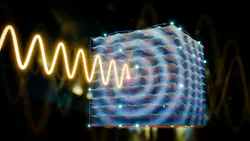
Yannis Laplace and his team at École Polytechnique’s Lab of Irradiated Solids, and colleagues from the Collège de France and Helmholtz-Zentrum Dresden-Rossendorf (HZDR), recently introduced all-optical photonic time crystals, in which the material’s optical properties—reflectivity and resonance frequency—are dynamically modulated at picosecond timescales (see video).
Thanks to the HZDR’s TELBE superradiant terahertz (THz) source, the team was able to drive their photonic crystal into a new regime of light-matter interaction within the terahertz range—where light oscillates at frequencies on the order of 1 trillion times per second. Their work expands photonic crystals’ reach from space to time, which may prove to be a gamechanger for ultrafast optical computing, new telecom systems, and possibly new types of THz lasers.
“During the past few years, my group has worked on plasmonic metamaterials within the THz frequency range as a way to develop functional devices to manipulate light and light-matter interactions,” says Laplace, an assistant professor of physics. “Notably, we showed that in equilibrium these systems are highly tunable with parameters such as temperature and magnetic field.”
Naturally, the next step for the team was to explore dynamical aspects like tunability in time when modulated with an intense THz light pulse. “Photonic time crystals are optical systems that must be modulated dynamically very strongly at ultrafast timescales,” he says. “We already knew our system would respond nonlinearly to THz light. Our question was: How strong and fast, and would it be enough to reach the photonic time crystal regime of operation?”
Plasmonic metamaterial platform
The team’s platform for their photonic crystal is a plasmonic metamaterial—an artificially constructed array of cavities for THz photons—that harnesses surface plasmons, which are collective excitations of electrons at the surface of a semiconducting material.
“Our system consists of the semiconducting material indium antimonide (InSb), an insulating dielectric material, and a periodic structure of gold stripes on top,” says Laplace. “Overall, this structure acts as resonators for surface plasmons, which allows us to design their resonant frequencies and properties.”
For their experiment, the researchers used an intense multicycle THz light field to drive the plasmonic excitations within the cavities to a large amplitude, which effectively modulates their properties in time (such as their resonant frequency) through a nonlinear effect. “This, in turn, modulates the optical properties of the whole metamaterial in time,” he says. “And this modulation is sufficiently strong and fast enough to reach the photonic time crystal regime of operation.”
How does their method work? “If we shine a strong multicycle THz pulse onto our metamaterial and probe the resulting optical properties with another THz pulse, we can observe the system’s optical properties oscillate in time (due to the drive),” Laplace explains.
These oscillations are so strong and fast it completely redefines the optical properties of the system. “It means we can harness them to convert the frequencies of photons fast and efficiently,” he says. “The time-averaged optical properties of the structure are also modified, which represents a new way to engineer optical properties—not by designing a structure in equilibrium as is usually done, but with a temporal approach.”
Right now, the researchers can use the photonic time crystal regime to decrease optical dissipation of their metamaterial. In the future, they’d like to explore further frequency conversion, amplification, and lasing.

An advance for photonics in two ways
How is this work an advance for photonics? First, plasmonics. “Plasmonics is great because it allows us to confine photons at spatial scales orders of magnitude smaller than the diffraction limit (the lower bound for photon confinement in free space), so it shows promise for making optical devices very compact,” says Laplace. “But this gift comes at a price: Losses. Plasmons rely on the motion of electrons within solids and are subject to large dissipation—photonic losses—and this is a problem for many applications.”
His team showed these losses can be decreased substantially with a temporal drive (by a factor of 2 in their experiment), and they hope to further decrease them in the future. “Ultimately, the possibility to develop lossless plasmonic platforms would be a gamechanger for these technologies, because they can profit from the confinement they allow without losses as a drawback,” he says.
Second, signal processing and manipulation in photonics. “Signal manipulation in photonics relies on nonlinear optical phenomena, such as the conversion of light from one color to another,” says Laplace. “In photonic time crystals, these phenomena arise on the time scale of the light’s temporal period itself—it’s a completely new regime of parameters for photonics. Photonic time crystals should allow nonlinear optical processes to be achieved much faster and will dramatically increase the rates for signal processing/optical computing.”
Laplace and his team experienced several aha! moments, including one during beamtime at the HZDR TELBE facility, when they saw “strong and fast modulations” coming out of their metamaterial that told them their initial intuition was correct.
“We developed the theoretical model of our system with our collaborators and saw it matches our experimental observations very well,” he says. “Building on it, we could use it to distinguish between a photonic time crystal and a more common modulated optical system—and ours was a photonic time crystal.”
As you can likely guess, this moment “felt like intellectual satisfaction,” Laplace says. “Not only were we seeing something new but we could also precisely explain it. We now use this model to screen a wide range of the parameter space of this system to guide us before we perform our time-consuming experiments.”
The next big challenge the researchers will take on is to further decrease the losses within this system with a dynamical drive and overcome the threshold for lasing, which corresponds to a central prediction of photonic time crystals.
Direct potential applications of this work? They’ll pertain to the THz frequency range—frequencies located at the intersection between electronic and photonic technologies. “This range is underdeveloped compared to electrical and photonic technologies—the famous THz gap—and its development is timely,” he says. “We foresee the development of amplifiers, frequency converters, ultrafast modulators, and maybe new types of lasers within this range.”
His team will continue to work on their system “so THz applications can emerge as early as possible—hopefully within the next few years,” says Laplace. “Simultaneously, from a more fundamental point of view, we’re interested in pushing the boundaries of knowledge in time-modulated optical systems, which represent one of the most exciting frontiers in photonics at the moment, to develop next-gen concepts and devices in photonics.”
FURTHER READING
T. Guo et al., Nature, 656, 343–348 (2026); https://doi.org/10.1038/s41586-026-10825-9.
Related Articles



About the Author
 Sally Cole Johnson
Sally Cole Johnson
Editor in Chief
Sally Cole Johnson is Laser Focus World’s editor in chief, and she has more than 25 years’ experience as a science and technology journalist. She specializes in physics and semiconductors, and wrote for the American Institute of Physics for more than 15 years, and also covered theoretical physics and neuroscience for the Kavli Foundation, and complexity for the Santa Fe Institute. Johnson has also written extensively about military embedded systems, high-performance computing, software-defined networks, and infosec. She is a member of the National Association of Science Writers (since 2001).
When she isn’t writing about optics, photonics, or quantum advances, you can find her outside in northern NH in the garden with birds landing in her hand or heading for the mountains with her bike, skis, or crampons and ice axe.