Can an ultrablack coating help reduce satellite brightness?
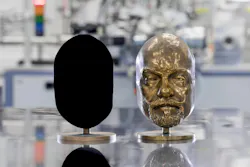
Astha Chaturvedi, a postdoctoral researcher at the University of Surrey, and colleagues recently put an ultrablack coating developed by spinout Surrey NanoSystems to the test by measuring how it reflects light under a range of illumination and viewing conditions, and then simulated how a coated satellite within low Earth orbit (LEO) would appear to observatories on the ground (see video).
Chaturvedi’s motivation? It stems from simply looking up at the night sky and noticing how much it’s changing. She’s both an amateur and professional astronomer, and it’s not unusual for her to count one satellite passing overhead every minute. While working on the DECam Local Volume Exploration Survey (DELVE) collaboration—a deep, multicomponent survey to image the entire high-Galactic-latitude southern sky using DECam on the 4-meter Blanco Telescope at Cerro Tololo Inter-American Observatory in Chile—for her Ph.D. work at the University of Surrey, Chaturvedi began “seeing satellite trails corrupt astronomical images we’re trying to use for science, and it became more real for me,” she explains. “The night sky is a shared natural resource, and satellite brightness affects everyone’s view of it.”
Brightness makes it more difficult for astronomers to explore the Universe, and as Chaturvedi dug deeper into the problem, she realized major surveys like the Vera C. Rubin Observatory’s Legacy Survey of Space and Time (LSST)—built with public funding to help answer some of the biggest questions of the Universe—will be significantly affected by satellite brightness. The estimated cost of dealing with satellite contamination is around $22M, she says.
“It’s really surprising there are currently no regulations about how bright satellites can be in space, and there isn’t a permanent solution to the problem,” says Chaturvedi. “After discussing this with my advisor, we realized it was something we can actually help with. I’m incredibly grateful to have had the opportunity to work on an environmental problem where—instead of just pointing out the problem—we can explore a practical solution.”
Vantablack 310
The idea behind Vantablack 310 was to make a coating that’s both extremely black and robust enough for use in space. Its silicon-oxygen framework helps it withstand the harsh LEO environment—particularly attacks from atomic oxygen.
“At the microscopic level, the coating contains nanostructured pigments that create tiny ‘light traps.’ Rather than bouncing back off the surface, light is reflected multiple times within these microscopic structures until most of it is absorbed,” says Chaturvedi. “It’s what gives the coating its remarkably low reflectance and makes it a promising candidate for reducing satellite brightness.”
Vantablack 310 is designed to absorb nearly all of the light that falls on it. Unlike conventional black paints, which simply absorb some light and reflect the rest, “its nanostructured surface traps incoming light within tiny microscopic cavities,” says Chaturvedi. “The light bounces around multiple times inside these structures before being absorbed—leaving little time to be reflected back. An important advantage is that it’s also designed to withstand the harsh environment of space, including exposure to atomic oxygen within LEO, and this makes it a promising candidate for future satellite applications.”
What do satellite owners need to know about this coating? It’s designed “to be practical to use and can be applied using standard coating methods,” Chaturvedi says. “Most importantly, it should be used strategically. Before applying it, engineers need to model both the satellite’s brightness and its thermal behavior to identify surfaces where the coating will have the greatest benefit without affecting spacecraft performance.”
Simulations framework
Chaturvedi combined laboratory measurements of an ultralow-reflectance coating with physics-based satellite brightness simulations to predict how a coated satellite would appear to astronomical observatories under different observing geometries.
Rather than simply measuring how dark the coating is within the lab, “I translated its optical properties into realistic on-sky brightness predictions,” she explains. “This allowed us to quantify how much a coating like Vantablack 310 can reduce satellite visibility and whether it will help meet the astronomical community’s recommended brightness limits. More broadly, the framework provides a way to evaluate any future coating or satellite surface design before launch, which makes it a practical tool for designing satellites that are more compatible with astronomy.”
Although the team focused on satellite light pollution, their simulations framework is much more general. Any spacecraft surface with measured optical properties can be evaluated before launch to predict its on-sky brightness. “This makes it useful for satellite design, mission planning, and testing new optical materials,” Chaturvedi says. “Similarly, ultrablack coatings have broad applications wherever stray light is a problem—from space telescopes and Earth-observation instrumentation to star trackers and precision optical systems.”
Validation
The researchers’ immediate goal is to validate their predictions in orbit using the Vantablack 310 coating for the Jovian-1 CubeSat mission. “At the same time, ongoing environmental testing, including thermal qualification, will help establish how the coating performs under the harsh conditions of space,” says Chaturvedi.
She’s continuing to develop the simulation framework so it can model the brightness of an entire satellite and not just individual coated surfaces. “Ultimately, we’d like to provide satellite designers with a predictive tool that allows them to evaluate and optimize spacecraft brightness before launch—and help build future satellite constellations more compatible with astronomy,” Chaturvedi says.
FURTHER READING
A. Chaturvedi, N. E. D. Noël, K. Clifford, J. Whitfield, and K. A. Ryden, Mon. Not. R. Astron. Soc., 550, 1, stag1136 (Jul. 2026); https://doi.org/10.1093/mnras/stag1136.
Related Articles
 Rubin’s 1.7-gigapixel image of a field of stars within the constellation Lupus gives us an unprecedented view of the Universe. Faint, glowing clouds spread across this image are galactic cirrus—clouds of interstellar gas and dust found in the foreground of the Milky Way.
About the Author
 Sally Cole Johnson
Sally Cole Johnson
Editor in Chief
Sally Cole Johnson is Laser Focus World’s editor in chief, and she has more than 25 years’ experience as a science and technology journalist. She specializes in physics and semiconductors, and wrote for the American Institute of Physics for more than 15 years, and also covered theoretical physics and neuroscience for the Kavli Foundation, and complexity for the Santa Fe Institute. Johnson has also written extensively about military embedded systems, high-performance computing, software-defined networks, and infosec. She is a member of the National Association of Science Writers (since 2001).
When she isn’t writing about optics, photonics, or quantum advances, you can find her outside in northern NH in the garden with birds landing in her hand or heading for the mountains with her bike, skis, or crampons and ice axe.