NSF-DOE Vera C. Rubin Observatory begins capturing a ‘movie’ of the cosmos
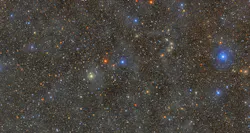
One year after the NSF-DOE Vera C. Rubin Observatory stunned us with its first look imagery, the 10-year Legacy Survey of Space and Time (LSST) is officially underway.
Atop Cerro Pachón in the Chilean Andes (elevation: ~2,682 meters/8,799 feet), Rubin’s 8.4-m Simonyi Survey Telescope will use a 3,200-megapixel camera to observe the southern sky every few nights for the next 10 years to create an ultrawide, ultrahigh-definition time-lapse record of the Universe (see video). For perspective, an iPhone 17 Pro camera has 48 megapixels.
Rubin’s design features enormous light-collecting power, the ability to move rapidly across the sky, and a wide field of view. Its 3,200-megapixel digital camera—the world’s largest—can capture a new, detailed image about every 40 seconds, or ~1,000 images/10 terabytes of data per night.
Coolest optics involved? “The world’s largest camera has a focal plane with 201 total charged-coupled device (CCD) image sensors, built to a flatness of 4 microns,” says Aaron Roodman, SLAC, deputy head of LSST. “Literally the coolest part of the camera are its 201 image sensors—cooled to -100°C for optimal performance.”
The goal is to capture pulsating stars, supernovae explosions, the fossil record of galaxies, and to gain a better understanding of the mysteries of dark energy and dark matter, and, of course, to discover entirely new phenomena.
Why 10 years? It allows Rubin to collect data from each point in the sky roughly 800 times, which will provide scientists with deep, time-rich views to catch subtle events, moving objects, and to study the Universe’s accelerating expansion.
What’s it like to get to work on LSST and what does it all mean for science? “The LSST survey is the start of a new era in astronomy,” says Risa Wechsler, SLAC and Stanford University, director of the Kavli Institute for Particle Astrophysics and Cosmology (KIPAC). “One of the most exciting things to me is how broad the discovery potential is—we’ll not only see more of the Universe than ever before but we’re also opening up new ways to see it change with time and across space.”
Rubin is already compiling a census of our Solar System—including millions of asteroids and comets. In its early optimization surveys, it discovered more than 11,000 asteroids within a month and a half.
It’s a thrilling time for multi-messenger astronomy—exploring cosmic events via signals such as light, gravitational waves, and cosmic rays. Rubin’s observations of transients such as stellar explosions, actively feeding black holes, and collisions between compact objects will alert telescopes around the world to these fleeting events. As many as 7 million alerts of changes in the night sky go out each night to astronomers/scientists. And when complete, LSST’s final dataset of astronomical data—containing billions of objects with trillions of measurements—will be available to scientists and the public.
Everyone in the world is invited to follow along with LSST in real time or engage with Rubin’s data by visiting rubinobservatory.org or noirlab.edu.
If you missed Justine Murphy’s podcast with Erin Howard about Rubin/LSST, be sure to check it out:
Related Articles

About the Author
 Sally Cole Johnson
Sally Cole Johnson
Editor in Chief
Sally Cole Johnson is Laser Focus World’s editor in chief, and she has more than 25 years’ experience as a science and technology journalist. She specializes in physics and semiconductors, and wrote for the American Institute of Physics for more than 15 years, and also covered theoretical physics and neuroscience for the Kavli Foundation, and complexity for the Santa Fe Institute. Johnson has also written extensively about military embedded systems, high-performance computing, software-defined networks, and infosec. She is a member of the National Association of Science Writers (since 2001).
When she isn’t writing about optics, photonics, or quantum advances, you can find her outside in northern NH in the garden with birds landing in her hand or heading for the mountains with her bike, skis, or crampons and ice axe.