How many satellites and mirrors lighting up the night sky is too many for astronomy?

Our dark and starry night sky—arguably the most stunningly gorgeous work of art we’ll ever experience by simply looking up—is in peril. Astronomers are sounding the alarm as several satellite companies make plans to send more than 1.7 million satellites, including extremely bright ones, into low-Earth orbit (LEO).
Since 2019, we’ve all seen the number of satellites zipping overhead on a dark night increase—mostly thanks to SpaceX’s Starlink constellation—and it’s no longer unusual for a satellite to cross astronomers’ images. But until a few years ago, this wasn’t typical.
At this stage, with ~15,000 satellites in LEO today (or 32,000 if you count the dead satellites and space debris), astronomers routinely obtain images with a satellite streak crossing them. 1.7 million is 100x more satellites than currently in orbit today, and every image will have several satellite streaks. While each streak “burns” only a small fraction of one image, the damage adds up and it would likely result in a significant amount of data being lost.
“Various satellite companies have more than a total of 1.7 million satellites in the approval pipeline,” says Olivier Hainaut, an astronomer at the European Southern Observatory (ESO) for more than 30 years, who is developing recommendations to mitigate the impact of satellite constellations on astronomy. “Not all of these will be launched—some companies will go bankrupt and others will change their minds—but other companies will appear, so the 1.7 million is a good estimate of what’s likely ahead within roughly 10 years.”
Hainaut calculated 100,000 faint satellites—below naked eye visibility—in LEO is the absolute limit if we want to preserve our ability to observe the night sky with modern telescopes. “Breaching this number or having brighter satellites will significantly degrade the telescopes’ data output,” he explains. “If the breach is large, some telescopes would lose all their data.”
This isn’t binary. 101,000 satellites will cause a small degradation; 200,000 will have a larger one; and one million will be a disastrous degradation. With fewer than 100,000 satellites, the losses are “in the noise,” Hainaut says.
Data centers and daylight-on-demand satellites in space?
SpaceX is currently seeking approval from the U.S. Federal Communications Commission (FCC) to launch a constellation of more than one million satellites into orbit for space-based data centers.
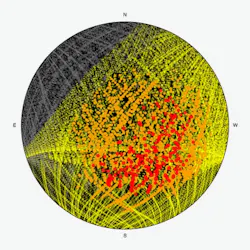
What does this mean for the night sky? Hainaut determined that for a large part of each night, hundreds of satellites would be visible to the naked eye and, at certain times, up to several thousand—similar to the number of stars seen with the naked eye in good conditions. To the telescopes, tens of thousands of satellites would be visible. “Other planned satellite constellations, such as E-Space’s Cinnamon and China’s CTC-1 and 2, would add hundreds of thousands more satellites into orbit—and further worsen the problem,” he says.
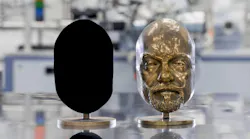
Reflect Orbital, a U.S. startup, is also seeking approval from the FCC to launch a constellation of very large mirror-like satellites to provide sunlight at night—with reflected beams that span at least 5 km on Earth’s surface. They intend to start with a prototype satellite in orbit this year and increase their satellite population to 50,000 by 2035. “These would be the brightest-ever satellites in orbit, with damaging consequences for dark skies on Earth,” says Hainaut.
Satellite brightness will affect everyone on Earth
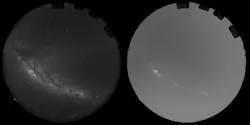
The number of satellites being sent into LEO is merely one aspect of the problem—an equally important one is the brightness of the satellites. “As long as they’re fainter than magnitude 7 (a weird astronomical unit for brightness; mag 7 corresponds to the brightness of the faintest star visible with the naked eye in perfect conditions), they leave a narrow trail on our image,” Hainaut explains.
When they are brighter, two things happen: Trails get broader and, in the worst case, they can affect the entire image. “Rubin’s LSST camera is particularly sensitive to this,” Hainaut says. “The camera is very wide by design and it’s what makes LSST special, so it’s particularly sensitive to satellites. To make the matter worse, Rubin’s camera—the largest in the world—packs some very high-density control electronics, which makes it susceptible to cross-talk. A very bright satellite trail will appear many times on the image—the real trail and many ‘ghosts’ caused by electronic cross-talk. Bright satellites can kill LSST.”
When light from satellites illuminate the atmosphere, “it scatters the light and makes the sky brighter—the sky is blue during the day because the atmosphere scatters sunlight,” Hainaut adds. “It’s a small effect. At night, all the light scattered from the stars contribute ~4% of the dark sky brightness. But some bright satellites are so bright and numerous they would increase the brightness of the dark sky by 200 to 300%. This gigantic amount of light pollution will affect most of the planet, not just observatories. If you go to a really dark place—deep countryside, high mountain, desert—the sky will look like what you get from the suburb of a small town, but with the addition of hundreds of bright satellites crossing the night sky.”
The two effects—trails covering images and the brightness of the dark sky—will compromise astronomers’ observations for distant galaxies. “If a trail crosses the image of the distant galaxy you try to observe, it’s lost,” Hainaut says. “And the brighter sky means you’ll need a much longer exposure to get the image—further increasing the chances to get zapped by a trail. Depending on the number of satellites, it could cost us ~30% of the data. In the worst case, with many bright satellites, essentially 100% of the data are lost and all of the investment into the observatory is lost.”
What can satellite owners do to cut brightness? “There are many discussions ongoing between astronomers and the satellite industry, and the International Astronomical Union organized a forum to meet and exchange information (see cps.iau.org),” says Hainaut.
With minor adjustments to satellite design and the way they’re oriented with respect to the sun, their “brightness can be decreased by a large fraction,” Hainaut says. “Big companies like SpaceX, OneWeb, and Amazon LEO, to mention a few, are very active and work really hard to improve the situation. It may not be enough in the case of satellites designed to be superbright on purpose—like Reflect Orbital.”
Reflect Orbital’s goal is to bring sunlight during the night via large mirrors in space. They promise never to illuminate the observatories, but it won’t protect small observatories or amateur astronomers. “Within the beam it will be daylight,” Hainaut points out. “Even outside the beam, the satellites will be superbright—like Venus, the ‘morning star.’ It’s too bright and will cause enormous light pollution.”

Who regulates satellites and what can the community do to help?
International law dictates that each country “is legally responsible for the satellites launched from their country—including private companies,” says Hainaut. “This coordination is ensured at the United Nations (UN) level by the UN Committee for the Peaceful Use of Outer Space (COPUOS).”
By talking to satellite companies, “we can explain the problem,” Hainaut says. “At the beginning, they were simply unaware of it. But we can bridge the gap between astronomical engineering and space engineering. They can propose improvements—we can evaluate whether it’s useful or not. We can propose tradeoffs and solutions. Some are feasible, some not, but it’s moving along.”
Within the context of the International Astronomical Union’s CPS and the UN COPUOS, astronomers are also working with policymakers. “The satellite issue is broader than astronomy,” Hainaut says. “On one side, the problem is for astronomers but it’s also orbital crowding. Packing one million satellites in LEO will dramatically raise the risk of collisions, which can cause a catastrophic chain reaction, low atmosphere pollution caused by the large increase of rocket launchers, as well as high atmosphere pollution caused by all of these satellites burning this within the upper atmosphere.”
The good news is the space industry itself has a direct interest in establishing good satellite regulations. “A chain-reaction collision would render LEO unusable for many years—and instantly kill their satellite business,” Hainaut says. “This is an example of a problem that can be resolved by multilateral discussions involving all stakeholders and all nations, where everyone wins with an agreement.”
FURTHER READING
O. R. Hainaut, arXiv:2604.09427v2 [astro-ph.IM] (May 29, 2026); see www.eso.org/public/archives/releases/sciencepapers/eso2607/eso2607a.pdf.
Related Articles
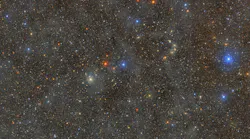 Rubin’s 1.7-gigapixel image of a field of stars within the constellation Lupus gives us an unprecedented view of the Universe. Faint, glowing clouds spread across this image are galactic cirrus—clouds of interstellar gas and dust found in the foreground of the Milky Way.
About the Author
 Sally Cole Johnson
Sally Cole Johnson
Editor in Chief
Sally Cole Johnson is Laser Focus World’s editor in chief, and she has more than 25 years’ experience as a science and technology journalist. She specializes in physics and semiconductors, and wrote for the American Institute of Physics for more than 15 years, and also covered theoretical physics and neuroscience for the Kavli Foundation, and complexity for the Santa Fe Institute. Johnson has also written extensively about military embedded systems, high-performance computing, software-defined networks, and infosec. She is a member of the National Association of Science Writers (since 2001).
When she isn’t writing about optics, photonics, or quantum advances, you can find her outside in northern NH in the garden with birds landing in her hand or heading for the mountains with her bike, skis, or crampons and ice axe.