Field-emission cathodoluminescent far-UVC source below 240 nm?
Emma Eriksson, Ph.D., senior project manager of R&D for PureFize Technologies AB, a Sweden-based company that specializes in broad-spectrum ultraviolet (UV) solutions, answers Laser Focus World’s questions about how field-emission cathodoluminescence may provide a complementary scalable route for far-UVC source development and shows potential for future spectrum tuning and application-specific system design.
Laser Focus World: What led to your far-UVC work?
Emma Eriksson: Our inspiration came from a simple question: Could our existing UV technology platform be extended into the far-UVC region below 240 nm? Far-UVC is attracting significant interest because of its antimicrobial potential and its different interaction profile with biological materials and cathodoluminescence to generate broad-spectrum UV emission. Since the emitted spectrum is determined by the phosphor material excited by electrons from a nanostructure, the technology isn’t restricted to a single wavelength range. By developing new phosphor materials, we can explore entirely new spectral regions.
One of the challenges limiting broader far-UVC adoption is source technology. This made it scientifically and technically compelling to investigate whether our existing platform can provide an alternative way to generate far-UVC emission. Our project was driven by both scientific curiosity and to answer the question of whether our established UV source architecture can also be used to produce far-UVC through advanced phosphor development.
LFW: Can you describe the basic optics, materials, and design concepts involved?
Eriksson: Our source isn’t a laser. It’s based on field emission and cathodoluminescence to produce broad-spectrum emission rather than a narrow spectral line.
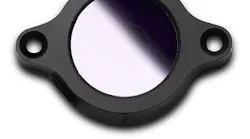
The device consists of a nanostructured electron emitter and a phosphor-coated optical window separated by a short vacuum gap. When a voltage is applied, electrons are emitted from the nanostructures through field emission and accelerated toward the phosphor layer. The phosphor absorbs the electron energy and converts it into UV emission through cathodoluminescence. Our entire system is integrated into a compact capsule ~3 cm in diameter and 0.5 cm thick.
Phosphor is the key material component because it defines the emitted spectrum. While our current platform generates UV primarily within the UVC and UVB regions, the far-UVC project focuses on phosphors capable of emitting below 240 nm. An important collaboration parter is Professor Thomas Jüstel at FH Münster University of Applied Sciences, whose research group specializes in nanoscale and microscale optical materials.
Optically, the device behaves as a wide-angle source rather than a narrow-beam splitter. We measured an emission angle of ~100°, which may be advantageous for applications in which irradiance distribution and area coverage are important.
LFW: How does your source work and what differentiates it?
Eriksson: Our source operates through a two-step mechanism that separates electron generation from UV production. First, zinc oxide (ZnO) nanostructures generate electrons through field emission. These electrons are then accelerated toward a phosphor layer, which converts their energy into UV photons through cathodoluminescence.
What differentiates the platform is that the emission spectrum is defined by the phosphor material rather than the source itself. This differs from mercury lamps, excimer lamps, or LEDs, whose emission characteristics are largely fixed by the underlying technology.
Our field-emission/cathodoluminescence platform is already used for broad-spectrum UV generation. The far-UVC effort focuses on extending this platform into shorter wavelengths through phosphor development and system optimization. We see this as a complementary far-UVC technology—particularly if spectrum tuning, wide-angle emission, thermal stability, rapid startup, and scalable manufacturing are desirable.

LFW: What are the main benefits?
Eriksson: The main benefits are flexibility and scalability. Because the emission spectrum is determined by the phosphor, the platform can be adapted to different UV wavelength ranges through materials selection. The system is also modular, which enables optimization for different treatment areas, irradiance levels, geometries, and integration requirements.
Scalability is equally important. The underlying field-emission and manufacturing technology already exists and is used commercially within our broader UV platform. Extending it to far-UVC primarily requires phosphor development and system optimization rather than the creation of an entirely new source architecture.
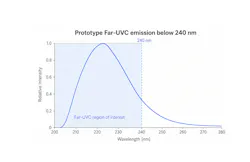
Early prototypes have demonstrated several promising characteristics, including emission below 240 nm, tunable output power, ~100° emission angle, rapid startup, and stable relative irradiance across a broad temperature range without active cooling.
LFW: What was the most exciting aspect of this work?
Eriksson: The most exciting moment was observing measurable emission below 240 nm. Conceptually, our approach was sound because we already knew the phosphor determines the emitted spectrum. But there was a significant difference between a theoretical concept and a spectral measurement that confirms far-UVC generation.
This was our ‘aha!’ moment of realizing the same fundamental architecture used for broad-spectrum UV can be extended into a much more challenging wavelength range. It was equally encouraging to see the prototypes also exhibited practical characteristics such as tunable output, wide-angle emission, fast startup, and stable performance.
Scientifically, the most fascinating aspect is the combination of nanostructured electron emission and phosphor-defined deep-UV generation. It’s a system in which materials, electron physics, geometry, and optics all interact closely.
LFW: What kinds of technical challenges remain?
Eriksson: The primary challenge is phosphor optimization. While the field-emission/cathodoluminescence platform is already established, efficient and stable far-UVC generation requires further advances in phosphor composition, emission intensity, spectral purity, and long-term stability under electron excitation.
At the system level, improvements are still needed in efficiency, optical output, uniformity, and lifetime. Factors such as device geometry, electron transport, phosphor coatings, reflective structures, optical windows, and driving electronics all influence overall performance.
Comprehensive validation is also essential. Performance must be characterized over time, under varying environmental conditions, and in application-relevant configurations. And any far-UVC technology requires rigorous safety validation, including assessment of spectral output, irradiance, exposure conditions, and compliance with applicable exposure limits.
LFW: Applications?
Eriksson: Far-UVC is being explored for microbial control where microbial risk reduction is important, such as within the air and on surfaces. This creates potential relevance in occupied areas such as healthcare environments, public transportation, indoor air systems, and food processing—to name only a few.
LFW: What’s next?
Eriksson: The next phase focuses on improving phosphor materials, optimizing spectral performance and output power, and enhancing system efficiency. In parallel, we’ll continue performance safety validation through spectral characterization, irradiance measurements, stability testing, and eventually application-specific studies.
Our timeline largely depends on progress in phosphor development. But we’re not developing an entirely new source platform, but rather extending an established field-emission/cathodoluminescence UV technology into a new and highly promising wavelength range.