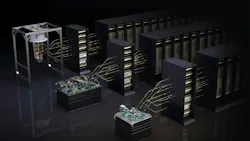
Nvidia’s strategy in quantum computing is unlike any other company’s because they’re not building their own quantum processor, but rather the platform that all other quantum hardware and software can integrate into and leverage to achieve the potential of quantum computing.
This might not surprise anyone familiar with the way Nvidia engages with other industries—it’s core to their strategy playbooks. They don’t build robots, but work with everyone who does. They also don’t build a self-driving car, but work with every company that does. See a pattern? Robots and self-driving cars require tons of graphics processing unit (GPU) computing and artificial intelligence (AI) to be successful. Nvidia’s quantum strategy is similar: Build a quantum platform and partner with companies working on quantum computing, including ones with photonic qubit approaches.
“Our team works on the development of photonic quantum computers,” says Sam Stanwyck, director of quantum product for Nvidia. “Photonics is one of the most promising technologies for quantum computers, which are going to be a part of and integrate with future AI systems. We work closely with almost every company building photonic quantum computers—including PsiQuantum, Xanadu, Orca, and Quandela.”
Stanwyck began his Ph.D. in applied physics in 2011 at Stanford University, and afterward took a job at early quantum startup Rigetti Computing in 2017. He then moved to Nvidia as the first hire when the company started working on quantum in 2021. “It’s been an amazing journey,” he says. “Early on, it was one or two qubits in academic labs. Now we have systems with hundreds of qubits available to anyone over the cloud. And we’re doing error correction where the error correction helps, which is a miraculously fast amount of progress. During the past six months the whole world changed because of AI and Agentic AI, and how we develop platforms for quantum computers has as well.”
One quantum misconception he’d like to clear up? “When we talk about a quantum computer, it’s really about integrating a quantum computer with a supercomputer,” Stanwyck says. “The word ‘computer’ is a bit of a misnomer and leads to expectations around memory and storage and scheduling and logic, which aren’t true for quantum computers. Quantum computers are more of an accelerator or a very precious instrument that can compute.”
It’s no insult—quantum computers will make supercomputers much more powerful and capable of solving important problems. “This is good news for the long-term scientific and commercial value of quantum computers and how closely they will integrate with supercomputers—and it’s a big reason why Nvidia is so excited about this,” he adds. “It’s a really important part of future accelerated computers.”
How do Nvidia’s platforms help develop quantum computing?
Step 1: Simulations. “For computer development, we simulate as much as we possibly can from the hardware and the electronic design automation (EDA)-type simulations up to the application,” says Stanwyck. “This is true for GPUs as much as it is for quantum computers—30 years into GPUs being valuable.”
Simulations “run great on GPUs and accelerated computing, so we built platforms to accelerate simulations of quantum computers at every level,” he says. “PsiQuantum is integrating our simulators in CUDA-Q (an open-source hybrid quantum computing platform from Nvidia) to achieve 450x speedup. And we accelerate simulation in Xanadu’s software platform PennyLane, as well as work closely with Orca and Quandela on this. Simulation is a workhorse for every company developing quantum computers.”
Step 2: Quantum classical integration. Future quantum computers will never work alone or in isolation—they will be tightly coupled to GPU supercomputers. “It makes more sense to think of a quantum computer as a new type of accelerator, integrating with computer processing units (CPUs) and GPUs into a quantum-accelerated supercomputer,” explains Stanwyck. “This requires an interconnect and architecture, so we built NVQLink—an open and universal interconnect. It allows us to treat the entire GPU supercomputer like a single GPU with a high-bandwidth and low-latency interconnect. NVQLink does this for quantum to enable adding a quantum accelerator and using the GPU supercomputer to correct its errors, calibrate it in real time, while having a stable interface.”
Quandela, which builds photonic quantum computers in France, recently demonstrated an NVQLink that reduced their latency by an impressive 200x.
Step 3: Software integration and AI for quantum. Quantum computers won’t merely help with AI but will need to integrate and use it at every level.
“We’re working with PsiQuantum, Orca, and Quandela to release open models for quantum, called Nvidia Ising (pronounced like icing), which are fully open source, open data, open training framework models to calibrate a quantum computer and correct its errors,” Stanwyck says. “Photonic companies are integrating our Ising models to build and fine-tune on to improve their quantum computers.”
Scaling quantum error correction
One of the most important quantum challenges now is scaling error correction. “Error correction is how we take quantum bits, which are inherently very noisy, and turn them into noiseless bits so we can have a computer that runs like a computer,” says Stanwyck. “When a quantum computer runs, this is 99% of what’s happening. It’s more accurate to say it’s a quantum error correction machine doing a little bit of quantum computing.”
Making quantum error correction work requires lots of accelerated computing and AI delivered over low latency via an interconnect like NVQLink. “So we’re building NVQLink and the classical resource for error correction, which is called the decoder,” he says. “Some decoders use AI, others use accelerated computing, and this is the problem the entire quantum ecosystem is trying to solve.”
Expanding the application space
Quantum error correction is all about making hardware better, but another big challenge Stanwyck points out is expanding the application space. “Right now, there are a few problems with known, proven, exponential quantum advantage, and the most well understood one is around factoring,” he says. “We think there’s a much bigger space that quantum computers can help with—problems around simulating biology, chemistry, or physics for drug discovery, development of new materials or new batteries, and more efficient ways to generate energy.”
But it remains to be determined exactly how to build this application space, how much supercomputing you’d need, what the quantum computer needs to do, what the architecture is, how good your error correction decoder needs to be, and all of the resources needed to actually target these applications to deliver enterprise and scientific value.
“As we’re building this hardware, we’re working closely with our partners and doing our own research into applications of quantum computing, as well as applications of quantum plus AI plus high-performance computing (HPC),” Stanwyck says.
Nvidia built open models in the Ising family, out for a few months now, “and one of our quantum partners integrated the base model, not fine-tuned on their data, and put it on the task of calibration,” he says. “Calibrating a photonic quantum computer is incredibly technical and difficult, and it’s something you want people with Ph.D.s working on—to understand all of the parameters. They used this out-of-the-box AI model and got a 3x improvement in engineering time while achieving the same performance for the quantum computer.”
Stanwyck likens AI to a huge wave quantum is going to ride all the way from low-level design to how you calibrate and write software for them. “We’re building skills into our software product CUDA-Q and integrating it into agent-first (agentic) coding platforms, which is amazing for productivity because it lowers a barrier to entry,” he says. “It means a quantum chemist or AI researcher or biologist can simply use an AI agent and integrate it with CUDA-Q. It’s the start of this wave and it’s so exciting for every industry.”

An inflection point
Quantum computing has reached an inflection point with error correction. From 2010 until today, everyone built up systems with more and more physical qubits and ran experiments on them. “But we always knew we needed error-corrected qubits with error rates more akin to a transistor if we want to treat it like a computer,” Stanwyck says. “And now we’ve seen big players like Google and small startups from different modalities demonstrate quantum error correction improves fidelity. The exciting part of the theory of error correction is if we can throw enough compute and AI at it, the fidelity can keep improving. We’re now on the path to get to 10-15 error rates while scaling up, which will enable these applications we’re excited about.”
What’s on the horizon now? “We want to see quantum accelerators integrate into worldclass GPU supercomputers and accelerate them for important problems,” says Stanwyck. “We don’t know what the timeline is, but we’re trying to make it happen for as many people as possible. Ultimately, it’s about increasing the space of valuable problems computers can solve. This is the big picture target we’re always thinking about.”
About the Author
 Sally Cole Johnson
Sally Cole Johnson
Editor in Chief
Sally Cole Johnson is Laser Focus World’s editor in chief, and she has more than 25 years’ experience as a science and technology journalist. She specializes in physics and semiconductors, and wrote for the American Institute of Physics for more than 15 years, and also covered theoretical physics and neuroscience for the Kavli Foundation, and complexity for the Santa Fe Institute. Johnson has also written extensively about military embedded systems, high-performance computing, software-defined networks, and infosec. She is a member of the National Association of Science Writers (since 2001).
When she isn’t writing about optics, photonics, or quantum advances, you can find her outside in northern NH in the garden with birds landing in her hand or heading for the mountains with her bike, skis, or crampons and ice axe.