Quantum dots learn to speak telecom: 40 million single photons per second at 1300 nm
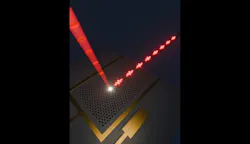
Lasers are the powerhouse of photonics: Coherent, powerful, and brilliant. At the other end of the intensity scale, single photons occupy a unique place in quantum technology as the only practical carriers of quantum information between distant systems. Single photons enable quantum key distribution (QKD), with security assured by quantum mechanics rather than computational assumptions, and they fuel photonic quantum computing, which requires vast numbers of identical photons.
Every application begins with a source of identical single photons on demand. Quantum dots are the premier solid-state source, but their best performance has so far been confined to near-infrared wavelengths. Bridging this interface to the telecom bands has seen decades of activity, yet the resulting photons have until now been noisy and incoherent. In our recent Nature Nanotechnology paper, we demonstrate a quantum-coherent photon–emitter interface within the original telecom band, a.k.a. “O-band,” spanning 1260 to 1360 nm, with transform-limited linewidths and more than 40 million single photons per second delivered directly into an on-chip waveguide.
Trapped at 930 nm
Our self-assembled quantum dot is a nanoscale island of indium arsenide, roughly 30,000 atoms, embedded within a gallium arsenide crystal. It confines electrons to discrete, quantized energy levels, and behaves as an artificial atom governed by the physics Niels Bohr introduced a century ago. Fittingly, much of this work took place at the institute bearing his name. Driven with a fast laser pulse, the dot is excited and then emits exactly one quantized photon when it decays.
An unknown quantum state encoded within such a photon cannot be copied, and interception introduces detectable disturbances—which makes single photons ideal carriers of secure quantum information. In the ideal limit, a source must efficiently deliver pure single photons that are also indistinguishable, meaning quantum-mechanically identical so they can interfere. Quantum dots have set the benchmarks on all three counts: Efficiency, purity, and indistinguishability.
But these benchmarks were set around 930 nm, where the highest-quality dots naturally emit. Historically, this was convenient because excellent lasers and efficient detectors were on hand. For some applications, however, this is a dealbreaker: Fiber attenuation at 930 nm is far too high for long-distance links. And silicon, the workhorse material of photonic integrated circuits, absorbs strongly below 1100 nm. The best quantum light-matter interface was incompatible with both the world’s fiber infrastructure and its most mature photonics platform.
Coherence is the decisive requirement and it is measured meticulously. The optical linewidth collects the fingerprint of every noise process in the device—from fast phonon dephasing to slow charge fluctuations. Two-photon interference, the standard test of indistinguishability, typically only probes a few nanoseconds of delay, whereas the linewidth integrates noise over millions of emission events. At the transform limit, the linewidth is set directly by the inverse lifetime and successive photons are highly indistinguishable. Despite extensive efforts, reported linewidths for telecom quantum dots stayed an order of magnitude above this limit—holding out on the promise of quantum dots.
Silencing the noise
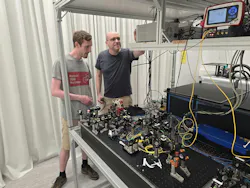
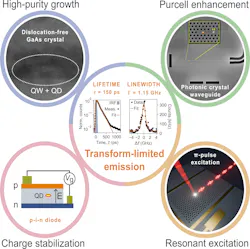
Our chips bridge the gap. Under 80-MHz resonant π-pulse excitation, our source delivers 41.7 million single photons per second into the on-chip waveguide mode, corresponding to a waveguide-coupled source efficiency of 52%, on par with the best 930-nm devices, and 7.6 million per second into a standard telecom fiber. We record a linewidth of 1.15 GHz, only 8% broader than the transform limit of 1.08 GHz that follows from the measured lifetime τ = 150 ps.
In practical terms, of the 40 million photons generated each second, at least 92% are identical. The directly measured raw two-photon interference visibility between back-to-back photons is 84%—without any post-selection or spectral filtering, and limited only by setup imperfections, primarily residual pump-laser leakage. Notably, the source barely blinks, staying “on” 95% of the time, whereas blinking has previously capped the efficiency of other telecom emitters well below 50%.
A materials story
Reaching this performance was at its core a materials challenge. The established route for pushing indium arsenide (InAs) dots to 1300 nm is to overgrow them with a thin indium gallium arsenide (InGaAs) strain-reduction layer, which relaxes the vertical strain and allows the dots to grow taller (about 5.2 nm vs. 3 nm for 930-nm dots) and shifts their emission into the O-band. The difficulty is managing this strain without creating defects—every impurity, dislocation, and rough interface near a dot can act as a charge trap, and fluctuating charges shift the emission energy from one photon to the next, precisely the noise that destroyed coherence in earlier devices. Because these dots are larger, they are especially prone to such fluctuations.
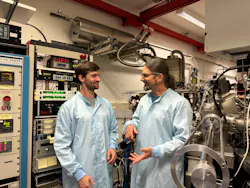
A turning point came during the growth development in Bochum. We realized that the brightness of quantum-well test samples correlates directly with the roughness of their interfaces, giving us a simple proxy for material quality before committing to a full wafer. Guided by this compass, we optimized the molecular-beam-epitaxy process, rebuilt the aluminum-cell protocol, and purified the arsenic source until interfaces were atomically smooth. Our test structures were even brighter than the previous best reference sample. Only then did we grow the device wafer.
Within the Niels Bohr Institute cleanroom, we patterned these samples into suspended photonic-crystal waveguide circuits with electrical contacts to form a vertical p-i-n diode with the dots in the intrinsic (i) region. The diode stabilizes the charge environment and suppresses the slow fluctuations that would otherwise prevent stable resonant operation. A slow-light waveguide provides a fast decay channel through the Purcell effect, which shortens the window where residual noise can act and sends the photons into the engineered circuit mode. Finally, the chip is cooled to 4 K to suppress thermal phonons, and resonant laser spectroscopy confirms what the growth data promised: Decoherence is suppressed to the lifetime limit.
One lesson that stands above the rest is that no single ingredient gets us there. It’s the interplay of resonant excitation, growth purity, charge control, and Purcell enhancement—all at the same time—that unlocks quantum coherence. Remove any one and the system degrades.
Why the O-band?
When building photonic systems, the wavelength is the point. The O-band lies around the zero-dispersion wavelength of standard single-mode fiber, where the material and waveguide contributions to dispersion cancel and pulse broadening is suppressed. This allows tight multiplexing, which can unlock high secure data rates despite the weak single-photon signals. Beyond this, the single-photon level O-band quantum signals are spectrally well separated from the classical high-power laser traffic filling the 1550-nm C-band, which eases coexistence on fibers without signal contamination. Just as important, 1300 nm unlocks silicon: Quantum-dot chips can now be combined with silicon-on-insulator circuits by micro-transfer printing or wafer bonding, on a mature, foundry-ready platform.
From one emitter to many
The next milestone is scale. The diode already tunes each dot’s emission across 400 GHz, so multiple emitters on one chip can be brought into mutual resonance. This is the prerequisite for multiphoton interference and entanglement distribution. We are refining the growth protocol for wafer-scale uniformity, and reducing circuit losses is a photonic engineering task with a clear roadmap. A recent blueprint for photonic quantum computing tolerates on the order of 10% loss and a few percent of linewidth broadening. Demanding as these numbers are, telecom quantum dots can now enter this conversation.
The dichotomy between the best solid-state quantum light sources and the installed fiber network stood for decades, but has now been overcome. The task ahead is to reproduce this coherence across many emitters and connect them with low-loss photonic integrated circuits, so quantum networks can be built on the fiber infrastructure we already have.
ACKNOWLEDGMENT
The study was carried out with our co-authors at the Niels Bohr Institute, Ruhr University Bochum, the University of Basel, and Sparrow Quantum, Copenhagen.
FURTHER READING
M. Albrechtsen et al., Nat. Nanotechnol., 21, 642–647 (2026); https://doi.org/10.1038/s41565-026-02156-7. Free to read at https://rdcu.be/ffBTF.
P. Holewa and M. Syperek, Nat. Nanotechnol., 21, 618–619 (2026); https://doi.org/10.1038/s41565-026-02158-5.
About the Author
Marcus Albrechtsen
Marcus Albrechtsen is a DFF international postdoc at the Swiss Federal Institute of Technology Lausanne (EPFL) in Lausanne, Switzerland and at the Niels Bohr Institute, University of Copenhagen, Denmark.
Severin Krüger
Severin Krüger is a doctoral researcher at Ruhr University Bochum, Germany.
Arne Ludwig
Arne Ludwig is a researcher at Ruhr University Bochum in Germany, leading advanced molecular-beam-epitaxial growth of semiconductor quantum dots.
Leonardo Midolo
Leonardo Midolo is an associate professor at the Niels Bohr Institute, University of Copenhagen, leading the Quantum Optoelectronic Devices Group within the Center for Hybrid Quantum Networks (Hy-Q). He served as principal investigator and lead scientist for the research featured in this article.