Multimode squeezed light a key to scalable quantum technologies?
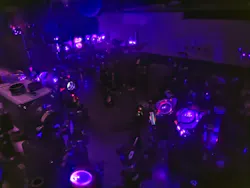
A group of researchers led by Professor Maria Chekhova at Max Planck Institute for the Science of Light in Germany may have cracked the code to scalable quantum technologies with a squeezed light approach to measure multimode quantum channels of light simultaneously to reveal their entanglement—even when most of this light vanishes before it hits a detector (see video).
What is squeezed light? It’s one of the fundamental building blocks of many optical quantum technologies, but is sensitive to loss not only during optical operations but also during detection. The researchers figured out a way around these issues by first amplifying the squeezed light with a multimode optical parametric amplifier (MOPA) to increase its signal without adding noise.
“One of its particularly valuable features is that it can be generated on demand and across many modes to enable high-dimensional quantum technologies,” explains Mahmoud Kalash, a Ph.D. student at Friedrich Alexander University working with Chekhova. “Until now, efficient detection of highly multimode squeezed light was demonstrated mainly for states encoded within temporal modes. By using MOPAs, we developed an efficient detection method for squeezed states encoded within spatial, spectral, and temporal modes. We demonstrated this capability within the spatial domain and, in a separate study, within the spectral domain.”
Multimode squeezed light
For their experiment, the researchers needed a source of multimode squeezed light. “In our case, it was a second-order nonlinear bismuth triborate (BiBO) crystal,” says Kalash. “We generated the squeezed light through parametric down-conversion by pumping the crystal with intense laser pulses at 355 nm to produce broadband quantum light centered around 710 nm.”
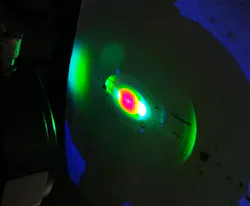
Then they use a MOPA based on the same nonlinear process, but operated at a much higher gain. “The amplifier boosts the quantum signal of all relevant modes before detection, and we use a spatial light modulator to separate the overlapping amplified modes and direct them to different positions on a camera to allow us to access them simultaneously and in real time,” he says.
This hadn’t been achieved before because mode sorting is generally very lossy, and such losses strongly degrade squeezing. “By amplifying the modes before sorting them, our method becomes tolerant to these losses and other detection imperfections,” Kalash says.
Quantum advance
High-dimensional quantum technologies “require simultaneous, real-time access to many optical modes—particularly for applications involving feedback and control,” says Kalash. “In quantum computing, for example, multimode squeezed states can be combined to form complex entangled cluster states in which the modes act as interconnected nodes of a computational network. The ability to monitor many of these nodes simultaneously is an important step toward scalable and faster characterization and control of such systems.”
One of the most thrilling moments during this work for Kalash was when the MOPA enabled them to measure -7.9 dB of squeezing, which corresponds to about 6x less noise than the vacuum level, while maintaining high state purity. “To the best of our knowledge, this is the strongest squeezing reported for pulsed light,” he says. “This was the moment we realized the MOPA approach could become highly relevant for practical, real-world quantum technologies.”
Spatial coupling
Traveling-wave optical parametric amplifiers allow the group to generate and detect squeezing. Unlike waveguide- or cavity-based systems, “this approach supports spatial coupling over a wide range of angles and transverse positions,” says Kalash. “It’s highly advantageous for generating and manipulating spatially multimode light, but it also makes the optical alignment particularly challenging. After several years of working with these systems, we’ve developed the experience needed to align and operate them reliably.”
Quantum scaling
The researchers’ multimode squeezed light method can support a wide range of quantum technologies—including “quantum computing, quantum communications and teleportation, as well as quantum-enhanced metrology, sensing, and imaging,” says Kalash. “Its key advantage is the ability to access many quantum modes simultaneously and in real time.”
Next up, the group plans to extend MOPA-based detection beyond squeezed states to more complex non-Gaussian quantum states. “We’ve already taken the first step with single-photon states, and a future goal is to address multimode non-Gaussian states and Schrödinger-cat states, which are key resources for universal quantum information processing,” he adds.
FURTHER READING
M. Kalash, A. Sudharsanam, M. H. M. Passos, V. Parigi, and M. Chekhova, Nat. Commun., 17, 3904 (2026); https://doi.org/10.1038/s41467-026-72357-0.
M. Kalash, U.-N. Han, Y.-S. Ra, and M. V. Chekhova, arXiv:2508.04502v1 (Aug. 6, 2025); https://doi.org/10.48550/arXiv.2508.04502.
About the Author
 Sally Cole Johnson
Sally Cole Johnson
Editor in Chief
Sally Cole Johnson is Laser Focus World’s editor in chief, and she has more than 25 years’ experience as a science and technology journalist. She specializes in physics and semiconductors, and wrote for the American Institute of Physics for more than 15 years, and also covered theoretical physics and neuroscience for the Kavli Foundation, and complexity for the Santa Fe Institute. Johnson has also written extensively about military embedded systems, high-performance computing, software-defined networks, and infosec. She is a member of the National Association of Science Writers (since 2001).
When she isn’t writing about optics, photonics, or quantum advances, you can find her outside in northern NH in the garden with birds landing in her hand or heading for the mountains with her bike, skis, or crampons and ice axe.