Chirality is a ‘hidden’ property of Smith-Purcell radiation
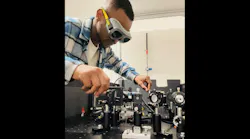
A surprising discovery by a team of researchers led by Lin Wu, an associate professor of physics at Singapore University of Technology and Design (SUTD), reveals Smith-Purcell radiation is inherently chiral and that a simple silicon grating can bring out this hidden property.
Back in 1953, physicists Steve Smith and Edward Purcell demonstrated that an electron beam sent past a grating will emit light in colors based only on the electron’s speed, the observation angle, and the grating’s spacing—and the phenomenon is known as Smith-Purcell radiation.
“Free-electron-light interaction is an area of research our group has been working on, with a focus on using free electrons to generate light,” says Juan-Feng Zhu, a Research Fellow working with Wu. “Free-electron radiation is attractive as a light source because of its flexibility. Unlike conventional light sources, with operating wavelengths often constrained by electronic or optical properties of constituent materials, free-electron radiation can be tuned over a broad spectral range by controlling the electron energy and the parameters of the photonic structure.”
This flexibility is especially valuable for spectral regions in which compact light sources are difficult to achieve, such as the terahertz, extreme ultraviolet (EUV), and potentially x-ray regimes. “The growing interest in free-electron EUV light sources also highlights the importance of this direction,” he says. “Free-electron lasers (FELs) are now being actively explored as alternative high-power EUV sources for semiconductor lithography.”
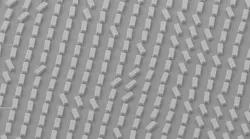
Smith-Purcell radiation is a simple example. When an electron travels close to a periodic grating its evanescent field interacts with the grating and is converted into propagating radiation, and its emission wavelength is determined primarily by the electron velocity and the grating period.
“Silicon gratings are interesting to our team because silicon photonics provides a mature platform for compact and integrated optical devices,” says Zhu. “Combining Smith-Purcell radiation with silicon nanostructures offers a potential route toward integrated, on-chip free-electron light sources while retaining the broad spectral tunability of free-electron radiation.”
Smith-Purcell radiation
One way to understand Smith-Purcell radiation is to start with the electromagnetic field carried by the moving electron. “An electron traveling near a surface carries an evanescent electromagnetic field around it,” explains Zhu. “This field is localized near the electron and doesn’t directly propagate into the far field as ordinary light does. A periodic grating can provide the extra momentum needed to convert part of this evanescent field into propagating photons—and this is the basic mechanism behind Smith-Purcell radiation.”
The key is that an electron’s evanescent field carries transverse spin angular momentum, which means the local electromagnetic field has an intrinsic rotational property associated with the electron’s motion. “When this field interacts with the grating, the transverse spin angular momentum can be converted into longitudinal form in the emitted light,” he says. “Longitudinal optical spin is associated with circular polarization, or the handedness of light.”
An important aspect of this work is that the grating itself doesn’t need to be chiral. “Even a conventional, achiral silicon grating can reveal the chirality already encoded inside the electron’s electromagnetic field,” Zhu says.
Chirality as a hidden property
Chirality entered the project because Professor Wu’s research group at SUTD does extensive research in chiral metasurfaces and chiral light-matter interactions, and she always encourages the team to exchange ideas across different research topics and explore interdisciplinary opportunities. Inspired by the work on chiral metasurfaces, the researchers wondered: Can chirality also become an important degree of freedom in free-electron radiation?
“We noticed that many of the previous approaches to chiral Smith-Purcell relied on specially designed metasurfaces or photonic structures to generate or control chirality,” says Zhu. “By contrast, the chirality of conventional Smith-Purcell radiation itself hadn’t been explored.”
One reason is because Smith-Purcell radiation has traditionally been understood largely through a two-dimensional (2D) picture. “In this picture, we typically consider the plane containing electron trajectory,” he says. “Within this plane, the emitted radiation is linearly polarized. This led to a long-standing belief that conventional Smith-Purcell radiation is essentially linearly polarized.”
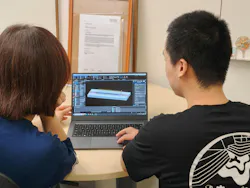
So the team decided to go back to the simplest system and ask: What happens if we look at conventional Smith-Purcell radiation in the full three-dimensional (3D) space? To do it, they built a simple 3D model of an electron traveling above a conventional grating, without introducing any chiral metasurface or specially designed chiral geometry. The result? Not one they expected.
“Looking beyond the conventional electron plane, we discovered the radiation wasn’t simply linearly polarized,” says Zhu. “Instead, left- and right-circularly polarized components naturally appeared in different regions of the 3D radiation pattern. In the symmetric system, these opposite chiral components are distributed symmetrically. In the conventional symmetry plane, their handedness balances out, leaving linearly polarized radiation. In other words: Chirality wasn’t absent—it was hidden by the symmetry and the conventional way in which Smith-Purcell radiation had been viewed.”
The best part of the discovery? “Our first reaction was definitely surprise and excitement when the 3D simulations showed clear left- and right-circularly polarized components within a system that was completely achiral,” Zhu says. “It wasn’t what we expected based on a conventional picture of Smith-Purcell radiation.”
But when a simulation contradicts your intuition, excitement is quickly chased by skepticism. “Before trying to explain the result, we repeatedly checked it using different simulation tools and different models,” he says. “The same chiral radiation pattern consistently appeared, so we became convinced it was a genuine physical effect rather than a numerical artefact.”
Then came a deeper question: Where does the chirality come from if neither the grating nor the overall structure is chiral? “We began looking for the physical origin and, through further literature research and theoretical analysis, connected the phenomenon to the transverse spin angular momentum carried by the electron’s evanescent field,” Zhu says. “The grating converts this spin to be converted into the longitudinal spin of the emitted photons.”
It was a real ‘aha!’ moment for the team because they realized the grating wasn’t creating chirality from scratch. “The chirality was already encoded within the electron’s evanescent field, and the Smith-Purcell process was revealing it in the emitted light. Once we understood this, the next step became quite natural,” he says. “If left- and right-handed components are already present but balanced because of symmetry, then breaking this symmetry should allow one handedness to dominate. This led us to explore simple symmetry-breaking approaches, such as twisting the electron trajectory relative to the grating or introducing a lateral displacement. By doing so, we can transform the hidden chirality into a net chiral emission and control its handedness.”
Time to rethink role of electrons in free-electron photonics
What does the group’s work mean for photonics? At the fundamental level, “our results expand the picture of Smith-Purcell radiation,” says Zhu. “Historically, Smith-Purcell radiation was discussed mainly in terms of wavelength, emission angle, and intensity. Our work shows polarization and chirality are also intrinsic degrees of freedom of this radiation—even in a simple, achiral system.”
This suggests it’s time to rethink the role of the electron in free-electron photonics. “A moving electron isn’t simply a broadband excitation source,” he explains. “Its electromagnetic near field has a rich vectorial structure and carries properties such as transverse spin angular momentum, which can be transferred into emitted photons through interaction with a photonic structure.”
It also suggests a different design philosophy for chiral free-electron emission. “Many previous approaches focused on engineering sophisticated metasurfaces or resonant photonic structures to create or manipulate chirality,” Zhu says. “The results show that another possibility is to start from the intrinsic spin properties of the electron field itself and use relatively simple symmetry breaking to access and control them.”
And this idea may extend beyond Smith-Purcell radiation, which is only one of the many mechanisms through which the electromagnetic field of a free electron can be converted into light. “Since the transverse spin originates from the electron’s evanescent field rather than from the grating itself, it’s natural to ask whether similar hidden chiral or spin-dependent properties may also exist in other free-electron radiation mechanisms,” Zhu says. “In this sense, our work provides a new understanding of Smith-Purcell radiation and also motivation to revisit other well-known free-electron emission processes from a full 3D and vectorial perspective.”
Many of these mechanisms have been studied for decades, but their polarization and spin degrees of freedom may still contain overlooked physics.
“It can be useful for free-electron light sources because polarization control doesn’t need to be tied to a specific optical resonance,” says Zhu. “It offers a way to combine chirality with one of the major advantages of free-electron radiation: Broad spectral tunability.”
Plenty of potential applications
The team’s now interested in developing compact and tunable chiral light sources. “Circularly polarized light is important for areas such as chiral spectroscopy, sensing, and studies of magnetic and chiral materials,” says Zhu. “At the same time, free-electron radiation provides an unusual degree of wavelength flexibility because the emission frequency can be controlled through electron energy and structural parameters rather than being fundamentally fixed by a particular material transition.”
It may be possible to add chirality to this flexibility without necessarily requiring a complex chiral structure or a narrow optical resonance. “This could provide a route to tunable chiral light sources, particularly within spectral regions where compact sources are difficult to achieve,” he adds.
Another area of interest is to extend this concept to the EUV regime. “Compact and accessible EUV sources remain challenging, while EUV radiation is important for applications ranging from advanced imaging and spectroscopy to semiconductor technology,” says Zhu. “Free-electron nanophotonic platforms may offer another route for generating and controlling light within this difficult spectral region.”
Yet another potential application is electron-beam diagnostics. The handedness of the emitted radiation responds to how the symmetry between the electron trajectory and the grating is broken, so polarization can provide information about the electron trajectory that complements conventional spectral and angular measurements.
“Beyond the fundamental physics, we’re interested in translating the concept toward practical devices,” Zhu says.
FURTHER READING
J. F. Zhu et al., Nat. Commun., 17, 10911 (2026); https://doi.org/10.1038/s41467-026-78729-w.
About the Author
 Sally Cole Johnson
Editor in Chief
Sally Cole Johnson is Laser Focus World’s editor in chief, and she has more than 25 years’ experience as a science and technology journalist. She specializes in physics and semiconductors, and wrote for the American Institute of Physics for more than 15 years, and also covered theoretical physics and neuroscience for the Kavli Foundation, and complexity for the Santa Fe Institute. Johnson has also written extensively about military embedded systems, high-performance computing, software-defined networks, and infosec. She is a member of the National Association of Science Writers (since 2001).
When she isn’t writing about optics, photonics, or quantum advances, you can find her outside in northern NH in the garden with birds landing in her hand or heading for the mountains with her bike, skis, or crampons and ice axe.