Program and control light’s chirality via a topology tweak?
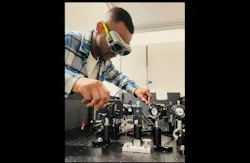
Thanks to topology, a branch of math that explores properties of geometric objects that remain the same while undergoing continuous deformations, a team of scientists led by Isaac Nape at the University of the Witwatersrand in South Africa and Kayne Forbes at the University of East Anglia (UEA) in the U.K. discovered a way to program and control light’s chirality (a.k.a. right- or left-handedness) and spin (see video).
In optics, chirality is usually associated with circularly polarized light (in which the electric field rotates either clockwise or anticlockwise as the light travels).
“Our work was motivated by the question of whether light can generate and control its own local handedness through propagation—without needing a material interface, a metasurface, or very tight focusing,” says Forbes, a lecturer at UEA’s School of Chemistry, Pharmacy, and Pharmacology, where he leads the Light-Matter and Nanophotonics Theory group.
Topological charge tweak
Topology enters through the way the phase and polarization of a light beam wind around space. “Structured light lets us bring these ideas together so we can design beams whose phase and polarization vary in precise ways across the beam,” explains Forbes. “We were interested in the possibility of the topology of the beam acting as a simple control knob. By changing the Pancharatnam topological charge (one parameter), we can make the local spin and chirality of the light reorganize themselves during propagation.”
It’s important to note that no special materials are needed for the effect itself. The spin and chirality emerge during the free-space propagation of a structured light beam—a vector vortex beam, in this case.
What’s a vector vortex beam? “Vector means the polarization varies across the beam, rather than being uniform,” says Forbes. “Vortex means the beam carries orbital angular momentum, which is associated with a twisted phase front. And topology enters via the way the beam twists around its own axis. In our work, this twist is controlled by the Pancharatnam topological charge, which sets how the beam’s phase and polarization vary as we move around the beam.”
At the starting plane, the beam is spin-balanced. Its left- and right-circular components are present equally, so there’s no local circular polarization. “But these two components carry different orbital structures,” Forbes points out. “As the beam propagates, they acquire different Gouy phases and different radial profiles. This makes the right- and left-handed circular components separate radially, which produces local spin and optical chirality.”

Spin-orbit interactions of light
Spin-orbit interactions of light “are usually associated with tight focusing, interfaces, anisotropic media, or nanostructures,” says Forbes. “In these cases, the spin and orbital degrees of freedom become coupled because the beam interacts strongly with a lens, a surface, or a material.”
One surprising part for the team was seeing a measurable spin-orbit effect within the paraxial (weakly focused/collimated) regime. “In free space, for example, the laser beams roughly maintain the same size,” Forbes says. “And even focused with lenses, the light bends at small angles relative to the direction of propagation/travel—so the effect isn’t caused by a material after the beam is prepared.”
It’s induced by propagation. “The Pancharatnam topological charge determines how the two circular polarization components evolve,” says Forbes. “These components then spread differently as the beam propagates, which creates a radial separation of opposite circular polarizations—essentially a free-space optical Hall effect.”
The beam begins with no local spin, but after propagation one handedness dominates near the center while opposite handedness dominates further out. By simply changing the sign of the topological charge, you can reverse this handedness pattern.
Theory, numerical modeling, experiments
The team’s work combines theory, numerical modeling, and experiments. “Our simulations show how the polarization ellipses, Stokes parameters, spin density, and Poincaré-sphere coverage evolve as the beam propagates,” says Nape, a senior lecturer and researcher at Wits School of Physics. “A useful way to visualize the result is that the beam starts with polarization states lying around the equator of the Poincaré sphere, which corresponds to linear polarization. As it propagates, the states move away from the equator—meaning circular and elliptical polarization components have appeared. Eventually, the beam can populate a much larger region of the sphere, which shows that a wide range of local polarization states has emerged.”
One of the most striking parts of their discovery of a hidden property of light is that “the beam starts with zero local spin and zero local chirality, but develops both just by propagating,” says Nape. “Our ‘aha’ moment was when we realized the Pancharatnam topological charge wasn’t just a label describing the beam—it actively controls the spin-orbit interaction. In other words: An integer winding number inside the input beam determines where left- and right-handed light appear later in propagation.”
This connects topology, spin, chirality, and propagation in a direct way. “If we change the topology, the beam’s local handedness reorganizes,” Nape says. “Importantly, this all occurs generically in free space.”
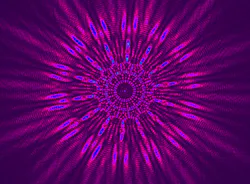
Structured light photonics, optical manipulation, chiral sensing
Three of the most obvious applications ahead are likely structured light photonics, optical manipulation, and chiral sensing. Another potential use is high-dimensional photonic information processing, because the beam links spin and orbital angular momentum in a controllable way.
“In principle, our discovery is relevant to both classical and quantum structured light, where information can be encoded within polarization (spinning light) and spatial modes (twisted light),” says Nape. “The photon spin and twist can be used as an alphabet within bright laser beams and at the single photon level. Each distinct state represents a different information symbol.”
The team’s present work is classical optical physics, but the same degrees of freedom, spin, orbital angular momentum, and spatial mode structure are also used for quantum photonics. “Our longer-term interest is whether this kind of topology-controlled spin-orbit structure can be useful for preparing, transforming, or encoding high-dimensional photonic states,” says Nape.
Next, the researchers plan to explore how general and useful this mechanism is. “We’ve shown the Pancharatnam topological charge can control spin and chirality for free-space propagation, and now the question is how far this control can be pushed,” says Nape. “We’re also interested in how it can be used for information encoding, optical manipulation, and chiral light-matter interactions. Our broader aim is to move from demonstrating an interesting structured light effect to developing it as a practical design principle.”
FURTHER READING
L. Mkhumbuza, P. Ornelas, A. Dudley, I. Nape, and K. A. Forbes, Light. Sci. Appl., 15, 214 (2026); https://doi.org/10.1038/s41377-026-02278-6.
About the Author
 Sally Cole Johnson
Sally Cole Johnson
Editor in Chief
Sally Cole Johnson is Laser Focus World’s editor in chief, and she has more than 25 years’ experience as a science and technology journalist. She specializes in physics and semiconductors, and wrote for the American Institute of Physics for more than 15 years, and also covered theoretical physics and neuroscience for the Kavli Foundation, and complexity for the Santa Fe Institute. Johnson has also written extensively about military embedded systems, high-performance computing, software-defined networks, and infosec. She is a member of the National Association of Science Writers (since 2001).
When she isn’t writing about optics, photonics, or quantum advances, you can find her outside in northern NH in the garden with birds landing in her hand or heading for the mountains with her bike, skis, or crampons and ice axe.