‘Beam combiner’ PIC proves powerful for astronomical interferometry
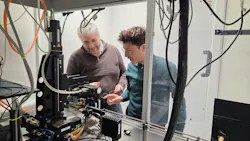
An ultrafast-laser-written “beam combiner” chip created by Heriot-Watt University’s Robert Thomson, a professor of photonics, and Aurélien Benoit, a postdoctoral research associate, in Scotland was recently put to the test during first-of-its-kind on-sky observations for the Chara ARay Integrated Optics Testbench (CHARIOT) at the CHARA Array on Mt. Wilson in California—and it proved it can replace larger, more complex mirrors and lenses.
Thomson became intrigued years ago by the possibility of using ultrafast lasers to write optical circuits directly within glass, which could then be useful for astronomy.
For astronomical interferometry, light collected by separate telescopes must be combined with extraordinary precision. “Developing laser-written photonic technologies for astronomy was the central aim of my U.K. STFC (Science and Technology Facilities Council) Advanced Fellowship, which began in 2010,” says Thomson. “This is a milestone in research that spans more than 15 years, and it reflects a sustained collaboration between photonics researchers and astronomers.”
Thomson and Benoit worked with Aline Dinkelaker, a physicist at the Leibniz Institute for Astrophysics Potsdam, and researchers from Humboldt University Berlin and University of Cologne in Germany, and Georgia State University to test their PIC in action.
PICs for astronomical interferometry
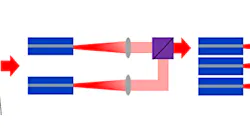
The group’s glass PIC guides and manipulates light via optical waveguides. “Bringing waveguides close together allows light to couple between them, which provides a way to split and combine optical signals,” explains Benoit. “For astronomical interferometry, we combine light from the same object collected by separate telescopes. This light produces interference fringes, and their contrast contains information about the object’s angular structure, such as the apparent diameter of a star. The resolving power depends on the separation between the telescopes, which allows us to explore details far smaller than either telescope could resolve individually.”
It also performs the beam-combination function and diverts light into calibration outputs, which allow fluctuations in incoming brightness to be accounted for.
Special sauce?
The PIC’s “special sauce” is its fabrication method, infrared operating band, and fiber-connected packaging. “We use ultrafast laser inscription—tightly focused, extremely short laser pulses—to permanently modify the refractive index inside glass to create buried waveguides,” says Benoit. “This approach gives us the freedom to route optical waveguides in three dimensions.”
The material? Infrasil, which is a high-purity silica glass with very low hydroxyl content. “Hydroxyl-related absorption can introduce unwanted losses within the infrared,” Benoit says. “Infrasil provides good transmission across the astronomical K-band—~2 to 2.4 µm—and is compatible with the waveguides we need.”
And glass provides “both the optical medium and a mechanically stable structure to hold the waveguide together,” he says. “Connecting the device to fibers makes it practical to install and exchange within an astronomical instrument.”
Sensitivity, calibration, and scaling
Sensitivity, calibration, and scaling are challenges. “We need to preserve as many photons as possible through the complete optical system, while controlling polarization, wavelength-dependent behavior, and background noise,” explains Thomson. “There’s also an important distinction between obtaining repeatable measurements and establishing their absolute accuracy. Our reported sub-1% precision concerns raw squared fringe visibility on bright stars. Extending this performance to fainter targets will require further improvements in sensitivity and calibration.”
Combining more telescope beams means the optical waveguides and calibration become more demanding. “The engineering challenge is to increase capability while retaining the stability and practical simplicity that make integration attractive,” he points out.
A win for photonics and astronomy
For Benoit, the most striking aspect of this work is the connection between the physical scale of the device and the scale of the measurement. “We’re making microscopic changes inside a piece of glass only a few centimeters long, but these changes help us extract information from light collected by widely separated telescopes,” he says.
A broader lesson, perhaps, is “how much depends on the complete instrument,” says Benoit. “A promising chip is the starting point. Fiber interfaces, packaging, detectors, calibration, and data analysis all determine whether this promise produces useful performance. Seeing these elements come together is especially satisfying after such a long program of research.”
On-sky demonstration
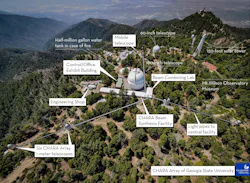
This work is an advance for photonics because it shows the chip can indeed deliver useful performance for real astronomical observing conditions. During 2024 and 2025, the PIC was put to the test in the CHARIOT instrument, and it recorded signals from a wide range of stars—including ones fainter than reached by the system it replaced.
“To our knowledge, it’s the first on-sky demonstration of this type of beam combiner within the K-band,” says Benoit. “The CHARIOT instrument that holds the photonic chip achieved better than 1% statistical precision in raw squared fringe visibility for bright stars.”
As far as astronomy, it’s another route to compact and stable instruments “that can exploit the resolving power of widely separated telescopes,” he says. “One particularly valuable aspect is the ability to test new photonic components within an operational observatory. It creates a practical connection between developing a device in the lab and establishing what it can contribute to astronomical measurements.”
Precise measurement of stars
The most immediate applications for the PIC are measuring stellar diameters, investigating close binary systems, and detecting faint emission from circumstellar dust.
“Exozodiacal dust is particularly interesting,” says Thomson. “It’s dust around other stars, analogous to the dust responsible for zodiacal light within our solar system. Understanding it helps us investigate planetary systems and assess the foreground emission that future instruments will encounter when trying to observe faint planets. These are among the science motivations for CHARIOT.”
Longer term, “extending the technology into the mid-infrared could support instruments for detecting and characterizing exoplanets and warm dust,” he adds. “The broader opportunity is to build sophisticated optical measurement functions into compact, robust devices.”
FURTHER READING
A. N. Dinkelaker et al., Mon. Not. R. Astron. Soc., 552, 2, stag1745 (Oct. 2026); https://doi.org/10.1093/mnras/stag1745.
About the Author
 Sally Cole Johnson
Editor in Chief
Sally Cole Johnson is Laser Focus World’s editor in chief, and she has more than 25 years’ experience as a science and technology journalist. She specializes in physics and semiconductors, and wrote for the American Institute of Physics for more than 15 years, and also covered theoretical physics and neuroscience for the Kavli Foundation, and complexity for the Santa Fe Institute. Johnson has also written extensively about military embedded systems, high-performance computing, software-defined networks, and infosec. She is a member of the National Association of Science Writers (since 2001).
When she isn’t writing about optics, photonics, or quantum advances, you can find her outside in northern NH in the garden with birds landing in her hand or heading for the mountains with her bike, skis, or crampons and ice axe.
Related
 A photograph of the 10-telescope MRO Interferometer facility, with drawings of the telescopes superimposed, is shown.