Radio telescopes benefit from ultraprecise optical frequency combs
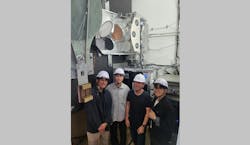
Very long baseline interferometry (VLBI), a technique in which multiple radio telescopes observe simultaneously, aligns the phases of faint radio signals received from space received by each telescope as if aligning them to a single precise ruler. But existing electronic reference signal methods struggle as observation frequencies increase, which turns precise phase calibration into an even bigger challenge.
As a solution, a team of researchers led by Jungwon Kim, a Korea Advanced Institute of Science and Technology (KAIST) professor, are directly applying optical frequency combs (OFCs) to radio telescope receivers. Their single optical system, developed in collaboration with the Korea Astronomy and Space Science Institute (KASI), the Korea Research Institute of Standards and Science (KRISS), and the Max Planck Institute for Radio Astronomy in Germany, takes care of both reference signal generation and phase calibration problems (see video).
Kim has long suspected OFCs would be highly beneficial for radio astronomy due to their coherent link between the optical and microwave domains and their exceptional timing performance.
“Researchers from KRISS and KASI approached me in 2021 to discuss applying OFC technology to radio antennas,” he says. “We identified the necessary technical elements and explored how OFCs could be most effective. Through the process, I gained a deeper understanding of radio telescope receivers and realized that phase calibration was a critical bottleneck—and it became clear OFCs could provide a very effective solution.”
It led to a five-year research grant in 2022, and Kim’s team began their full-scale research.
New reference signal technology for radio telescope receivers
The basic concept behind the team’s new approach involves using an OFC as a versatile signal source. “For the time domain, an OFC generates a train of ultrashort pulses at regular intervals,” says Kim. “And for the frequency domain, this corresponds to a series of regularly spaced spectral lines, similar to the teeth of a physical comb.”
For VLBI, signals from multiple widely dispersed radio telescopes are combined and it requires two critical components: a high-frequency, low-noise local oscillator (LO) signal for downconverting radio signals, and a series of RF tones (an RF comb) at regular intervals for phase calibration.
As observation frequencies increase and span multiple bands, “generating these signals through purely electronic means is becoming increasingly difficult,” says Kim. “Our design uses the OFC to overcome this limitation. By performing optical-to-electronic conversion of the OFC using a high-speed photodiode, we can generate a wideband RF comb. From this comb, we can either use the series of tones for phase calibration or extract a single tone to serve as a high-performance LO signal. In short: OFC allows us to handle both calibration and downconversion with a single photonics-based system.”
How does the team’s approach work? It begins by locking the OFC to a hydrogen maser, which serves as the reference signal for the antenna and ensures the OFC inherits the hydrogen maser’s stability and accuracy.
The optical signal “is then transmitted through approximately 100 meters of optical fiber to the receiver room at the antenna,” explains Kim. “To prevent timing fluctuations caused by environmental factors such as temperature changes or vibrations, we use a fiber stabilization system. This system compares the timing of the pulses reflected from the far end of the fiber with the incoming pulses and actively compensates for any detected timing drift.”
At the receiver, a high-speed photodiode performs the optical-to-electronic conversion. “The resulting wideband RF comb is used directly for phase calibration, while specific high-frequency harmonics are extracted to serve as the LO signals,” Kim says. “Finally, these signals are injected into the telescope system to facilitate precise downconversion and calibration.”
Next-level engineering for real-world telescope systems
While the underlying principles may seem straightforward, implementing them in a complex, real-world system is always a high-stakes process. “There’s a specific kind of tension when you first power everything up at a telescope site because so many variables are at play,” says Kim.
An aha! moment for the team hit when they first injected the OFC signals into the antenna and successfully extracted the phase calibration (PCAL) signals. “Seeing the first fringe signal was incredibly rewarding,” says Kim. “In VLBI, the fringe is the ultimate proof that the entire system is working in perfect harmony across the network. It was a moment of great relief and joy for the entire team to see our ideas finally manifest as a clean physical signal.”
The transition from a university laboratory to continuous operation within a real facility is a significant system challenge because the environment at a telescope site is far less ideal than within a controlled lab, and ensuring sensitive instruments work reliably in the field requires next-level engineering.
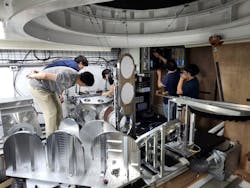
“Several subsystems involved in this work, such as the fiber frequency comb source, the fiber stabilization system, and the laser-RF locking systems, were all developed and home-built by my graduate students at our KAIST laboratory,” Kim says. “My students then moved these systems to the telescope site and handled the entire installation process. Making these systems function at a real-world facility required much more dedicated effort than in the lab—and I truly appreciate the hard work of my students, who successfully merged these difficult installation and stabilization tasks at an active telescope site.”
The team recently installed a second photonics-based system at the Korean VLBI Network Pyeongchang telescope, which allows them to conduct multi-antenna experiments to verify how much this photonics approach truly benefits broadband phase calibration. “Our goal is to see the system adopted for higher-frequency multiband antennas worldwide, which would enable more precise observation within the millimeter-wave and submillimeter-wave regimes,” says Kim.
Beyond antennas: Optical atomic clocks
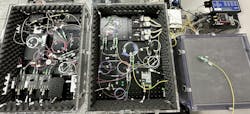
In another effort, the team is working to deliver accurate atomic clock signals from KRISS via fiber links. “By linking each antenna to optical atomic clocks, we can perform intercontinental clock comparisons,” says Kim. “By observing the same radio source and carefully calibrating the instrumental and atmospheric delays, we can compare the frequency stability and accuracy between atomic clocks across the great distances. If successful, this will be a key technology for the operation of future optical atomic clocks and the eventual redefinition of the International System of Units’ (SI) second based on these new standards.”
FURTHER READING
M. Hyun et al., Light Sci. Appl., 15, 53 (2026); https://doi.org/10.1038/s41377-025-02056-w.
About the Author
 Sally Cole Johnson
Sally Cole Johnson
Editor in Chief
Sally Cole Johnson is Laser Focus World’s editor in chief, and she has more than 25 years’ experience as a science and technology journalist. She specializes in physics and semiconductors, and wrote for the American Institute of Physics for more than 15 years, and also covered theoretical physics and neuroscience for the Kavli Foundation, and complexity for the Santa Fe Institute. Johnson has also written extensively about military embedded systems, high-performance computing, software-defined networks, and infosec. She is a member of the National Association of Science Writers (since 2001).
When she isn’t writing about optics, photonics, or quantum advances, you can find her outside in northern NH in the garden with birds landing in her hand or heading for the mountains with her bike, skis, or crampons and ice axe.