Interdigitated graphene metamaterial enables EAM devices
A shift in academic work toward two-dimensional (2D) graphene metamaterial electro-absorption modulators (EAMs) appears to be underway. Unlike typical semiconductors, these modulators aren’t limited by their bandgap bandwidth and can open the door to extremely efficient broadband optical modulators that are suitable for short-reach links and transceivers used for data centers or cloud computing.
What’s an interdigitated graphene metamaterial, you ask? Pretty much what it sounds like—a mashup of a fingerlike electrode pattern with a material engineered to have the electronic properties of graphene that can manipulate light waves.
EAMs modulate light intensity by altering the absorption coefficient of active material through an applied electric field. “Graphene has a linear Dirac cone structure and zero bandgap, so it can absorb light uniformly across a broad range,” explains Ehab Awad, a professor of electrical engineering at King Faisal University in Saudi Arabia, whose team recently created an interdigitated graphene metamaterial and built an EAM device. “When a gating voltage is applied, the Fermi level of graphene is raised and the optical transitions are suppressed due to the state filling (Pauli blocking). This makes the material transparent in a process called saturable absorption.”
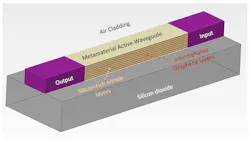
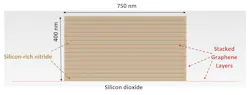
The graphene EAM device’s single-mode active metamaterial waveguide is made of 15 interdigitated graphene layers separated by 25-nm-thick layers of silicon-rich nitride (see Figs. 1 and 2), which act as a three-dimensional (3D) capacitor. Applying an external voltage “alters the chemical potential of the graphene and enables the device to be switched from near total light absorption (off state) to high transparency (on state),” he says. “The metamaterial design optimizes the area of light-matter interaction, which leads to a high absorption coefficient, low insertion loss, and a compact overall device footprint.”
Surprises? Its measured electro-optic bandwidth (up to 46 GHz) was substantially larger than the theoretically expected electrical 3-dB bandwidth (20.2 GHz). “This is due to the nonlinear steep slopes of the transfer function of the EAM that transformed small electrical inputs into much larger optical outputs, which results in a clear signal at higher frequencies,” says Awad. “The system also shows an amazing power to change data and, at the same time, clean noisy input amplitudes.”
One remaining challenge is that fabrication problems such as uniformly separating the metamaterial layers can impact the modulation bandwidth of the device. “Any change in manufactured quality of the graphene or silicon-rich nitride might modify the chemical potential and dielectric constant, which adversely affect the predicted operating voltage range and total device capacitance,” he says.
Short-reach data transfers
The team’s graphene EAM is intended “for short-reach data transfers between servers and switches in data centers,” says Awad. “It’s also well suited for wavelength-division multiplexing (WDM) by transmitting electrical data at several shortwave-infrared wavelengths within the range of 1 to 2 µm. And it’s also a strong contender for a data repeater to use in or between data centers because it can recover amplitude from noisy data.”
What’s next? Their EAM device “shows promise for ultrafast short-reach optical interconnects and regenerative transceivers in cloud computing data centers with limited space and thermal management constraints,” says Awad. “Its broadband strength also makes it a good contender for sophisticated WDM networks. And the femtosecond recovery time of graphene may also make EAM a good choice for all-optical modulation applications.”
FURTHER READING
E. Awad, Opt. Express, 34, 34086–34097 (2026); https://doi.org/10.1364/oe.610064.
About the Author
 Sally Cole Johnson
Editor in Chief
Sally Cole Johnson is Laser Focus World’s editor in chief, and she has more than 25 years’ experience as a science and technology journalist. She specializes in physics and semiconductors, and wrote for the American Institute of Physics for more than 15 years, and also covered theoretical physics and neuroscience for the Kavli Foundation, and complexity for the Santa Fe Institute. Johnson has also written extensively about military embedded systems, high-performance computing, software-defined networks, and infosec. She is a member of the National Association of Science Writers (since 2001).
When she isn’t writing about optics, photonics, or quantum advances, you can find her outside in northern NH in the garden with birds landing in her hand or heading for the mountains with her bike, skis, or crampons and ice axe.