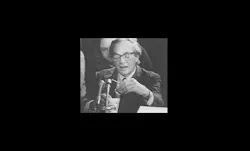
What would Richard Feynman have thought of artificial intelligence (AI)? If still alive, he’d be unusually suited to answer the question because he was a Nobel Prize-winning physicist, a gifted teacher, and a lifelong tinkerer. Faced with something new, he wanted to take it apart and understand why it worked.
It sounds like a pretty good approach to AI. This is less speculative than it first appears. Feynman became interested in AI and neural networks during the 1980s.1 At Caltech, he, John Hopfield, and Carver Mead explored links among brains, computers, and physics.2 And their questions led to today’s systems that can reason, code, recognize images, and generate designs. My guess is that after asking how it works, Feynman’s next question would be: “What can I invent with it?”
Feynman was already thinking about intelligent machines
For a theoretical physicist, Feynman had an unusual interest in computers. His clearest bridge to modern AI came at Caltech. In the early 1980s, Feynman joined Mead and Hopfield around the graduate course The Physics of Computation. The 1982-83 Caltech catalog lists all three as instructors and describes computation across logic gates, neurons, and other physical systems.3
Hopfield published his landmark neural-network paper in 1982. His model showed how many simple neuron-like elements could create associative memory, with network states moving toward learned stable memories.4 He later shared the 2024 Nobel Prize in Physics for foundational work underlying modern machine learning.
Feynman then worked with Danny Hillis and Thinking Machines on the massively parallel Connection Machine. Hillis said Feynman first called the million-processor concept the “dopiest idea” he’d heard.5 Then he helped build it. Very Feynman: Doubt it, test it, get your hands dirty.
AI as an invention partner
Most AI discussions focus on productivity. Useful, certainly. But for me, the more interesting opportunity is invention. AI can participate in the invention loop.
I use AI almost like a multidisciplinary engineering team. A mechanical problem can quickly lead to biology, optics, materials, electronics, or control theory. And often, the value is a connection I wouldn’t have made on my own.
I also push toward physical reality. Why should this work? What dimensions and materials are required? Can we calculate the first-order physics? Can we make and test it? I often reject an answer or change a requirement. The idea that survives can look very different.
Sometimes AI exposes the invention beneath the embodiment. One implementation may reveal a broader physical principle, and then the question becomes: What else can this principle create?
AI should not replace invention. It should increase the number and quality of useful intellectual collisions. Producing 100 ideas is not innovation. Producing one idea that is new, useful, defensible, and able to survive an experiment is.
Does the machine actually understand?
I doubt Feynman would spend much time debating whether a large language model (LLM) truly “understands.” He cared about the difference between knowing the name of something and understanding it.
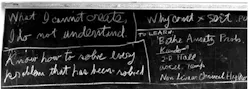
His final office blackboard contained the line: “What I cannot create, I do not understand.”6 For an inventor, it’s a demanding standard. Understanding means being able to predict, modify, or create.
Don’t merely ask AI for an answer. Change an initial condition. Introduce a conflicting requirement. Ask for different architectures. Ask what assumption each depends on and what experiment would prove it wrong. In other words: Find the boundaries. A polished explanation is not validation.
Cargo cult innovation?
In his 1974 Caltech address “Cargo Cult Science,” Feynman warned about work that looks like science without all of its rigor.7 His concern was fooling ourselves. AI gives us a remarkably efficient new way to do that.
AI can produce a beautiful invention disclosure, equations, a patent-style claim, and a confident explanation of novelty. None of this makes the idea work.
The runway may look excellent. The question is whether the airplane lands.
A five-minute-old idea can now arrive wearing a suit and carrying a market analysis. So ask: Does it violate a physical limit? Has somebody already done it? Can we build a proof of concept? What result would make us abandon it?
The mistake is not using AI to invent but rather letting presentation quality masquerade as technical quality.
Nonlinear attraction
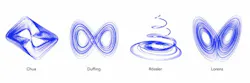
My graduate work centered on nonlinear dynamics and a sinusoidally forced pendulum used to demonstrate chaos.8 Simple rules can produce remarkably complex results.
Neural networks have some of this same attraction. Many simple computational elements interact, but no single element contains the behavior we see in the whole.
The Hopfield connection makes the attractor analogy more than a metaphor. A Hopfield network is a dynamical system in which learned memories behave as attractors. It’s not the same as a Lorenz strange attractor, nor proof that today’s LLMs contain them—but it is an intriguing bridge.
Feynman looked for understandable mechanisms beneath complicated behavior. I suspect AI interpretability would have fascinated him. Why does one prompt work while another fails? Could there be something analogous to strange attractors in AI’s huge state space?
I see a practical version in my own invention work. Change a few words, reverse an assumption, or ask from another engineering discipline and the AI may head toward a different family of solutions. I now do this deliberately: perturb the prompt and see where else it goes.
For invention, that sensitivity can be useful. An unexpected design may reveal a deeper principle that can be generalized.
From idea generation to discovery
I believe Feynman would be most interested in AI applied to science and invention: Searching design spaces, building models, examining data, and proposing experiments.
His 1982 paper “Simulating Physics with Computers” helped lay the groundwork for quantum computing.9 If nature is quantum mechanical, he reasoned, perhaps a machine intended to simulate nature efficiently should be quantum mechanical too.
AI gives inventors a similar invitation. It can move among technical domains and expose analogies that are easy to miss. A medical-device mechanism may solve a footwear problem. Computational photography may suggest a new sensor. Biology may inspire a thermal solution.
But there would be a Feynman test: Did we discover something we did not know before? The exciting possibility is reaching a solution that neither the inventor nor the model would have reached independently.
Takeaway
So what would Richard Feynman have thought of AI? I believe he would have loved it. Not uncritically. He would probe it, break it, challenge it, understand its failure modes, and then put it to work. That is also how I think inventors should use it.
My experience is that AI’s greatest value is not replacing invention. It lets me explore more directions, test them faster, and keep an unexpected connection alive long enough to become an experiment.
AI shouldn’t become an oracle beside the inventor. It’s better as a fast, broad, occasionally wrong collaborator that never tires of being asked: “What if?”
The inventor still has the critical job: Choose the problem, supply physical intuition, challenge assumptions, recognize the odd result, test it, and decide what is worth pursuing. Feynman called it the pleasure of finding things out. For inventors, there is another pleasure: Finding something out and realizing that nobody appears to have built it yet.
And this brings me to the question I think Feynman would ultimately ask: What can we use this remarkable new machine to discover—and then create—that nobody has thought of yet? It sounds like a pretty good day of inventing.
REFERENCES
1. E. Mjolsness, arXiv:2209.00083 (2022); https://doi.org/10.48550/arXiv.2209.00083.
2. W. Clavin, “The Roots of Neural Networks: How Caltech Research Paved the Way to Modern AI,” Caltech Magazine (Jun. 4, 2025); https://magazine.caltech.edu/post/ai-machine-learning-history.
3. California Institute of Technology, Caltech Catalog 1982-1983, Bi/CS/Ph 250 abc, “The Physics of Computation.” The catalog lists Carver Mead, John Hopfield, and Richard Feynman as instructors and describes computation across physical devices, neurons, and large-scale parallel systems.
4. J. J. Hopfield, Proc. Nat. Acad. Sci., 79, 8, 2554–2558 (1982); doi:10.1073/pnas.79.8.2554.
5. W. D. Hillis, Phys. Today (Feb. 1989); doi:10.1063/1.881196.
6. Caltech Archives and Special Collections, “Richard Feynman’s blackboard at the time of his death,” Caltech Images Collection (1988).
7. R. P. Feynman, “Cargo Cult Science,” Caltech commencement address (1974).
8. F. C. Thomas III, “Design of a Sinusoidally-Forced Pendulum for the Demonstration of Chaotic Phenomena,” Bucknell University M.S. Engineering Thesis.
9. R. P. Feynman, Int. J. Theor. Phys., 21, 6/7, 467–488 (1982).
About the Author
 Fred Thomas
Fred Thomas is a Distinguished Technologist in HP’s Advanced Compute and Solutions (ACS) business and an inventor with more than four decades of experience turning emerging technologies into practical products. He holds more than 100 U.S. patents spanning data storage, electro-optics, machine vision, digital pen technology, nanostructures, and thermal systems.
His technical contributions have helped enable products from Iomega’s Zip and Jaz drives to HP digital pen platforms and the HP Z Captis material digitization system, which received a CES 2025 Best of Innovation Award and a 2025 Laser Focus World Innovators Gold Award. Thomas also invented AO-DVD, an ultra-high-density optical storage concept using subwavelength nanostructures. He holds degrees in mechanical engineering and physics from Bucknell University and serves there as an Innovator in Residence, sharing experience in invention, intellectual property, and emerging technology. Through his Laser Focus World writing, he explores emerging technologies and the craft of invention—how ideas are discovered, evaluated, developed, protected, and translated into products and impact. His perspective is grounded in the belief that successful invention combines technical depth with structured curiosity, persistence, and a practical understanding of value.
Related
 dreamstime_xxl_169765834
 A recent public view of the datacom transceiver global market and how Generative-AI is driving deployment of 800G+ transceiver solutions into the optical network.