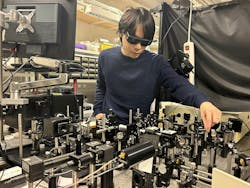
Artificial intelligence (AI) relies on tensor operations—think complex math/computations—for everything from image recognition to natural language processing, and an international team of researchers led by Professor Zhipei Sun’s photonics group at Aalto University’s Department of Electronics and Nanoengineering in Finland recently came up with a single-shot tensor computing approach via a single propagation of light to speed AI up (see video).
The physical properties of light—instead of electronic circuits—can perform many computations simultaneously at the speed of light.
“Optical computing is an emerging field and, inspired by previous work, I became interested in it,” says Yufeng Zhang, a postdoctoral researcher in Sun’s group. “But in most previous demonstrations, the degree of parallelism achieved was still lower than electronic hardware such as graphics processing units (GPUs), whose core strength lies in massively parallel matrix-matrix multiplication. This mismatch meant most optical systems couldn’t truly meet the needs of general-purpose AI computation.”
During the summer of 2023, Zhang began to wonder: Is it possible to achieve matrix-matrix multiplication or even tensor-matrix multiplication in a single optical propagation? “One day, while reading Professor Joe Goodman’s Introduction to Fourier Optics, I came across the ‘Stanford method,’ an early spatial optics-based vector-matrix multiplier. And it triggered the question: Why is a two-dimensional optical field used only to encode one-dimensional vectors? It marked the beginning of our work,” he says.
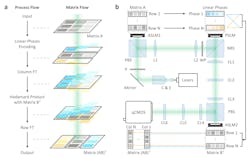
The core concepts behind the team’s work stem from wave optics—particularly the properties of optical Fourier transforms (see Fig. 1).
How does the team’s method work? “We encode the input matrix A directly into the spatial amplitude of an optical field,” explains Zhang. “By exploiting the phase-position duality between the spatial and spatial-frequency domains, we assign each row of matrix A with a distinct linear phase gradient. Through a combination of optical Fourier transformation and imaging, the light fields corresponding to all encoded rows are mixed in space.”
Within this mixed field, “every row vector of A performs a dot product with every column vector of B in parallel,” Zhang says. “The linear phase encoding acts as a positional tag, which ensures each result naturally appears at the correct location of the output matrix—all within a single propagation of light.”
Because linear phase modulates different wavelengths differently, multiwavelength multiplexing extends this approach from matrix-matrix multiplication to tensor-matrix multiplication.
Aha! moments
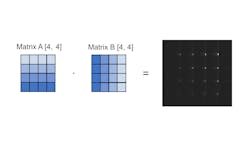
Two moments of this work really stood out for Zhang. “The first was during the winter of 2023. After spending three months assembling and aligning our first prototype system, I tested two simple [4,4] matrices,” he says. “When the detector showed 16 distinct intensity spots (see Fig. 2), exactly matching the expected output, I was thrilled. It was the first clear sign the method truly worked. Although this data didn’t appear in the final paper, it remains my personal favorite.”
Another of these moments occurred during the summer of 2024. “I wondered whether a standard neural network weight could be used directly in our optical tensor processor,” Zhang recalls. “Traditional optical neural networks are designed around optical propagation physics, which differs from the structure of standard neural networks. As a proof of principle, we numerically reconstructed an idealized version of the system and directly inserted the unmodified weights of a conventional convolutional neural network. To my surprise, the inference accuracy was almost identical to the digital model. This result convinced us that if engineering challenges can be addressed, our method could genuinely contribute to future computing technologies.”
And yes, their work involved simulations. “Because our work is fundamentally methodological, we conducted extensive simulations both for validating the computational method itself and demonstrating its application in optical neural networks,” says Zhang. “These simulation results form an integral part of our study—by supporting the method’s reliability and revealing its limitations.”
System alignment and calibration challenges
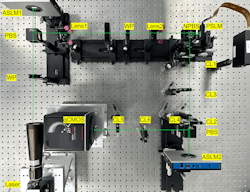
Two major challenges were involved in this work. “First, system alignment. Achieving pixel-level alignment between spatial light modulators (SLMs) is extremely difficult,” says Zhang. “To address it, I developed a pixel-level calibration technique, which we included in the supplementary information of our recent paper in Nature Photonics in the hope that it may help other researchers facing similar alignment tasks.”
The second challenge was the setup itself (see Fig. 3). Because it’s “a laboratory-scale optical system, noise and environmental disturbances make it difficult to reach the accuracy predicted by theory,” Zhang says. “We performed extensive calibration and optimization; while the performance isn’t perfect, it’s sufficient to validate our method.”
Parallelism ahead
The team’s work increases the level of parallelism achievable in general-purpose photonic computing—and potential applications include acting as an efficient computing platform for neural networks or quantum simulation combined with future optical devices.
As far as a timeline for practical deployment, “it’ll require high-speed optoelectronic interfaces and system components, along with implementation on integrated photonics platforms. These directions form the core of our upcoming research,” says Zhang.
About the Author
 Sally Cole Johnson
Sally Cole Johnson
Editor in Chief
Sally Cole Johnson is Laser Focus World’s editor in chief, and she has more than 25 years’ experience as a science and technology journalist. She specializes in physics and semiconductors, and wrote for the American Institute of Physics for more than 15 years, and also covered theoretical physics and neuroscience for the Kavli Foundation, and complexity for the Santa Fe Institute. Johnson has also written extensively about military embedded systems, high-performance computing, software-defined networks, and infosec. She is a member of the National Association of Science Writers (since 2001).
When she isn’t writing about optics, photonics, or quantum advances, you can find her outside in northern NH in the garden with birds landing in her hand or heading for the mountains with her bike, skis, or crampons and ice axe.