Advanced echelle gratings enable high-precision exoplanet detection
Radial velocity (RV) is a leading technique for exoplanet detection and characterization, which measures Doppler shifts in a star’s spectrum caused by the tiny wobble induced by an orbiting planet. By measuring the periodic red and blue shifts in spectral lines induced by the star’s motion in the radial direction, RV measurements enable the determination of orbital parameters and provide a minimum mass for the companion. Detection of these tiny spectral shifts requires both extremely high spectral resolution and long-term measurement stability.
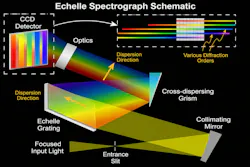
RV measurements are achieved via a high-resolution spectrograph that disperses starlight into its constituent wavelengths and precisely records the positions of the star’s absorption lines. In an RV spectrograph, light from the telescope enters through a slit, is collimated, and then encounters an echelle grating, a key enabling component the heart of the instrument, which disperses the light into multiple diffraction orders (see Fig. 1).
Ruled echelle gratings are used for this application and direct most of the diffracted energy into high orders, where wavelength separation is greatest. This provides the spectral resolution needed to detect tiny Doppler shifts associated with planetary signals. Because these high orders overlap, a second dispersive element, typically a grating-prism hybrid known as a “grism” is used to separate them in the perpendicular direction. The resulting array of spectra is recorded on a large-format charge-coupled device (CCD) detector, which enables thousands of stellar absorption lines to be measured simultaneously across a broad wavelength range.
The advanced Radial-Velocity All-Sky Search-2 (PARAS-2) spectrograph, developed by India's Physical Research Laboratory, is one example of MKS' Newport Richardson Gratings supports astronomical spectroscopy at the Mount Abu Observatory in India.
Similar mosaicked ruled echelle gratings are also used for other high-precision RV instruments, such as The High Accuracy Radial Velocity Planet Searcher 3 (HARPS3), part of the Terra Hunting experiment, which further shows the scalability and performance of our ruled grating technology for exoplanet detection and characterization (see Fig. 2).
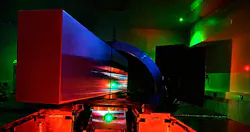
The demanding performance requirements of modern RV spectrographs for detecting tiny Doppler shifts places equally demanding requirements on their diffraction gratings and cross-dispersing optics. Advanced echelle grating technology helps achieve the performance needed for modern exoplanet discovery.
High-precision radial velocity spectroscopy
The PARAS-2 spectrograph is installed on a 2.5-meter telescope at Mount Abu Observatory in India, and it delivers a spectral resolution of R ≈ 107,000 across the 380- to 690-nm wavelength range.1
It is engineered to push performance toward the sub-meter-per-second regime by combining high spectral resolution with exceptional instrumental stability and control of subtle noise sources. It delivers light through two optical fibers: One delivers starlight collected from the telescope, while the other delivers light from a calibration source that consists of a uranium-argon hollow cathode lamp and Fabry-Pérot etalon. This enables continuous drift monitoring via wavelength reference and improves long-term calibration and repeatability.
The spectrograph’s fiber-fed architecture allows it to be environmentally isolated from the telescope—housed within a vacuum chamber enclosed by nested thermal shells to maintain a temperature of 22.5°C ± 0.001°C and a pressure of 0.005 ± 0.0005 mbar. It limits instrumental drift to below 30 cm/s, which helps prevent thermal effects from masking planetary signals.
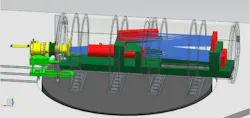
This high-precision radial velocity spectrograph also uses a white-pupil optical design to reduce aberrations and beam walk, and maintains consistent illumination across echelle orders (see Fig. 3). Spectra are recorded on a 6144 × 6190 back-thinned CCD with high quantum efficiency across the 380- to 690-nm band.
Advanced echelle grating fabrication
The high-precision radial velocity spectrograph requires both high resolving power and wide spectral coverage, and achieving it requires a grating with a low groove frequency and high blaze angle so that most of the incident light is dispersed into high orders—to provide enough wavelength separation and sufficient signal intensity for high spectral resolution sensing across a broad spectral range.
But the combination of low groove frequency and high blaze also results in deep grooves, approximately 7 µm in this case, which is a ~10x larger depth than most gratings. Fabricating a grating with all the necessary performance characteristics—blaze angle, groove depth, groove frequency, efficiency, and spectral range—is well beyond the capabilities of holographic production processes, which makes a traditional ruled grating the only option.
Producing such deep grooves presents several challenges. The burnishing tool must displace substantial volumes of material without chipping or distorting the groove walls, maintain a precise blaze angle across tens of thousands of grooves, and operate over lengthy ruling runs where even minor thermal drift or vibration can compromise accuracy. And the PARAS‑2 design raised the difficulty bar even further by requiring a grating measuring 840 × 214 mm.
The complex manufacturing process began by fabricating a 220 × 420 mm master echelle grating on the MIT B ruling engine. It was ruled onto an aluminum-coated Zerodur substrate using a diamond tool under highly stabilized environmental and vibrational conditions.
Two 214 × 415-mm replica gratings were then produced from this master. Both of these gratings were mounted and aligned onto a specialized precision fixture. Once the alignment was complete, the two aligned gratings were replicated to a monolithic Zerodur substrate to yield the required 214 × 840-mm grating.
This mounting process demanded nanometer-level alignment accuracy between segments to prevent spectral discontinuities and preserve resolving power. To achieve it, every adjustment in the relative position of the two replicas was followed by a thermal settling period of several days before reverifying alignment.
Acceptance testing of the mosaic grating showed: Peak perpendicular polarization and parallel polarization plane absolute average diffraction efficiency measured >60% for orders peaking between 398 to 697 nm, spectral resolution >700,000, and spatial resolution was <2 arcseconds. The diffracted wavefront across sub-apertures demonstrated irregularity <0.07 wave at 633 nm. The result was a large-format mosaic grating with a performance indistinguishable from a smaller 214 × 415-mm grating (see Fig. 4).
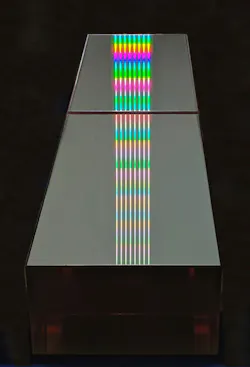
The high-precision radial velocity spectrograph’s design also requires a 240 × 240 mm cross-dispersing component, a grism. Beyond demanding optical figure and spectral performance requirements, the component was significantly larger than typical astronomical grisms.
So we fabricated a new replicated grating from an existing master, and then replicated it further to form a grism. As in the case of the echelle grating, maintaining the required groove orientation across such a large surface demanded extreme mechanical stability and metrology accuracy during assembly.
Exoplanet discoveries
The PARAS‑2 spectrograph began service during mid-2022, when it joined an exclusive group worldwide of high-precision RV spectrographs coupled with meter-class telescopes. Since entering service, it has contributed to two confirmed exoplanet discoveries. The second, announced in February 2025, is a planet of 78.5 Earth masses and a size of 6.41 Earth radii orbiting an F-type star.
Its success highlights the power of the RV detection method. Large, high-accuracy echelle gratings are at the heart of RV instrumentation, and the fabrication technology for producing these gratings sets the foundation for next-generation spectrographs on 30-meter-class telescopes and future space-based observatories to detect Earth-like planets.
MKS makes new master gratings and supplies advanced ruled echelle, echellete and mosaicked gratings, and grisms for demanding astronomical and scientific spectroscopy applications worldwide.
ACKNOWLEDGEMENT
Newport and Richardson Gratings are trademarks of MKS Inc.
REFERENCES
1. A. Chakraborty et al., Bull. Soc. R. Sci. Liège, 93, 2, 68-88 (2024); https://doi.org/10.25518/0037-9565.11602.
2. A. Chakraborty et al., Proc. SPIE, 10702, 107026G (Jul. 20, 2018); https://doi.org/10.1117/12.2313055.
About the Author
Angshuman Deka
Angshuman Deka, Ph.D., is a principal mechanical engineer at Newport Richardson Gratings, MKS Inc.
Robert Bourdelais
Senior Global Business Development Manager, MKS Newport
Robert Bourdelais is senior global business development manager at MKS Inc.'s Photonics Solutions Division. He holds an MS in Mechanical Engineering from the Rochester Institute of Technology, a BS in Mechanical Engineering from the University of Buffalo, and a BS in Physics from Geneseo College.
Robert has 30 years of combined experience in engineering, R&D, operations management, product management, marketing, and sales. He has published several research papers, presented at various industry conferences, and has authored over 190 US patents. In 2002, Rob was awarded the prestigious Eastman Innovator award and was a multi-year member of the Eastman Kodak Research Scientific Council.