Optical data storage approach dynamically conceals/reveals images
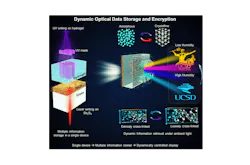
A new approach to optical data storage developed by Professor Abdoulaye Ndao’s lab at the University of California, San Diego stores multiple images within a compact device that can be retrieved via ambient light—no need for specialized optics. It moves us a step closer toward user-friendly optical encryption and displays.
Optical information storage has successfully increased storage capacity from two-photon 3D memory to optical disks and metasurface multiplexing, but this density comes at the cost of making retrieval conditional upon a precisely specified probe—a particular wavelength, polarization, angle, or reference wavefront. The information is dense, but either requires complex encoding methods or is only accessible through an instrument built to match the encoding.
“Our question was whether the stimulus state of the medium itself can serve as the multiplexing dimension instead,” says Ndao. “If different channels become eligible under different environmental conditions, rather than different optical ones, retrieval needs no special optics—you illuminate with white light and change the state of the medium to select a channel. This moves multiplexing from a property of the illumination to a property of the storage medium.”
The motivating factor behind Ndao’s work was the gap between two well-developed but largely incompatible paradigms: High-density static optical storage on one side, and dynamic, stimuli-responsive photonic materials on the other. “Our question was narrow and concrete: Can we put a rewritable channel and dynamically switchable channel into the same thin-film stack, address them independently, and read both out under ordinary white light with no auxiliary optics? Neither material system is new on its own,” he says.
Fundamentals first
The group’s work centers on three mechanisms that operate within one stack: Nonvolatile phase switching, cavity tuning by hydrogel swelling, and disordered plasmonic enhancement.
For nonvolatile phase switching, Ndao’s group uses antimony trisulfide (Sb2S3), which is a chalcogenide phase-change material (PCM) suited to visible-range photonics because it combines a large refractive index contrast between its amorphous and crystalline states (∆n ≈1.0) with a wide bandgap and relatively low optical loss within the visible.
“A focused nanosecond laser pulse locally heats the crystalline film above its melting point and quenches it into the amorphous state,” says Ndao. “And a continuous-wave laser or thermal annealing drives it back to a crystalline state. These are the write and erase operations for the first data channel. Because the phase transition is nonvolatile, data is retained without any power input—unlike conventional electronic memory.”
Cavity tuning by hydrogel swelling involves a carboxymethyl cellulose hydrogel (CMC-N3), which forms the spacer layer of a plasmonic resonator cavity. “When water vapor is absorbed, the hydrogel swells and increases the cavity’s physical thickness,” he explains. “This shifts its optical resonance to longer wavelengths—and it essentially converts an ambient environmental variable (humidity) into a tunable color filter. Because the hydrogel is patterned by UV exposure through a photomask, regions of different crosslinking density swell by different amounts, which creates spatially resolved color contrast that encodes the second data channel.”
Disordered plasmonic enhancement is achieved via evaporated silver (Ag), which self-aggregates into discontinuous nanoislands and supports broadband localized surface plasmon resonances. “These sharpen and saturate the transmitted color without any lithographic patterning, and their porosity lets water vapor through to the hydrogel below,” says Ndao.
For the encoding part, the stack on glass is a layer of 20-nm Sb2S3 with a 7-nm SiO2 cap, a layer of 160-nm CMC-N3 hydrogel, and then 25 nm of self-aggregated Ag nanoislands. “The Sb2S3 is crystalized by annealing and then written by local amorphization with a 527-nm pulsed laser focused through the substrate, and a 405-nm continuous-wave laser recrystallizes to erase,” he says. “And the hydrogel is spin-coated and exposed through a photomask, which fixes a spatial map of crosslinking density. It means two independent patterns sit at two different heights within a stack about 200-nm thick.”
Every point on the device is an independent Fabry-Pérot-type resonator, bounded below by the Sb2S3 and above by the Ag nanoisland layer, with the hydrogel as the spacer. “What’s transported at this point is set by the optical path length of its own local cavity, along with the plasmonic response of the Ag layer,” Ndao says. “Two variables set the path length independently—the local state of the Sb2S3 underneath (amorphous vs crystalline, (∆n ≈1.0), which shifts the resonance due to refractive index change; and the local hydrogel thickness, h, which is determined by crosslinking density locally, and ambient humidity together.”
Each pixel transmits a color that encodes the state of both layers at this position. Retrieval isn’t a decoding computation—it’s a direct spatial imaging of the transmitted color field. “Contrast appears wherever neighboring pixels have different resonance conditions,” he says.
For retrieval, the readout itself, illumination is broadband incoherent white light in transmission. “The image is formed by whatever imaging system is on the far side,” Ndao says. “No polarizer, narrowband source, specific incidence angle, reference beam, or phase reconstruction is needed. This is the practical difference from metasurface multiplexing, in which the encoded channels are only separable under the specific illumination condition each was written for.”
Challenges to overcome
One hurdle left to clear is the hydrogel channel is write-once. “Ultraviolet (UV) crosslinking of CMC-N3 is an irreversible covalent reaction,” says Ndao. “What’s reversible in this work is the retrieval dynamically (the conceal/reveal cycle driven by swelling and deswelling)—not the pattern itself. Re-encoding this channel currently requires washing off the hydrogel and redepositing it. Only the Sb2S3 layer is rewritable in the true sense. Photocleavable crosslinkers or dynamic supramolecular networks are the obvious routes to fix this.”
Another challenge that remains is Ag oxidation. “During four months at ambient conditions without encapsulation, the encoded patterns survived but the color degraded, which we attribute to oxidation of the nanoislands,” he says. “Any encapsulation approach must remain permeable to water vapor, which is a genuine design conflict.”
Lessons learned
One surprise during this work came from a failure and was purely geometric. “Our first devices put Sb2S3 atop the hydrogel and they showed no humidity response at all,” Ndao says. “Sb2S3 is hydrophobic, so it simply sealed the hydrogel off from ambient vapor. Inverting the stack solved it immediately. In hindsight it’s obvious, but at the time it looked like a materials-compatibility problem rather than a layer-ordering problem and we spent real effort on the wrong hypothesis.”
Another one was the discovery that Ag nanoislands are multitaskers. “We introduced them as the plasmonic element for color saturation and contrast,” he says. “Their discontinuous, self-aggregated morphology also provides the vapor path to the hydrogel and, because of the nanoscale gaps, it shortens the diffusion length enough to give the sub-second response times we measured. A continuous Ag film of the same thickness would have blocked vapor transport and destroyed the dynamic response.”
Rewritable optical data storage, anticounterfeiting, reconfigurable displays
Three potential applications for the group’s approach stand out, and the first is rewritable optical data storage. “It’s the most direct application,” says Ndao. “The Sb2S3 layer functions as a nonvolatile laser-addressable medium with a demonstrated pixel size down to 3 µm, which corresponds to a pixel density of more than 8,000 PPI. Compared to conventional optical disc media, this platform operates in transmission under broadband white illumination—it eliminates the need for specialized laser readout optics—and is compatible with large-area thin-film deposition methods and UV nanoimprinting, so this points toward scalable manufacturing.”
The second is anticounterfeiting and secure labeling. “Two independently encoded channels within a stack <250-µm thick is readable under ambient light, but one channel is legible only when humidity is deliberately raised,” says Ndao. “We validated it with two QR codes that resolve to different URLs, depending on ambient humidity. Reproducing a label requires access to the exact stack, laser writing parameters, and photomask, and it’s a meaningful barrier for consumer goods authentication.”
And the third is reconfigurable displays. “The full color gamut accessible through swelling under a single white-light source suits low-refresh-rate ambient or signage displays,” he says. “It doesn’t suit video-rate applications, which sub-second switching rules out.”
More innovation ahead
Ndao’s top priority now is to replace environmental humidity with an on-demand electrical stimulus. “We’re exploring electroactive soft materials and electro-optic structures as replacements for the humidity-responsive hydrogel, which would allow information switching through a small applied voltage rather than through passive environmental changes,” he says. “It would dramatically reduce switching latency and enable integration with standard electronic drive circuits—a prerequisite for most data storage and communications applications.”
On the materials side, his group is working on hydrogel chemistries to support true rewritability of the encryption channel—rather than the current write-once UV crosslinking. “Dynamic supramolecular networks based on reversible noncovalent bonds and photocleavable crosslinkers that can be erased and repatterned with a second light stimulus are both under active investigation,” Ndao says.
For large-area applications, Ndao and his group are interested in developing environmentally adaptive optical surfaces—architectural coatings or decorative panels that autonomously modulate their appearance in response to seasonal or indoor humidity changes without any electronics or power consumption. “The passive, energy-free nature of humidity actuation is an asset within this context rather than a limitation,” he says.
Compatibility with UV nanoimprinting lithography “opens a path toward nanoscale feature formation over large substrate areas at low cost, which would substantially increase the information density achievable within the Sb2S3 channel beyond the laser-written pixels we’ve demonstrated,” Ndao says.
FURTHER READING
A. Nauman et al., Light Sci. Appl., 15, 238 (2026); https://doi.org/10.1038/s41377-026-02330-5.
About the Author
 Sally Cole Johnson
Sally Cole Johnson
Editor in Chief
Sally Cole Johnson is Laser Focus World’s editor in chief, and she has more than 25 years’ experience as a science and technology journalist. She specializes in physics and semiconductors, and wrote for the American Institute of Physics for more than 15 years, and also covered theoretical physics and neuroscience for the Kavli Foundation, and complexity for the Santa Fe Institute. Johnson has also written extensively about military embedded systems, high-performance computing, software-defined networks, and infosec. She is a member of the National Association of Science Writers (since 2001).
When she isn’t writing about optics, photonics, or quantum advances, you can find her outside in northern NH in the garden with birds landing in her hand or heading for the mountains with her bike, skis, or crampons and ice axe.