Metasurface holograms enable ‘optical lock’
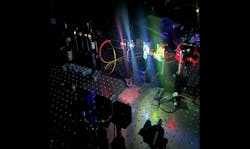
Motivated by a gap in optical encryption, a team of researchers led by Professor Junsuk Rho at Pohang University of Science and Technology (POSTECH) in South Korea created a holographic encryption method based on the wavelength of light and the precise spacing and alignment between layers of metasurfaces made of silicon nitride.
While many holographic encryption approaches can hide information, they tend to act as single-purpose optical elements. The team saw an opportunity to create a reconfigurable and scalable approach in which the same physical metasurfaces can be reused in different combinations to reveal different messages—more akin to a hardware encryption platform than a one-off hologram (see video).
“We were inspired by diffractive deep neural networks, in which each diffractive layer plays a specific role in a larger optical computation,” says Rho. “This idea led us to design our system so each individual metasurface layer can perform a meaningful standalone function, while combinations of layers can unlock additional encrypted outputs.”
A metasurface is a flat optical component made of nanostructures—a.k.a. meta-atoms—that precisely shape light. “In our device, each metasurface acts like a thin optical computing layer that applies a designed phase pattern to a wavefront,” says Rho. “We design these patterns using a framework inspired by diffractive deep neural networks (D2NNs), but instead of a monolithic stack we make it modular so each layer can work alone or cooperate with others.”
Metasurface-based hologram security
The team codesigns multiple metasurface layers so that for a single-layer mode, each metasurface alone reconstructs its own hologram—an ID image for the first layer and a QR code for the second layer. In cascaded mode, if you stack specific layers together, “the light field from the first layer propagates through free space and then gets reshaped by the second layer to create a new hologram—an encrypted password—that doesn’t appear when either layer is used alone,” Rho explains.
Two key challenges were involved in this work. One is efficiency and crosstalk in multilayer polarization optics. “For cascaded polarization-converting metasurfaces, the overall throughput depends strongly on polarization conversion efficiency, and imperfect conversion can leak as background/crosstalk—and it meant we had to design meta-atoms carefully and validate the system with amplitude-aware modeling,” says Rho.
The other is alignment and spacing control because “the encryption relies on tight tolerances in layer spacing and lateral alignment, and in practice achieving and maintaining this alignment can be physically challenging,” Rho adds. “So we used precision stages to control these degrees of freedom and quantified how reconstruction fidelity degrades as the layers become misaligned.”
Physically keyed, difficult to replicate
The encryption key here isn’t simply a digital password but physical parameters such as the illumination wavelength and precise spacing and alignment between layers.
An encrypted hologram “appears only when the layers are stacked in the correct configuration with the correct spacing,” says Rho. “If the spacing shifts or the layers are laterally misaligned, the reconstruction degrades rapidly.”
Replication is also challenging “because the device relies on nanostructured metasurfaces that require sophisticated fabrication to copy accurately,” Rho says. “In this sense, the security isn’t purely mathematical. It behaves like an optical lock that reveals the correct image only under the right physical setup.”
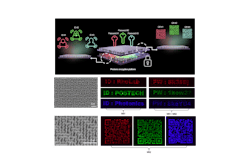
Optical lock
One of the coolest moments for Rho was realizing the system doesn’t just hide information—it behaves like a real optical lock. When the stack is configured correctly, the hidden image snaps into place.
“With misalignment or the wrong spacing, it doesn’t simply become dimmer. It becomes meaningfully scrambled,” Rho says. “Seeing this sharp transition in both simulation and experiment felt like a clear demonstration that the system behaves like a physical key—and the correct configuration reliably unlocks the intended image and small deviations quickly prevent it from appearing.”
Simulations
The team’s simulations work combines nanophotonic meta-atom design with a wave-optics computational stack model. They simulate free-space propagation between layers using the angular spectrum method and optimize each metasurface phase profile with a D2NN-inspired approach—and treat each layer as a trainable optical transformation.
“We train the system modularly so every layer can reconstruct a hologram on its own, while selected stacks of layers produce additional encrypted outputs,” Rho says. “The optimizer learns these single-layer and stacked-layer targets together across multiple wavelengths, and updates all layers jointly so the full set of reconstructions works consistently.”
They also simulated dynamic holography by changing the interlayer spacing to generate different frames. “This highlights an important security feature: Spacing itself can act as part of the key—it’s not only the correct wavelength and correct set of layers that matters but also the correct physical configuration,” Rho says. “Even small spacing errors can scramble the reconstruction and prevent the hidden information from appearing.”
Optical authentication and anticounterfeiting applications ahead
The researchers’ metasurface holograms are well suited for optical authentication and anticounterfeiting, especially if you want a tag that reveals different information only under the correct reader conditions (wavelength + correct stacking). It also fits access control (physical key + optical response) and high-density information storage, in which multiple channels are packed into one compact element.
In the short term, “we want to make the system more robust and practical by developing packaging that reliably maintains the required spacing and alignment, along with simpler illumination and readout modules and more standardized keys, such as fixed-wavelength sets paired with mechanical spacers,” says Rho. “Looking ahead, one natural direction is to scale the platform to more layers and wavelengths to expand the number of unique channels. At the same time, it’ll be important to explore designs and packaging that better tolerate real-world handling while preserving the security selectivity that comes from the physical configuration.”
FURTHER READING
C. Park, Y. Jeon, S. Lee, Y. Kim, and J. Rho, Adv. Funct. Mater. (Nov. 29, 2025); https://doi.org/10.1002/adfm.202523309.
About the Author
 Sally Cole Johnson
Sally Cole Johnson
Editor in Chief
Sally Cole Johnson is Laser Focus World’s editor in chief, and she has more than 25 years’ experience as a science and technology journalist. She specializes in physics and semiconductors, and wrote for the American Institute of Physics for more than 15 years, and also covered theoretical physics and neuroscience for the Kavli Foundation, and complexity for the Santa Fe Institute. Johnson has also written extensively about military embedded systems, high-performance computing, software-defined networks, and infosec. She is a member of the National Association of Science Writers (since 2001).
When she isn’t writing about optics, photonics, or quantum advances, you can find her outside in northern NH in the garden with birds landing in her hand or heading for the mountains with her bike, skis, or crampons and ice axe.