High-performance electro-optic modulators enable laser metrology onboard LISA space mission
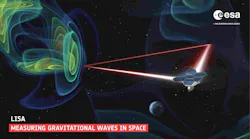
Planned for launch in 2035, LISA will be the first space-based observatory dedicated to gravitational waves. Led by the European Space Agency (ESA), with contributions from European member states, NASA, and an international scientific consortium, the observatory will comprise three spacecrafts flying in a triangular formation. The spacecraft will be separated by approximately 2.5 million kilometers and will continuously exchange 1064-nm laser beams (see Fig. 1).
A passing gravitational wave will produce an extremely small change in the apparent distance between freely falling test masses inside the spacecraft. LISA must recover this signal from a laser interferometry system with stability requirements that extend far beyond those of conventional optical instrumentation.
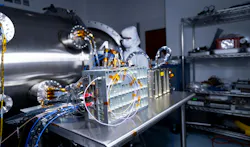
NASA’s Goddard Space Flight Center recently awarded Exail a €3.27 million (~$3.78M) contract for qualification and flight models of near-infrared lithium-niobate (LiNbO3) phase modulators for LISA’s laser hardware (see Fig. 2), which will be integrated into the master oscillator power amplifier architecture developed for the mission.
LISA needs highly performant and reliable phase modulators
Phase modulators are critical to the LISA mission because they encode the timing and ranging information required to synchronize the three spacecrafts and reconstruct gravitational-wave signals. They also transmit telemetry across the 2.5-million-kilometer constellation, as well as commands from Earth.
Each spacecraft carries its own reference clock, but clock fluctuations can contaminate the interferometric measurement. To compare and correct these clocks, LISA transfers clock information between spacecraft by phase-modulating the outgoing laser beam at approximately 2.4 GHz. The modulator creates optical sidebands that carry the timing reference alongside the optical carrier. Received sidebands allow the relative clock noise to be characterized and removed during data processing; the same optical link also supports ranging and data-transfer functions.
Optical power handling separates a laboratory device from flight hardware
Inside the component, a micrometer-large waveguide confines light within a LiNbO3 crystal. An RF voltage applied through electrodes changes the crystal’s refractive index, thanks to the Pockels effect, and shifts the optical phase billions of times per second. If the principle seems simple, maintaining low loss, low phase noise, and stable performance at high optical power within a space-qualified package is a technological endeavor successfully passed by Exail.
High optical input power was one of NASA’s most demanding requirements. Waveguide modulators within the 1-µm range face photorefractive and thermal effects. For LISA, the component must preserve modulation performance while operating within a low-noise laser chain and survive the environmental constraints of launch and deep space (>6 years for the LISA mission).
After long-duration aging tests, Exail’s modulators are now qualified to withstand optical input powers exceeding 500 mW without degradation in modulation performance. NASA laser scientist Kenji Numata pointed out that Exail is the only manufacturer worldwide able to meet all the technical requirements for the reference-clock transmission function.
NASA has also funded Exail to develop radiation-hardened ytterbium-doped fibers for the LISA 2-W power amplifier, including gamma-radiation testing up to 40 krad.
Industrializing LiNbO3 to TRL9
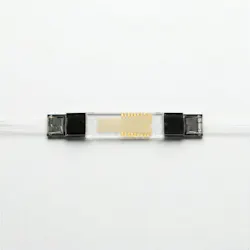
Exail manufactures its electro-optic modulators in Besançon, France. The industrial process combines waveguide etching, electrode deposition, fiber pigtailing (see Fig. 3), precision assembly, ruggedized packaging, and optical and RF testing. Traceable materials, documented screening, and reproducible performance are also essential for the manufacturing of qualification models and flight models.
This manufacturing capability builds on decades of experience controlling optical phase in LiNbO3 technologies and producing photonic components for harsh environments. Exail's space-grade phase modulators are already flight-proven at Technology Readiness Level 9 (TRL9)—by operating in orbit on NASA’s GRACE Follow-On mission since 2018, and were selected again for the GRACE-C mission.
Reliable optical components for a variety of space applications
The growing use of optical systems in space is expanding the role of electro-optic modulators. The same trend applies to radiation-hardened doped optical fibers and micro-optic assemblies—two other space-qualified technologies we’ve industrialized.
In optical communications, our components encode, amplify, combine, and route high-speed data carried by laser beams, as demonstrated through the TELEO program and the technologies developed for SOLiS. We’re increasingly positioned as a critical supplier across this value chain—from individual components to ModBox, an integrated optical modulation solution for optical ground stations (OGS).
The ability of electro-optic modulators to control optical phase and amplitude with high fidelity also supports emerging quantum communication architectures based on quantum key distribution (QKD). We supply leading QKD equipment manufacturers worldwide. Flight models of our high-extinction-ratio LiNbO3 amplitude modulators, operating at 850, 940, and 1550 nm, were selected for three major European space quantum communication programs: EAGLE-1, Europe’s first operational satellite QKD demonstration; QKDSat, targeting commercial QKD services; and SAGA, Europe’s sovereign QKD mission.
For scientific and Earth observation missions, Exail’s optical components support frequency stabilization, clock transfer, ranging, and precision interferometry. At the most advanced end of our optical integration capabilities is the space-grade laser source developed for cold-atom manipulation within CARIOQA, Europe’s Quantum Space Gravimetry Pathfinder mission. This critical subsystem successfully completed commissioning and performance validation in June 2026, with no anomalies detected.
Across these applications, ultimate instrument performance depends not only on the quality of each component but also on the stability and compatibility of the complete optical chain—and on the ability to manufacture, qualify, and reproduce it with consistent flight-level performance.
About the Author
Simon Jumel
Simon Jumel is scientific communications manager for Exail, which is based in Saint-Germain en Laye, France.