Future of space connectivity: Advanced optical technologies enable space laser communications
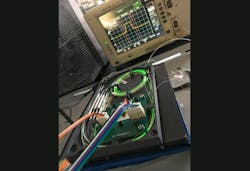
Free-space optical (FSO) communications is transforming the way data travels through space and across the atmosphere. Demand for broadband connectivity is taking off at an explosive rate—from satellite constellations to secure defense links and terrestrial networks—and optical links are increasingly adopted as a solution to transmit more data, faster, and more securely than ever before.
Exail was recently selected to provide advanced optical technologies for SOLiS, a very-high throughput space laser communications demonstrator. Developed by a consortium led by Thales Alenia Space on behalf of the French space agency (CNES), as part of the France 2030 program launched by the French government, it aims to demonstrate the technical and economic viability of an optical communications service relying on geostationary satellites and ground stations.
Yole Group forecasts the optical satellite communications hardware market will reach around $3B by 2030. The sector is now entering an industrial phase, with scalable production of laser terminals and standardized components. Exail is among the component vendors increasingly identified as critical players within this value chain, which covers laser sources, modulators, amplifiers, and optical ground stations (OGS).
From radio to light: An era of connectivity with free-space optical communications
Satellite laser communications initiatives, such as SOLiS, are contributing to the evolution of telecommunications toward multi-orbit networks. Mirroring the revolution brought by fiber-to-the-home (FTTH) on Earth, these laser-based FSO links are poised to deliver data transmission rates 10–100x higher than traditional radio-frequency systems.
Future satellite constellations will rely on OGS connected to satellites orbiting from 400 km (low-Earth Orbit; LEO) to 36000 km (geostationary orbit; GEO). Each satellite will also share optical links with each other to provide mesh coverage of Earth from space.
Despite the challenges involved in establishing and maintaining optical links in free space, FSO communications will solve key limitations of current RF telecommunications:
- Optical frequencies eliminate spectrum licensing issues and interference. There will be no more RF-frequency congestion.
-
Laser beams are extremely narrow and difficult to intercept or jam, which make them well suited for defense and governmental links, where security requirements are high.
-
FSO links will provide high-speed connectivity where deploying fiber cables is impractical—remote regions, maritime, or tactical networks.
A service such as SOLiS aims to strengthen intercontinental network resilience at a time of increasing sabotage against land and subsea optical fiber links. Geostationary satellites offer a technically viable option for ultrasecure transfers of large amounts of data between two users on Earth.
Leverage scalability, stability, and reliability of fibered optical technologies
To achieve very-high throughput and long-distance performance, spaceborne optical terminals in LEO or GEO orbit must generate and maintain highly stable laser beams over hundreds to thousands of kilometers—within conditions of radiation and extreme temperature variations.
Exail has accumulated experience as a designer and manufacturer of space-grade optical components through its participation in CNES-supervised programs such as TELEO and CO-OP. We’ve developed and supplied space-grade low-power amplifiers, passive optical components, and laser communication equipment for optical satellites, but also flight-proven (TRL9) lithium niobate electro-optical modulators to NASA for the GRACE missions. The SOLiS demonstrator will benefit from this heritage.
Fiber-based optical amplifiers
FSO systems require diffraction-limited, single-mode beams to achieve long-distance pointing precision and minimize divergence. Specialty optical fibers (think large mode area) ensure the laser beam maintains its shape and phase integrity across intersatellite or ground-space links to improve signal-to-noise ratio and data throughput. Fiber amplifier technology also benefits from decades of development in telecom and industrial laser markets.
Exail leverages its extensive experience and a patented fiber composition to manufacture space-grade, radiation-hardened (rad-hard) optical fibers, now deployed within thousands of low-noise (LNOA) and high-power (HPOA) optical amplifiers. The erbium (Er)-doped fibers and polarization-maintaining fibers we manufacture are at the heart of space-qualified fiber-optic gyroscopes (FOGs). The Astrix family of inertial reference units, jointly developed with Airbus and based on high-performance FOGs, have accumulated more than 490 years of in-orbit heritage across LEO, GEO, and even Lagrange orbits, with more than 64 units deployed.
Optical amplifiers based on erbium/ytterbium (Er:Yb)-doped fibers provide high optical gain and power conversion efficiency in a compact form factor. They make it possible to reach power levels and stability that contribute to the technological maturity of FSO systems. We recently launched a single-mode Er:Yb fiber designed to ensure power scalability in FSO systems, in particular for OGS. Featuring a 10-µm core, the fiber achieves 30 W for more than 700 hours, with immunity to photodarkening. Combined with Exail’s matching passive fibers, fiber Bragg gratings (FBGs), and pump combiners, users can efficiently develop fully integrated amplifier architectures. Other types of Er-doped and Er:Yb-doped optical fibers—single- or double-clad—can also be used to develop optical amplifiers exceeding 100 W for optical feeder links in OGS.
For SOLiS, Exail is supplying the optical amplifier for the reception channel of the laser communication payload. It involves a complete LNOA module based on the TRL9 technology, which is already proven on TELEO, and several single-channel optical amplifiers (LOFAs) that will leverage Exail’s space-grade, rad-hard doped fibers to deliver higher gain and stable output—even under fading or scintillation conditions.
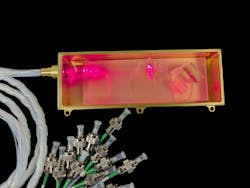
Ultrarugged micro-optical assemblies for ground-to-space telecommunications
FSO laser modules must survive launch vibrations, vacuum cycling, and temperature gradients—without compromising optical alignment. Exail’s expertise in micro-optical assembly delivers hermetic, vibration-resistant packaging. And our precision alignment techniques developed for ground-based telecommunications (Telcordia) and other harsh environments (Exail’s micro-optical assemblies are used in the KM3NeT underwater neutrino telescope operating 3500-m-deep offshore Sicilia) are now applied to FSO terminals and flying payloads.
Our multiplexer/demultiplexer (MUX/DEMUX) based on free-space micro-optical assemblies is a compact, high-performance solution designed to reduce its footprint and maintain alignment stability across a wide temperature range. Already deployed in OGS, the solution is undergoing space qualification as part of the CO-OP project that led to SOLiS. For SOLiS, MUX and DEMUX will be delivered into integrated modules.
The success of TELEO in 2024 validated the performance of Exail’s TRL9 optical components and subsystems—supporting development of next-generation FSO systems. Our expertise covers the entire photonic chain from specialty optical fiber fabrication to active laser modulation and system assembly. Beyond optical transceivers, our ModBox-OGS platform provides a precise modulation solution for reference transmitters and receivers in OGS.
Bridge Earth and space via light
Through continuous innovation in fiber technology, laser stabilization, and ruggedized integration, Exail is contributing to ongoing developments in optical communications systems. With its existing portfolio of high-performance electro-optical modulators and free-space micro-optical assemblies dedicated to the implementation of quantum key distribution (QKD) systems, Exail is well positioned for the transition toward “quantum-ready” interoperable free-space optical links.
FURTHER READING
About the Author
Simon Jumel
Simon Jumel is scientific communications manager for Exail, which is based in Saint-Germain en Laye, France.